
Turin: One of the many advantages to Darren Burgess’ new life, having swapped the AFL for an expansive new role with Juventus, is that he is a million miles away from the relentless footy news cycle – especially in a parochial two-team town like Adelaide, where he has spent the majority of his career.
“You have to kind of chase AFL news,” Burgess, one of the world’s most-respected high-performance gurus, tells this masthead over a doppio espresso in Turin, his new home.
Darren Burgess now works as director of performance at Juventus FC.Credit: LightRocket via Getty Images
“Whereas for the last six-and-a half years I’ve been swamped. You don’t get any choice.”
Despite being on the other side of the planet, and being fully immersed in the world of top-level Italian soccer as Juve’s new director of performance, the views of Kane Cornes have managed to puncture his bubble of otherwise blissful ignorance. That’s possibly our fault for asking him.
It feels as though there has been a huge spike in injuries this AFL pre-season. Players have been dropping like flies: Carlton’s Jesse Motlop and North Melbourne’s Jackson Archer have done ACLs that will keep them sidelined for 2026, Hawthorn’s Will Day suffered a dislocated shoulder, Collingwood veterans Darcy Moore and Jeremy Howe did their calves, Adelaide’s Mark Keane fractured his leg at training, teammate Ben Keays tweaked his hamstring, Western Bulldogs’ Ryley Sanders tweaked both of his, while soreness led to arthroscopes for Blues pair Nick Haynes and midfielder Matt Cottrell, who will both miss the start of the season.
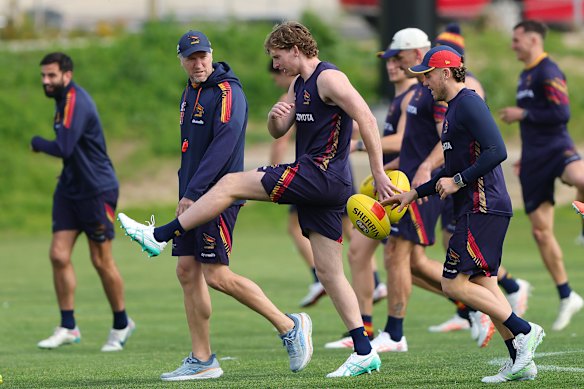
Adelaide’s former high-performance boss Darren Burgess reckons the structure of AFL off-season could be working against players.Credit: Getty Images
We could go on.
As is his wont, Cornes – who trained under Burgess during his first stint at Port Adelaide, between 2004 and 2007 – has expressed a controversial view on the matter.
This amount of “injury carnage”, he contends, is because AFL players are given too much time off between seasons.
“Players are having so much time off, they have de-conditioned,” Cornes said on SEN last month.
“Couple that with the fact they don’t have time to reintegrate with running skills to get up to speed, they are just straight back in and we’re seeing it. It’s brutal. Whilst the players’ association think they are doing the right thing by giving players so much time off, they’re harming the product and harming the players and their careers.”
Burgess can’t say for sure if this summer is an outlier in terms of volume of injuries – and it’s hard to check, since data on pre-season injuries isn’t readily available – but he remembers thinking last pre-season that there were an awful lot of blokes getting hurt, too.
He doesn’t think it’s because of the amount of annual leave they’re entitled to, though.
“What they do in Australia is have the best part of three months off,” Burgess said.
“You come back for three weeks before Christmas, then you have three weeks off, then you come back for two weeks, then you have four days off, then you come back for three weeks, and then you start playing games, and then most teams have another three days off before the season starts.
“That interrupted training would mean that you’re putting yourself at a higher risk of injury. Imagine if you’re on the edge the whole time: you just get into a rhythm, and then you stop again.”
The solution, Burgess believes, lies within the round-ball game – his first love, and one that he has been reunited with after deciding to step down as the Crows’ high-performance chief at the end of last season to become Juventus’ new director of performance, working alongside chief executive Damien Comolli and club legend Giorgio Chiellini, their director of football strategy.
In football, top European teams do not have staggered breaks. Usually, they get about a month off, or less if there’s a major tournament on during the summer; there is a growing consensus within the game, which Burgess agrees with, that the demands on elite players these days are too high. Some leagues break over winter for a couple of weeks, especially those in snowy countries, to avoid the worst of the weather.
But once they’re back for pre-season training, they’re back.

Darren Burgess has a high-ranking role at Juventus, one of the biggest clubs in the world.Credit: AP
“I’ve had a view for a long time now that a better system would be to give players probably until Christmas off – but then once January 1 hits, they go through the 10 weeks consistently until the season starts,” said Burgess, who has previously worked for Arsenal, Liverpool and the Socceroos.
“I think that would be a better model. It’s not necessarily the amount of time that the players are having off, it’s just that it’s interrupted all the way.
“Some would argue [it would be bad] if you give players three or four months off after the season … they do it in the NFL and they hire personal trainers – and if they come back in shit condition, the game finds you out soon enough, either through injury or non-selection.”
So Cornes, he believes, is half correct: the AFL pre-season is broken, but in terms of structure, not length.
“I’ve worked with Kane a lot,” Burgess said.
“Obviously, you can’t help but hear his views in media, and some of his views I really do agree with. The [amount of] time off is probably about right, but it needs to be more continuous once they come back.”
Most Viewed in Sport
Disclaimer : This story is auto aggregated by a computer programme and has not been created or edited by DOWNTHENEWS. Publisher: www.smh.com.au