
Three weeks ago, Australia’s entire batting stability was thought to depend on Usman Khawaja. Today, he is seen as a cherry on the cake.
Before Perth, it was white knuckles at the top of the order: Uzzie, first man picked, or bust.
Before Adelaide, by contrast, he is an elegant luxury item. Top or middle order? Retirement lap of honour or tap on the shoulder? These are important but not life-or-death selection options, it seems.
If things can change that quickly, however, they can change just as quickly the other way.
Cricket’s a funny game. Less so for England right now, but funny-peculiar nonetheless.
The decision whether to extend Khawaja’s career has been framed, somewhat insultingly, as a charitable donation.
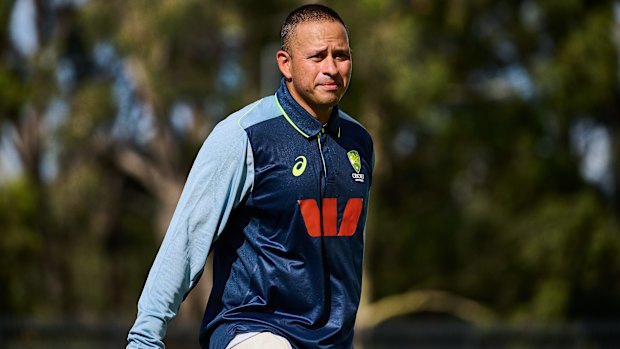
Veteran batsman Usman Khawaja is worthy of a spot in Australia’s XI for Adelaide.Credit: Getty Images
Several Australian luminaries have said Khawaja might not deserve selection in Adelaide, but will be given it anyway, out of recognition for his long service.
I would argue the decision will and should be made with characteristic Australian ruthlessness, by which I mean ruthlessness toward the opponent, and Khawaja ought to be selected on that basis.
Australia’s one big wobble in Brisbane, when Steve Smith, Cameron Green and Alex Carey went a bit whacky on the second night, was an outbreak of needless over-aggression.
Australia became, for a spell, England. It was the only time they surrendered control of the Test. Once Carey calmed down and the thumbscrews were put back to work, Australia were, once again, Australia. Disrespect the opponent, disrespect the game.
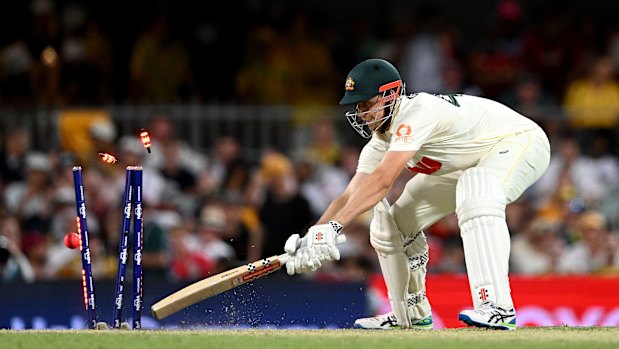
Wobble: Brydon Carse bowls Australia’s all-rounder Cameron Green in a reckless period of batting in Brisbane.Credit: Getty Images
Given what has been happening with the other mob, it was surprising that Australia needed to relearn the lesson.
So how does this affect the big decision on Khawaja?
At the outset, I’d like to acknowledge that Brisbane was a win for the selectors, and good on them.
I’m still not convinced that picking Brendan Doggett ahead of Nathan Lyon or Josh Inglis ahead of Beau Webster produced the strongest possible team, but what would I know?
Credit: Letch
Even Australian players talk the language of KPIs now, and the selectors’ only KPI is to pick a winning team. They put a big fat tick in their box.
In particular, their choice of Michael Neser was a sensible, evidence-based and successful one, which the player repaid, and the locals relished.
Is the lopsided state of the series because Australia are that good, or England that bad?
Fortunately, we don’t have to choose; our only obligation is to enjoy, or not enjoy, what is a zero-sum game in which Australia are as good as England allow them to be, and England are as inferior as Australia have made them.
The selectors’ only KPI is to pick a winning team. They put a big fat tick in their box.
In relation to Khawaja, though, there is a key performance impairment about the English pace attack: they’re not as good as it said on the packet.
That can be measured objectively from Mark Wood’s unfitness, the other bowlers’ cosmopolitan pitch maps, and Jofra Archer’s fickle humours. To be fair to Archer, it is very hard to bowl accurately at extreme pace, and he hasn’t been good enough to execute the skill.
When he dials down his pace searching for accuracy and rhythm, he is accused of not bending his back; when he bowls flat-out, sprays the ball and gets hit, he is mocked. Based on what we’ve seen, England invested a truckload of faith in a three-wheeler. With match fitness, that of course may change; but it’s Archer, so it may only change for a bit.
On the available information, England’s new-ball attack is not as fearsome as it appeared for that half-hour in Perth when Khawaja was missing in action with back spasms. He turned out not to be as super-critical to Australia’s survival as had been thought.
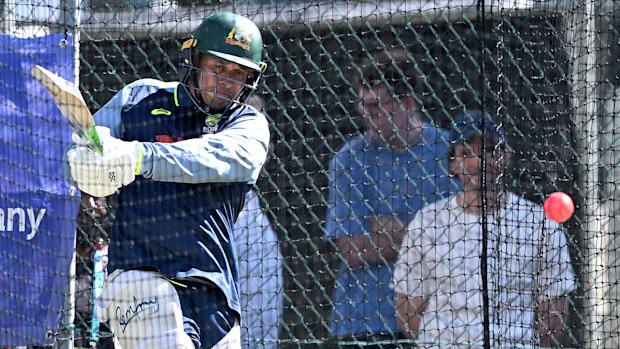
Usman Khawaja during a net session earlier in the month.Credit: Getty Images
On the other side of the coin, England’s bowling deficiencies mean that his 39-year-old reflexes are more likely to handle the challenge.
The only question facing Australia’s selectors is their best line-up to beat England in Adelaide.
By the looks of things, there is a lone batting vacancy and it falls between Khawaja, Inglis and Beau Webster.
Inglis showed in Brisbane that he is not a top-six (or top-seven) Test batsman against a challenging attack in Australian conditions.
Webster didn’t deserve to be dropped, but with the return of Lyon and Patrick Cummins, and the staunchness of the rest of the bowling attack, the Tasmanian is the unlucky man who has overturned the idea that it was harder to get out of the Australian team than get in.
If fit, Khawaja’s case is hard to resist. His Sheffield Shield scores before the first Test were 69, 46, 0 and 87 – more runs than any teammate except Steve Smith and Marnus Labuschagne. His Test output has fallen away in the past year in the face of good bowling and/or bad pitches, but his long-term record speaks for itself, emphatically in the last phase of his career since he turned 35.
And if England were asked for their opinion – Khawaja, Inglis, Webster? – it’s pretty obvious who they would least like to see on the team sheet.
Increasingly, Khawaja’s cricket has overlapped with politics. I don’t mean his stances on non-cricketing issues. I mean the feelings in Australian cricket that have lurked under his entire career, limiting his opportunities, lying in wait for his vulnerable moments.
When he is making piles of runs, as he has for most of the past four years, those feelings retreat into their dark corners. But they’re a virus waiting to return.
When he went down with back spasms in Perth, the insinuations spread: laziness, whatever. He has achieved success too effortlessly for his own good; his failures have seemed effortless too.
It’s insulting, not to mention fraught with risk and hubris, to buy a narrative that Khawaja is owed a last chance. The notion of ‘owing’ a player selection was, for two years, a dead end the selectors got themselves into, and now that they’ve been let out of it they’re hardly going to fall in again.
My opinion is he should play in Adelaide because he is one of Australia’s six best batsmen. Whether the selectors share that opinion, it’s the only criterion they should apply.
They score 500 runs in the first innings in Adelaide, they win the Ashes. Pretty simple. If Khawaja plays, it should be as an expression of ruthlessness, not charity; Australia being Australia.
Most Viewed in Sport
Disclaimer : This story is auto aggregated by a computer programme and has not been created or edited by DOWNTHENEWS. Publisher: www.smh.com.au



