
John NewtonWest Midlands
 Getty Images
At comics shop Forbidden Planet in Wolverhampton, something is happening.
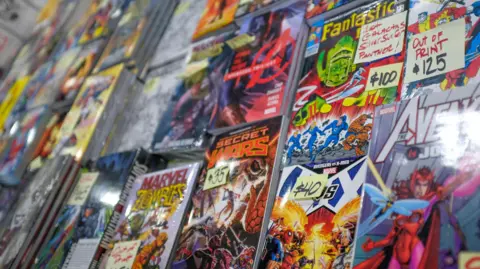
For years, the comics product there – and at stores like it – has been largely consumed by adult hobbyists; those who form the backbone of the direct-to-consumer, specialist market where staples include the superhero fare of US publishers Marvel and DC.
But manager Chris Ball, who has worked at the store for nearly 30 years, reports another crowd getting stuck into the pages – a “healthy wave” of young people.
At first, that may not seem surprising. After all, children were once the target audience for the format – they’re hardly strange bedfellows, and young customers are nothing new. And yet the fresh engagement has been enough for Mr Ball to take notice.
Underpinned by a market offering “a comic for everybody”, he puts the fresh business down, in part, to the superhero movie boom. Hollywood’s mining of fringe comics characters and boosting their profile, has, he says, driven trade.
He sees a similar situation in which the popularity of Japanese cartoons – anime – meets an audience for Japanese comics, manga.
“[It’s] huge at the moment – particularly with young people – so that’s getting them through the door.”
That is one store, though. How about elsewhere and more broadly?

 Getty Images
Mr Ball’s account, it turns out, is far from anecdotal.
Sales data suggests that UK kids are engaging strongly with comics. And so lively are the numbers – more on them shortly – they perhaps suggest something more: That beyond seeking out screen stars in their original form, kids may also be connecting to the medium itself; the bones of sequential, narrative art.
But in a digital age of flashier bells and whistles, why are comics appealing to them? How are speech bubbles and static drawings punching through?
To find out more, the BBC has been talking to Mark Fuller.
He is chief executive of Comic Book UK, a collective representing the interests of UK comics publishers, creators and retailers. It works to champion the domestic industry, and has big-picture plans for the content, the people who make it, and the children learning to love it.
“The market is thriving,” said Mr Fuller, a lifelong comics fan. “And there’s appetite particularly for children’s comics [comics specifically designed with kids in mind].”
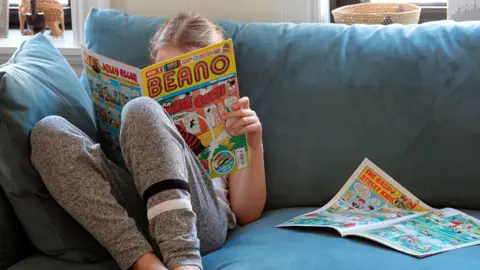
Among these are classic title The Beano, and relative newcomer The Phoenix. Each issue devotes a page or two to several different strips, rather than one long read.
Alongside the mature audience-friendly 2000 AD, which features the likes of Judge Dredd and Rogue Trooper, the trio are thought to reach a combined weekly audience of roughly 200,000.
On top of that, according to trade publication The Bookseller, there’s been a UK sales boom for bound collections of kids’ strips, along with kids’ graphic novels – deluxe-format, longer comic stories often focusing on a single franchise. By September this year, sales in these formats were up nearly 30% on the £20.2m generated in the whole of 2024 – then the all-time high.
Further data shows those sales to be closing the gap on the adult market equivalent, with kids’ content shifting only 3.2% fewer copies.
So, what’s behind a comics clamour when there’s so much vying for kids’ attention?
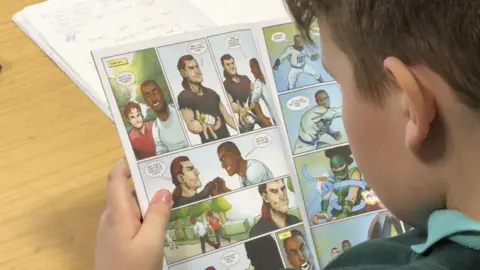
Partly, it’s as the observation in Wolverhampton. Comics characters, Mr Fuller agrees, are “all over the culture”, whether via silver screen or anime on Netflix. It’s a gateway “for the comics curious”.
There is also a matter of economy. “How much does a video game cost, or a family trip to the cinema compared to The Beano? Comics are cost effective. It’s easier to engage.”
But Mr Fuller recognises other practical factors too. And beyond them, something deeper; an experience exclusive to the medium, and one special enough to keep turning heads as well as pages.
“The joy of where we are now,” he said, pointing to shifts in availability and platform, is that “comics are reaching people in different ways”. Various subscription models, let alone the specialist store, mean the newsagent’s rack is no longer the sole provider.
And nor are paper pages. Web comics and apps have brought titles to the laptop and tablet, with The Beano among the latest titles set to offer a scrolling experience through its panels.
It’s a kid-friendly twist to content that otherwise remains the same as it ever was – the silent word and the still line. And yet, Mr Fuller says, it’s precisely such qualities that reveal the form’s innate appeal, and see it endure among louder, more kinetic offering.
“The challenge is that comics, like any other media, must fight to cut through the noise. The task is to do what they do best.
“Comics offer exciting art – that in itself is something. But paired with a creative story or fun jokes… you don’t get that anywhere else. The combination is rare. Comics do visual literacy in a way nothing else does.
“The other joy is the comics experience isn’t passive. You control how you engage. With a movie, you go at its pace. With comics, you decide. If you want to linger over a two-page spread of Judge Dredd, you can.”
The relationship between product and reader seems to occupy its own time and space. And with that, says Mr Fuller, “there’s a magic that happens”.
 Getty Images
In Birkenhead, Merseyside, the “magic” is being used to support disadvantaged young people.
Comics Youth CIC is a social enterprise group with the aim of “empowering youth to flourish from the margins of society”.
It offers kids a place to enjoy the medium together as readers. And, via workshops, to explore it as creators, whether just for fun, freeing an idea dying to get out, “harnessing their own narrative”, or getting their work under the noses of others. It’s helping voices become “discovered, distributed, and elevated”.
Anna Macdonald, an art director there, said engagement with “exciting visuals and incredible storylines” gave children “a break” from the everyday.
“It’s lovely to see young people coming to our workshops, reading comics and having fun,” she said.
“It gives them something to lose themselves in.”
Mr Fuller also recognises the social power of comics, saying they can be used as a tool to entice reluctant readers. And, through an egalitarian employment space, offer working class kids a route into creative industry where background may sometimes be barrier.
Community outreach, then, is just one of the ways through which Comic Book UK will seek to raise the medium’s profile as part of its business plan.
A raft of other steps are set to be shared shortly when the group formally launches its grand vision for the domestic scene.
It’s a project, Mr Fuller says, in which children are key. In fact, he thinks UK kids could be in the right place at the right time to hear the future calling.
But what does this ambition look like?
 Getty Images
Global appetite for comics of all types saw sales of $1.9bn last year, according to industry-watcher ICV2. Comic Book UK wants “a bite of that cake”.
The UK publishes an array of original comics. Seizing on attractive IP new and old, the plan is to help launch others and get more people reading and in more ways. The loftier idea is to grow so well that UK comics become recognised as a vital part of the nation’s creative output, and by extension, the economy.
It’s about taking the cue from the success of the US and Japan, the international, multi-media reach of their comics, and asking questions like: Why can’t the next big franchises be based on a comic from the UK? Why can’t UK comics be the world’s treasure trove of creative ideas?
“The risk is we don’t seize the opportunity,” Mr Fuller said. “Japan does, the US does. We must continue to be a comics-creating nation.
“Manga is flying out the door. Can we meet that audience with a homegrown alternative?
“And take a look at The Walking Dead. That’s a hugely successful entertainment franchise worth billions. The source was a comic [a US title, drawn by a British creative]. It’s stories like these we shine a light on. Can the next Walking Dead be a British comic? The UK benefits from such success.”
None of that, Mr Fuller says, can be realised without children.
“The last thing we want is for the comics audience to be [solely] adult nostalgists.
“It’s vital for any industry that there is a future audience, that you pull in future creators.
“We want to embrace the fact kids are sitting at home drawing. We want the young people of today to become the creators of tomorrow. We want to nurture the next generation of creative talent.”
Disclaimer : This story is auto aggregated by a computer programme and has not been created or edited by DOWNTHENEWS. Publisher: BBC