
KYOTO, Mar 17 (News On Japan) –
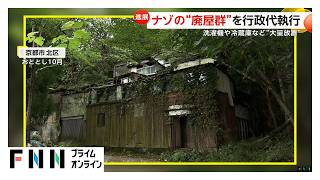
A large-scale cleanup operation was carried out on March 16th in Kyoto City as authorities moved to address a cluster of dilapidated structures and illegally dumped waste near a residential area close to Kinkakuji, marking the city’s first administrative enforcement action under regulations governing filled land.
[embedded content]
The site, located in the Haradani district of Kita Ward near the UNESCO World Heritage site Kinkakuji, had drawn attention since October 2024 when it was reported as a mysterious collection of abandoned buildings surrounded by large quantities of discarded appliances and debris.
At the scene, crumbling concrete blocks stood precariously near homes, while deeper into the area, eerie structures covered in corrugated metal sheets and overgrown with vines came into view. Some of the buildings appeared to be stacked atop one another, forming a multi-layered construction resembling a five-story structure.
Noriyo Yoshida, head of a local group working to improve the area’s environment, previously described the unusual construction, saying, “It’s not really a house. It’s made by stacking scrap materials and buildings on top of each other, like a five-layer structure, almost like a Ghibli-style castle.”
Surrounding the site were large quantities of abandoned items, including washing machines and refrigerators, left to deteriorate in the open.
Kyoto City had earlier stated it would persistently instruct the property owner to remove the structures, and on March 16th, it proceeded with administrative execution to remove embankments and other hazardous elements.
While most of the tin-covered structures have now been dismantled, piles of rubble, including concrete blocks, remain. Despite the enforcement action—the first of its kind in Kyoto under the law regulating filled land—significant debris is still stacked at the site.
Some of the most unusual structures, including those with buildings stacked on top of each other, remain untouched, along with abandoned vehicles and rusted bicycles, suggesting parts of the area have yet to be fully addressed.
Meanwhile, a similar issue requiring administrative intervention emerged in Koto Ward, Tokyo, where rows of abandoned vehicles had lined the streets, creating what appeared to be a graveyard of cars.
Many of the vehicles were missing license plates, with some stripped of tires or covered in graffiti, and interiors filled with discarded items such as shoes and baby strollers.
Roughly one year after the situation came to light, the scene has changed dramatically. When revisiting the site on March 16th, the previously lined-up vehicles had been cleared.
Following coverage of the issue in February 2025, authorities began taking action. At that time, 48 abandoned vehicles were present. Through coordination with police and guidance encouraging voluntary removal, the number was reduced to 15 by August 2025, after which the ward removed vehicles with unknown owners.
A comparison with earlier conditions shows the area has now been completely cleared, with pylons installed along the road to prevent further illegal parking or abandonment.
Local residents welcomed the changes, noting that the previously congested street had posed safety risks for oncoming traffic. “It was probably quite dangerous for cars passing through. I’m glad it’s been cleaned up,” one resident said, adding that the installation of pylons appears to be effective in preventing new vehicles from being left behind.
As such cases highlight potential safety and environmental risks, swift administrative action is increasingly seen as essential in addressing illegal dumping and abandoned property in urban areas.
Source: FNN
Disclaimer : This story is auto aggregated by a computer programme and has not been created or edited by DOWNTHENEWS. Publisher: newsonjapan.com