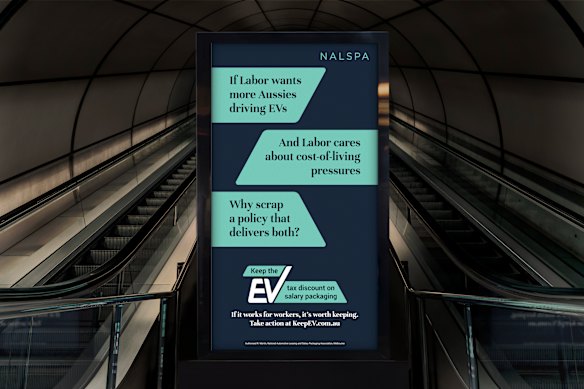

EV companies have launched a campaign against a move the Albanese government is considering to wind back tax breaks for clean cars, warning the budget savings plan would cost workers more and hurt environmental goals.
This masthead revealed last week that the government was examining changes ahead of the May budget after the forecast cost of the fringe benefit waiver for EV leases Labor introduced in 2022 blew out, adding pressure to already strained federal finances.
The EV tax breaks, limited to vehicles with a sticker price under $91,387, were introduced in a bid to fast-track Australian motorists’ adoption of EVs at a time when less than 4 per cent of all car sales were electric. The tax break for cars bought through lease hire was forecast to cost the budget $1.9 billion between 2022-23 and 2026-27.
However, uptake of EVs on novated leases has far outstripped government estimates, with the policy’s cost now blowing out to $5.1 billion over the four-year period. EVs now make up 13 per cent of the new-car market, while lower entry-level prices and second-hand options have boosted accessibility. The policy is expected to get even more expensive, reaching $2.8 billion in the 2028-29 financial year.
Reports of the incentive being removed or scaled back led to crisis talks among novated leasing providers and manufacturers in recent weeks, leading to the public lobbying effort to push the government into finding budget savings in other areas.
In a series of ads that will air on TV as well as run online and across public billboards, the National Automotive Leasing and Salary Packaging Association (NALSPA) warns Labor that axing or winding back its EV incentive for novated leases would stall uptake of cleaner vehicles and block workers from accessing cars that are cheaper to run.
“Labor says it wants more Aussies driving EVs and cares about cost of living for suburban families,” one ad states. “So why won’t they keep a policy that delivers both? Please keep the tax discount on salary packaging.”
Another ad features a series of essential workers. “The EV tax discount on salary packaging makes driving more affordable for workers like me,” a teacher says. A healthcare worker follows: “Especially those of us with long commutes.”
The ad ends: “Labor can’t have it both ways. Tell them to keep the EV tax discount on salary packaging. If it works for workers it’s worth keeping.”
The campaign has been backed by all leasing association members, and a broad range of the EV industry has also signed on in support, including manufacturers Tesla, Polestar and BYD, as well as lobby group the Electric Vehicle Council.
Polestar has also been vocal in urging the government to maintain the discount, warning Labor’s goal of 50 per cent of new vehicle sales by 2035 being electric will be harder to reach with the incentive.
“There’s still a lot of work required to meet those targets,” Polestar’s managing director of Australia Scott Maynard said. “Backtracking on measures encouraging EV uptake undermines those goals and would betray the government’s own commitments to the Australian public.”
Maynard noted that EV market share grew to more than 10 per cent in 2025 and is forecast to increase in 2026 due to demand side incentives. “Now isn’t the time to risk slowing that momentum with policy changes.”
Maynard said if Treasury was looking for tax savings, it should instead cut tax perks such as generous deductions and luxury-car tax exemptions for expensive petrol utes that were designed for tradespeople but are increasingly driven for private use.
“Support for tradies using their ute as a tool of trade makes sense. Subsidising the rollout of heavy, inefficient, dual-cab utes for private buyers is impossible to justify,” Maynard said.
While a decision on the EV discount is yet to be made, Treasury is exploring options such as axing the tax breaks, phasing them out or lowering the $91,387 price threshold so that it only subsidises more affordable EVs on the market.
Climate Change Minister Chris Bowen said last week that he and Treasurer Jim Chalmers were reviewing the policy. “We are doing that,” Bowen said. “We’ve reached no conclusions. We’re looking at its efficacy and its impact.”
Bowen also emphasised that the tax break was widely used in western Sydney, where commute times tend to be longer, underscoring the potential political risks of dumping it.
A productivity commission report from December recommended the government phase out the EV exemption. The opposition is committed to scrapping it.
According to the commission, while the EV tax breaks were effective at increasing uptake, it was at a cost of between $1000 and $20,000 per tonne of avoided greenhouse gases, which is costly compared with other measures. It also found the exemption “only benefits people who can access salary packaging or novated leases, incentivises more expensive car purchases, and does not provide an equal benefit to consumers based on emissions reduction”.
 Elias Visontay is a National Consumer Affairs Reporter at The Sydney Morning Herald and The Age.Connect via email.
From our partners
Disclaimer : This story is auto aggregated by a computer programme and has not been created or edited by DOWNTHENEWS. Publisher: www.smh.com.au