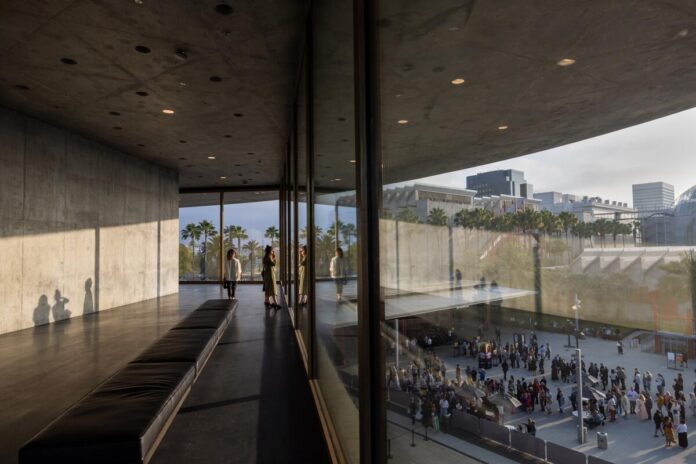
LACMA’s David Geffen Galleries, the pinnacle of a two-decade campus transformation, will officially open April 19.
That Sunday, a ribbon-cutting ceremony will kick off two weeks of priority member access to the galleries, with general admission beginning May 4, the museum said Thursday. Online ticket reservations open Thursday to members.
The announcement comes nearly a decade after news broke of business magnate David Geffen’s record-high $150-million donation toward the construction of a new museum building to be designed by Pritzker Prize-winning architect Peter Zumthor. Since the beginning, the Brutalist design has been polarizing — Angelenos have cheered or jeered the concrete vision.
The $720-million Geffen Galleries, which museum members got a first look at over the summer, will serve as the new home for LACMA’s permanent collection. It will display 2,500 to 3,000 objects at a time from its collection of approximately 170,000 objects. Stretching across Wilshire Boulevard, the structure houses 110,000 square feet in 90 exhibition galleries that will be organized thematically rather than by medium or chronology.
“The idea is for you to make your own path — not to speak at you, but to let you wander like you would through a park or a place,” LACMA Director and Chief Executive Michael Govan said in an interview with The Times. “That change in attitude, and how the building is built, is really exciting.”
Of the $720 million, Govan said, the majority came from private donors, with $125 million funded by L.A. County. Aside from paying off interest and principal, additional funds from a $875-million fundraising campaign will go toward public art, collection moving costs, office renovations and general landscaping.
The inaugural installation will use global bodies of water as an “organizing framework, emphasizing the cultural exchange, migration and commerce prevalent throughout the history of art,” LACMA said in a statement. Standout entries include Georges de La Tour’s “The Magdalen with the Smoking Flame” (c.1640), Vincent van Gogh’s “Tarascon Stagecoach” (1888) and Henri Matisse’s “La Gerbe” (1953). Art installation is currently in progress.
Guests tour the Geffen Galleries for an early preview on June 26, 2025.
(Allen J. Schaben / Los Angeles Times)
The four buildings that the Geffen Galleries replaced were “all broken up into little, tiny pieces, and they were not well traveled,” Govan said. The new structure is meant to make LACMA’s eclectic permanent collection more accessible on one extra-long floor.
“It’s kind of a worldview,” the executive said. “It’s big enough that it can hold the world.”
While the new building does not boast more gallery space than its predecessors — a point of public contention — Govan said that was never the plan due to county size regulations. Instead, the complementary additions of the Broad Contemporary Art Museum in 2008 and the Lynda and Stewart Resnick Exhibition Pavilion in 2010 added 100,000 square feet of gallery space. In all, the campus transformation brought LACMA’s total exhibition space from 130,000 square feet in 2007 to 220,000 square feet at present. (The Pavilion for Japanese Art, which has been undergoing a retrofit and renovation, is 10,000 square feet. It remains closed and will reopen at some point after the David Geffen Galleries.)

A guest tours one of the 90 galleries within the new space during a preview opening on June 26, 2025.
(Allen J. Schaben / Los Angeles Times)
Along with complaints about the building’s size, the Geffen Galleries’ heavy use of concrete had been criticized as an impractical choice for hanging art. According to LACMA’s preparators, that’s not a problem given the right tools.
Among the building project’s donors were Tony Ressler, co-chair of the museum board of trustees, after whom the Geffen Galleries’ south wing will be named, the museum also announced Thursday. Willow Bay, a longtime board member, will join Ressler as board co-chair.
“LACMA is a global cultural force that brings millions of people together through the power of art, connecting communities across Los Angeles and around the world,” Bay said in a statement. “I am deeply grateful for Tony’s leadership and generosity, and honored to join him as co-chair at this transformative moment in LACMA’s history as we advance our mission of enhancing access to art and education.”
Bay and her husband, outgoing Disney CEO Bob Iger, in 2018 made a “historic capital contribution” to support the preservation of Chris Burden’s “Urban Light,” which has become an iconic L.A. landmark. (Disney earlier this week named parks chief Josh D’Amaro as Iger’s successor.)
LACMA previously announced that the north wing of the Geffen Galleries would be named in honor of the late former board co-chair Elaine Wynn, who contributed $50 million toward the construction project.
As LACMA looks to the future, Govan said the museum isn’t ruling out future expansion. But any additions would be off the Wilshire campus, in areas such as South L.A and the Valley.
The idea is, Govan continued, “Let’s change the model. Let’s just put the wings, you know, the rest of the museum, in other places and strategically located.”

The new David Geffen Galleries building is part of LACMA’s ambitious expansion plans.
(Allen J. Schaben / Los Angeles Times)
Expansion, he said, is important for an encyclopedic museum, responsible for chronicling art history across many genres, geographies and media.
“If you’re the Frick and you only collect things of a certain period, you don’t have to expand,” Govan said. “But if your job is to keep up with the practice of artists and the world being bigger and bigger in terms of what people recognize as art, then you have to keep expanding.”
For now, though, he’s content to create a “big, beautiful gathering place” for Los Angeles.
“I always refer to our plaza as the living room for Los Angeles,” Govan said. “So this idea of the public space was so important from the beginning, and you see how the campus integrates with this.”
Zumthor’s building design, which includes overhanging canopies, intentionally creates shade with outdoor events in mind, the executive explained. It’s all about diversity of experience.
“You can take your selfie at ‘Urban Light.’ You can go to the jazz concerts, go see dozens of masterpieces outdoors… you can go inside somewhere and really focus quietly on a single work of art,” Govan said. “I wanted the range of all those experiences in a package where you wanted to hang out for the day.”
More to Read
Disclaimer : This story is auto aggregated by a computer programme and has not been created or edited by DOWNTHENEWS. Publisher: latimes.com