
Lando Norris has likened Formula 1’s new generation of cars to F2 machinery following the Barcelona pre-season test.
Norris got a first taste of his new McLaren MCL40 in the ‘shakedown’ that took place behind closed doors at the Catalan track last week, and he’s yet to draw definite conclusions from it.
“It certainly feels more like an F2 car in some ways with how you have to drive it,” the reigning F1 world champion and 2018 F2 runner-up reckoned. “I don’t know if I like that or not for the time being.
“I think we understood quite a few things already from Barcelona on how you had to drive the car, but in Barcelona you’re talking about fourth-gear corners, third-gear corners, quite open, quite wide. When you get to a street track or bumpy tracks, slower tracks, I think that’s a question we’re yet to answer, and Bahrain will answer some of those questions.”
Lando Norris, McLaren MCL40
Photo by: McLaren
Current F1 cars are much different from their predecessors with smaller, lighter chassis featuring active aerodynamics. Meanwhile, nearly half of the output from the power unit is delivered by electric energy, with power boosts to be used for overtaking as well as defence.
F2 engines are turbocharged too but not electric in any way, so presumably drivers are seeing some semblance of similarity chassis-wise – as Norris isn’t the first to mention this.
Whether 2026 F1 cars would be F2-like was a topic at last year’s Las Vegas Grand Prix as some drivers started to give insight into their simulator sessions. Aston Martin reserve driver Jak Crawford branded it “quite similar to drive to an F2 car”, which was put to Isack Hadjar, who described it as ‘closer to an F2 car performance-wise’.
So in the blink of an eye the debate shifted from behaviour to performance, and the FIA became keen to play down what it increasingly viewed as damaging concerns.
“I think comments about Formula 2 pace are way off the mark,” the federation’s single-seater director, Nikolas Tombazis, said. “We are talking about lap times, overall, which are in the region of one or two seconds off where we are now, depending on the track, depending on the conditions.
“And, obviously, at the start of a cycle, it would be silly to be faster than the previous cycle. It would cost us nothing from a regulations point of view, it would be very easy to make the cars go faster. But one has to gradually claw back what is gained by natural development. So you can’t start the cycle going faster than the previous one.
“Then, you know, in 20 years from now, you can imagine what would happen. So I think it’s natural that the cars are a bit slower, but I don’t think we are anywhere near the ‘it’s not a Formula 1’ [car] discussion in any way or shape.”
As far as lap times are concerned, the Barcelona shakedown delivered an unofficial benchmark of 1m16.348s by Ferrari’s Lewis Hamilton on Friday. That’s about five seconds slower than last year’s pole position, but given how steep a learning curve everyone is facing – and how much better track conditions will be in June – the gap should be much less substantial by the Spanish Grand Prix.
And, for the record, last year’s F2 pole time was Arvid Lindblad’s 1m25.180s. That’s not quite comparable.
But, again, the debate steered away from initial – and latest – comments about the new F1 cars’ behaviour and required driving style, though Esteban Ocon, Oliver Bearman and Oscar Piastri recently described the new machinery as “more nimble”.
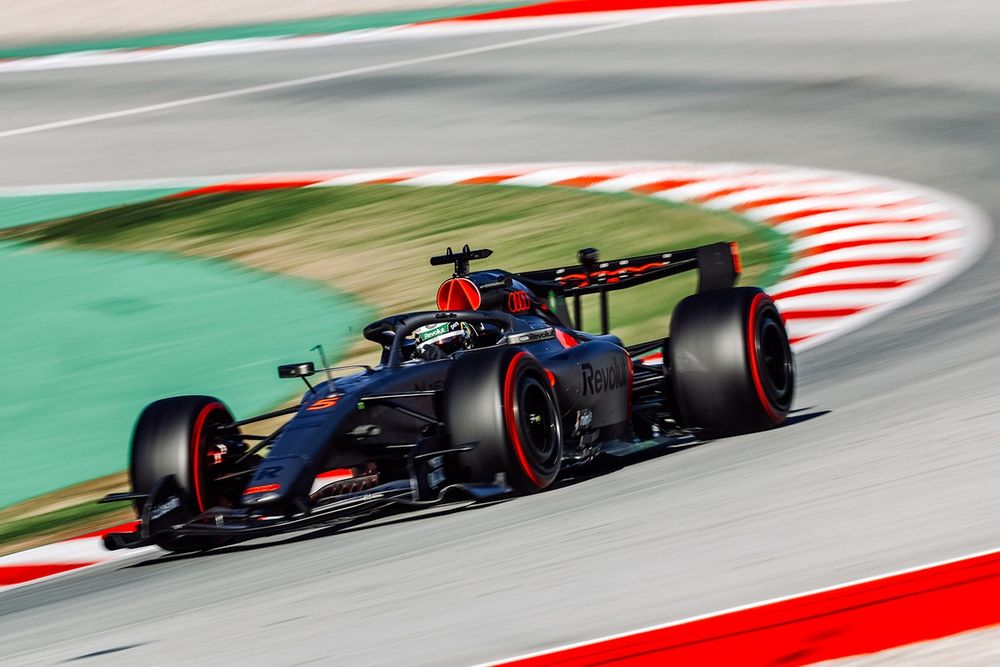
Gabriel Bortoleto, Audi F1 Team
Photo by: Audi
Gabriel Bortoleto did tackle the topic on the first day of the Barcelona test, when asked to compare the new machinery to 2025 F1 cars. He too likened it to F2, without going into detail.
“They are very different,” he said. “They feel a little different. I don’t know how to express because I didn’t really drive any similar car in the past. I would say the Formula 2 car, it’s much slower than the old regulations of Formula 1. And I feel these ones are going to be slower as well.
“But it’s very cool, you know, to have the power unit being 50% electric now, you’ll go out of the corner and you have so much speed being deployed and then you can see how strong it is. And these things are different and you need to get used to it and adapt your way of driving the car as well.
“But as I always say, it’s still a racing car and it’s not another world. It’s just a new regulation change that is very different.” The Bahrain tests will provide further insight as to how different.
Additional reporting by Stuart Codling
We want your opinion!
What would you like to see on Motorsport.com?
– The Motorsport.com Team
Disclaimer : This story is auto aggregated by a computer programme and has not been created or edited by DOWNTHENEWS. Publisher: motorsport.com