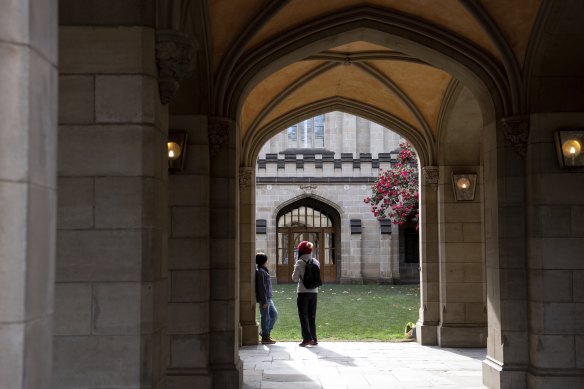

Workers at the University of Melbourne are hoping to be the first Australian tertiary education employees on a four-day full-time working week, and are seeking a 20 per cent pay rise over three years.
The reduced working week would apply only to non-academic “professional staff”, but academic staff are also pursuing the right to have their hours of work determined by committees, the majority of whose members would be workers, with the university’s executives forming a minority.
According to the latest reporting period, professional staff made up about half the 11,000 full-time equivalent head count in 2024.
The bold industrial claims were presented to the university’s management by the National Tertiary Education Union on Thursday.
In 2024, the university recorded revenue of more than $3.7 billion. That same year, it agreed to repay $72 million to more than 25,000 staff who had been underpaid during a decade of what the Fair Work Ombudsman described as “unlawful” conduct.
David Gonzalez, the NTEU University of Melbourne branch president, said on Thursday that evidence showed four-day working weeks – in which employees are paid a full-time salary over four standard 7.6-hour work days – to be highly effective.
“The evidence … is remarkably consistent – productivity holds, absenteeism drops and staff retention improves,” Gonzalez said.
“The University of Melbourne prides itself on being evidence led. It’s time to apply that to its own working conditions.”
Gonzalez said the unusual arrangement of working hours set by staff-dominated committees was warranted because employees at the university had reached breaking point under their workloads.
“When workloads are set without staff input, the result is burnout, which hurts academics’ ability to deliver world-class teaching and education.”
He argued the call for a 20 per cent pay rise was justified due to these increasing demands.
“You can’t keep asking staff to do more with less and then offer them a pay rise that doesn’t even keep up with the cost of living,” Gonzalez said.
The union also wants the university’s rules on artificial intelligence, a growing flashpoint on campuses around the world, to be embedded in the new workplace agreement.
“Staff have done the work to develop serious proposals. Now it’s time for management to engage constructively on our plan to make the university work better for staff, students and the community,” Gonzalez said.
A spokesperson for the university said it welcomed progress in the negotiations.
“Our existing commitments to sustainable salary adjustments, stability and consistency and maintaining core principles remain,” the spokesperson said.
“When we informed the unions of our willingness to meet and start negotiations in October last year, we reiterated our commitment to providing a substantive response. Negotiations to date have been productive, and with the log of claims now tabled, we look forward to making further progress with the aim of reaching in-principle agreement on a total … package that can be put to a staff vote later this year.”
Start the day with a summary of the day’s most important and interesting stories, analysis and insights. Sign up for our Morning Edition newsletter.
From our partners
Disclaimer : This story is auto aggregated by a computer programme and has not been created or edited by DOWNTHENEWS. Publisher: www.smh.com.au