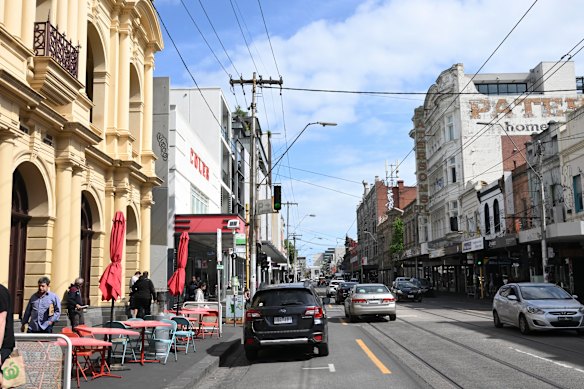

Melbourne’s CBD would be redrawn under a Liberal state government to make way for more high-rise buildings in inner-city suburbs, despite a glut of existing apartments nearby.
In Opposition Leader Jess Wilson’s first major housing policy announcement, the Coalition also pledged to fast-track outer suburban growth areas, taking aim at the Allan government’s focus on middle-ring development.
Under the Liberals’ plan, Melbourne’s capital city zone (CCZ) would be expanded to inner-city areas surrounding the CBD – including Southbank, North Melbourne, Fishermans Bend, Parkville, Fitzroy and Collingwood – to allow more higher-density housing.
The move is a direct challenge to the Allan government’s “activity centres” policy, which aims to rezone 60 suburban hubs – including many in the leafy middle-ring – for 20-storey towers to deliver 300,000 new homes by 2051.
The Liberal policy firmly centres high-rise development within seats currently held by Labor and the Greens, avoiding mandated density increases in the leafy inner and middle-ring suburbs the party needs to win or retain at the November election.
The Age has previously revealed Melbourne already has an oversupply of apartments in the CBD and Southbank, with 8000 new and unsold units in metropolitan Melbourne. More than 2000 of those apartments are situated within the City of Melbourne and Southbank.
However, the Coalition argues more apartments are needed in the inner city, noting only 1400 were completed in 2024 – fewer than half of the long-term annual average of 3600.
Under Wilson’s proposal, height limits would increase most significantly in the areas closest to the CBD and scale back towards established neighbourhoods.
It would allow higher height limits around heritage buildings and neighbourhoods by requiring appropriate design standards and setbacks.
RMIT emeritus professor of public policy David Hayward said the Liberal plan appeared firmly focused on the November election as it shielded middle-ring suburbs, and shifted high-density development into safe Labor and Greens seats.
Hayward said the policy seemed to protect those suburbs while ignoring the glut of unsold apartments already in the inner city.
“The broader problem for both parties is they’re both assuming there is a shortage of supply, but neither party has been able to demonstrate that,” he said. “All they’re going to do is redistribute the housing stock without solving the underlying problems of a dysfunctional housing market.”
He said the move would antagonise residents in the inner north who had not yet seen high-rise towers.
“You move into somewhere thinking this is how the future looks, then to have that completely upended is a pretty major change to have to deal with,” Hayward said.
The opposition also wants to speed up the delivery of homes in new growth areas, saying the government’s focus on activity centres and development in existing suburbs left greenfield areas neglected.
They have pledged to speed up precinct structure planning systems, with some commencement timelines currently stretching into the late 2030s.
Opposition planning spokesman David Southwick said Victoria’s construction sector was declining and builders were openly saying “anywhere but Victoria”.
“To get more families and young Victorians into homes, we need a new plan to cut red tape, reduce costs and make it easier to build in Victoria,” he said.
Urban Development Institute of Australia chief executive Linda Allison welcomed the greenfield plan, saying costly delays were hurting affordability in Melbourne’s newest suburbs where the majority of new homes are built.
“For years, industry has been crying out for reform to reduce red tape and make homes more affordable for Victorians. It is pleasing to see the Coalition listen and respond with planning policy aligned to our position,” she said.
She said the Coalition’s inner-city policy had a lot of potential, but the industry would be looking for more detail on plans for middle-ring suburbs.
“There needs to be density options right across Melbourne,” Allison said.
Hayward warned it would be costly to accelerate greenfield development because it required a lot more intensive infrastructure spending than developing already established suburbs.
Property Council of Australia Victoria executive director Cath Evans said enforcing two-year deadlines for precinct structure plans, publishing growth schedules, and setting strict requirements for referral authorities would give developers the certainty needed to start building in greenfield areas.
But she cautioned Melbourne could not rely on the inner city alone to meet housing demand in established areas.
“It’s essential that local structure plans are modernised to support more density in established suburbs if we are to meet our housing targets,” Evans said.
A government spokeswoman said Wilson’s plan would not result in any more homes, and would cut 300,000 new homes from activity centres and push up the price of housing.
“She wants to hand housing supply back to council blockers which is how we got a housing crisis in the first place,” she said.
“Our changes have delivered more homes than any state and have made Melbourne the most affordable capital city for young renters and buyers – progress the Liberals now promise to unwind.”
Start the day with a summary of the day’s most important and interesting stories, analysis and insights. Sign up for our Morning Edition newsletter.
 Daniella White is a state political reporter for The Age. Contact her at da.white@nine.com.auConnect via X or email.
From our partners
Disclaimer : This story is auto aggregated by a computer programme and has not been created or edited by DOWNTHENEWS. Publisher: www.smh.com.au