Every Event. Every Medal in 4K.
Watch live & on demand.
It is fair to state that Lindsey Vonn has been busier than most ACL victims in the eight days since she tore the notorious ligament best known for ending professional sporting seasons and even careers.
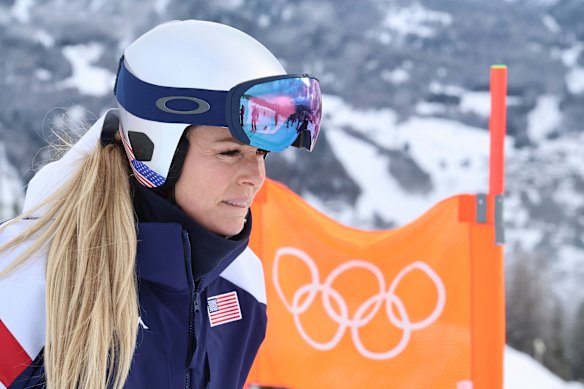
Four days after last week’s crash in Switzerland put in serious jeopardy the 41-year-old’s comeback from retirement, she sat at a press conference in Cortina d’Ampezzo and told the world nothing would stop her from attempting to compete at a fifth Winter Olympics.
A couple of days after, that she posted video of her undergoing a rehabilitation regime and appearing, to the naked eye, to function almost normally, aside from the conspicuous brace covering her left knee.
Then came Saturday, when the American skiing great posted the third-fastest time in a weather-interrupted second and final training – a mostly clean run that was 0.37 seconds off world champion Breezy Johnson’s pace and displayed a level of confidence belying her glaring predicament.
Sunday marked the D-Day of Vonn’s improbable women’s downhill campaign and, regardless of the result, she has already achieved something so remarkable it seemingly defies physics.
Vonn’s Milano Cortina resurgence, after almost six years in retirement and two after the insertion of a titanium replacement in her right knee, was already the story of the Games.
If she can compete – especially if she can win a medal – with a completely ruptured anterior cruciate ligament, bone bruising and meniscal damage in her left knee, it “would be the best comeback I’ve done so far; definitely the most dramatic”.
Lindsey Vonn is talk of the town at the Winter Olympics.Credit: AP
But how?
How, when ACL injury almost always dictates a withdrawal from a major sporting competition? Or several major competitions? Or even retirement?
Why do we constantly see footballers of all codes, netballers and basketballers sidelined for at least nine months to undergo surgery and gruelling rehabilitation, yet downhill skiers can strap on a brace and hurl themselves out of a starting gate and down a slope faster than Australia’s maximum driving speed limit?
Well, skiers have been competing without ACLs for decades. Australian Daisy Thomas, who entered these Games with a ruptured ACL, withdrew from the weekend’s slopestyle event after a practice-session crash but says she’ll still contest the Big Air from February 14.
Compatriot Laura Peel also sustained a “significant knee injury” in pre-Olympics training camp but is still aiming to compete from February 17, and Jarryd Hughes tore his ACL a fortnight before the Sochi 2014 Games but still took part.
In Vonn’s case there are three key factors, according to Dr Peter Larkins, a specialist sports and exercise physician and former track and field Olympian with extensive experience working in elite sport.
The first lies in Vonn’s own observation that her knee was not swollen and felt stable, which Larkins says was purely luck of the draw.
“When you do an ACL, there are two groups of people,” Larkins says. “There’s the group that get an exaggerated inflammatory response where the knee is really sore, really swollen, really inflamed, and you really struggle to get going.
“Then there’s a group that don’t get that inflammatory response. They do their ACL and they’re walking around and saying, ‘I can’t believe I’ve done an ACL’. It’s why some rugby and AFL players go off on the medical cart while others almost run off the ground.
“If you’re in that exaggerated group it manifests itself certainly within the first 12 to 24 hours, and we don’t like it as doctors because we know it’s going to be a much longer journey before they get their strength and their quads back. But if you’re in the group that’s not heavily inflamed and heavily swollen, your knee is a lot less sore, you recover better and you’ve got better muscle control straight away.”
The second critical element is the nature of skiing as a sport – with a caveat.
“Because it’s slide and glide where there’s no sudden stopping, where your foot hits the turf in a rugby game and you’ve got to change direction to chase, and suddenly one part of your knee goes one way and the other part of your knee goes the other way,” Larkins says.
“So it’s multidirectional and your foot is planted and fixed to the earth. But in skiing, you’re actually on a very low-friction surface because these are beautifully groomed slopes, and so the knee is connected to the foot is connected to the thigh, all as one chain – they’re not moving in different directions. Except when she goes through those incredible turns.
“It’s going to be the lack of control of the knee when you’re changing direction at that incredible speed – you see the angles they go through. That’s the dilemma. You don’t need an ACL to go in a straight line and change direction very slowly, but Olympic skiing is not slow skiing.
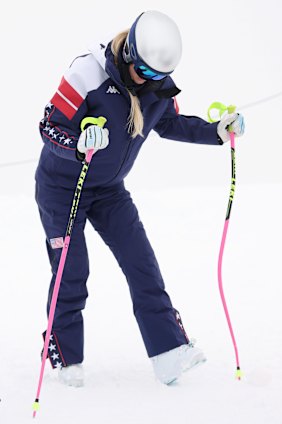
Lindsey Vonn in training over the weekend.Credit: Getty Images
“That’s when the brace comes in, and this is where her neural pathways talk to her muscles to switch on the muscles quickly so that the knee doesn’t start to come apart. In other words, the muscles are holding it together and the brace reminds the muscles to do the right thing.”
Which introduces the third factor: Olympic-level skiers already possess superior strength and stability in the muscles around the knee, through previous training of the thighs, hips, glutes and core.
“Olympic skiers do huge strength work and have terrific muscle control in their quads and hips,” Larkins says. “Vonn is incredibly strong in her thighs and hips. She’ll block the pain because she’s an elite athlete, and they have pain-blocking skills.
“She’s got the mindset. She’s got the brace, She’s got incredible fitness and strength because she’s been in the gym for the last six months getting ready for this.”
The Winter Olympic Games will be broadcast on the 9Network, 9Now and Stan Sport.
News, results and expert analysis from the weekend of sport sent every Monday. Sign up for our Sport newsletter.
Most Viewed in Sport
Disclaimer : This story is auto aggregated by a computer programme and has not been created or edited by DOWNTHENEWS. Publisher: www.smh.com.au