

Cherylann Mollan & Nikita YadavMumbai and Noida
 Getty Images
A few days ago, Sarvesh Kumar, a school teacher in India’s Uttar Pradesh state, was found dead in his home.
In a video purportedly made by him before his death, Kumar can be seen weeping as he talks about the pressures of election work and being upset about not being able to complete it on time.
“I have not been able to sleep for 20 days. If I had time, I would have finished this work,” he says in the video.
Kumar was among thousands of government staff deployed since 4 November to help update electoral rolls for more than 500 million voters across 12 states and union territories.
Called the Special Intensive Revision (SIR), the Election Commission (EC) says the drive aims to include every eligible voter and remove ineligible names from the rolls.
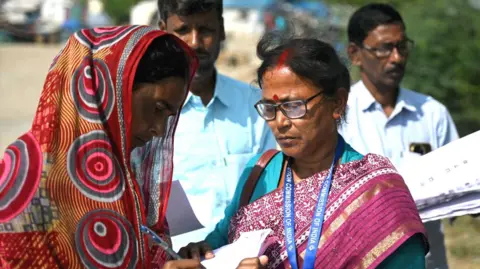
Booth-level officers (BLOs) – usually government teachers, junior staff and contract workers – serve as the EC’s grassroots field staff. They go door-to-door to distribute forms, verify documents, answer queries and upload accurate data, all within a one-month deadline.

 Getty Images
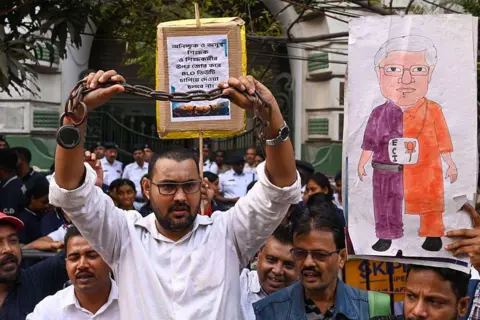
But that’s not all. Poll workers – many of whom are primary school teachers and anganwadi [government-sponsored childcare centre] workers – say that at times, they are also expected to juggle their regular work with election duties.
The BBC spoke to 10 BLOs in Uttar Pradesh and West Bengal – two politically crucial states where the SIR exercise has faced controversy. They said they were working 14–15 hours a day with little rest, minimal sleep, and meagre pay.
The punishing schedules have sparked outrage, especially after more than a dozen workers, including Kumar, died. Families have linked the deaths – from alleged suicides or heart attacks – to election work-related stress. The BBC has not independently verified the causes of death.
The EC has not responded to a detailed list of questions from the BBC.
In Gujarat, Arvindbhai Vadher, a primary school teacher, allegedly died by suicide last month “due to the torturous nature of BLO work”, his family told BBC Gujarati.
In a note purportedly written by him before his death which the BBC has seen, Vadher said that he had been feeling “constant fatigue and mental stress” for several days.
In another instance, Rameshbhai Parmar, a school principal in Gujarat, died in his sleep after a stressful day of SIR work, his family alleged.
Parmar’s daughter Shilpaben said he often worked long hours or late into the night, and on the day he died, he went out several times for SIR work and went to bed without eating.
The deaths have put poll workers’ conditions under scrutiny, with opposition leaders criticising the EC and government for rushing the SIR exercise. (The previous SIR exercise in 2002-2003 was conducted over six months.)
 Sudhir Kumar’s family
Media reports quoting a court affidavit say the EC has denied opposition claims linking BLO deaths to SIR work, calling them “false, exaggerated and politically motivated”.
Last week the EC announced the SIR schedule would be extended by a week, from 4 December to 11 December, without giving a reason.
But Manisha Kumari*, 35, a school teacher leading the SIR exercise in a residential complex in Uttar Pradesh’s Noida city, says that she’s unsure she’ll be able to finish her work even in that time.
For the past month, Ms Kumari has been up at 5am for housework and getting her children ready for school, then works on SIR from 9am to 5–6pm.
“Any short break I get is spent tracking down people who were not at home when I first visited,” she told the BBC.
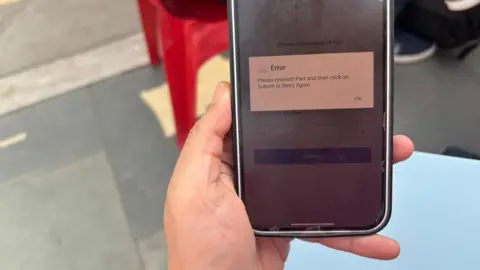
Evenings bring no respite. After reaching home, she tends to her children and then logs into the SIR app to upload verified forms. But the app crashes often and so she has to try after midnight again to complete the job.
“I have not had a day off since 4 November,” she says, adding that her students are suffering from her absence in class.
Many government schools in India are understaffed, and teachers say taking them from classrooms for exercises like these harms students.
Some BLOs told the BBC that they were doing the gruelling work despite the toll it was taking on their health because they were afraid of legal action.
In recent weeks, Uttar Pradesh officials have filed cases against poll workers for alleged SIR negligence, and there have been reports of threats of jail or job loss for refusal in other states.
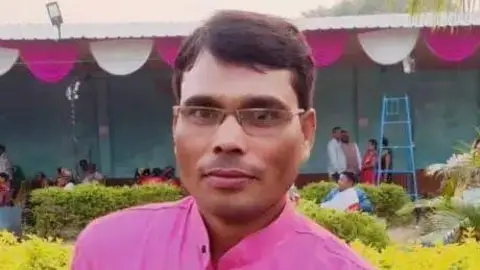
Sudhir Kumar Kori, an accountant from Uttar Pradesh, allegedly died by suicide after he took a day’s leave for his wedding and was reprimanded by his superior for it, his family told BBC Hindi.
Sunil Singh*, a poll worker in Ghaziabad, said that his “platelet count had dropped” sharply in the past couple of days but he wasn’t being allowed to take leaves because of SIR duties.
“My doctor has asked me to take rest, but these officials won’t listen. The only way to get a leave is to be admitted to hospital,” he said, adding that he was contemplating quitting his job at the state electricity department.
BLOs have no formal way to appeal their workload, but have protested and written to the EC and National Human Rights Commission for deadline extensions and better conditions.
Some states are enlisting student volunteers for the work, while districts in Uttar Pradesh offer cash, gifts and other incentives to top-performing BLOs.
India’s Supreme Court has directed states to deploy extra staff for SIR work to ease BLOs’ long hours.
The EC now has doubled BLO pay from 6,000 ($66; £50) to 12,000 rupees and raised supervisors’ pay from 12,000 to 18,000 rupees, adding a 6,000-rupee SIR incentive for BLOs.
But many BLOs told the BBC they hadn’t received any payment, and some didn’t even know how much they were owed.
In a past case, the EC blamed West Bengal for delaying BLO payments, while the state accused the federal government of blocking funds.
Several BLOs told the BBC they were using their own money and mobile phones for SIR work.
“Let us see if we get any money, our hopes are low,” a poll worker in Noida, who didn’t want to be named, said.
*Some names have been changed on request.
Additional reporting by Dilnawaz Pasha, BBC Hindi, and Apoorva Amin, BBC Gujarati.
Follow BBC News India on Instagram, YouTube, X and Facebook.
Disclaimer : This story is auto aggregated by a computer programme and has not been created or edited by DOWNTHENEWS. Publisher: BBC







