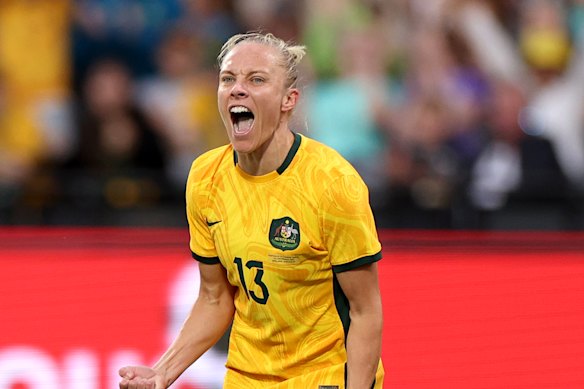

Matildas great Tameka Yallop revealed she will push her case for the 2027 FIFA World Cup as she spoke out about the health issues that plagued her last campaign.
In a wide-ranging interview with this masthead, the veteran of 130 caps for Australia shed light on the sleepless nights in agony she suffered due to an ongoing battle with endometriosis, with the worst of the bouts occurring during the 2023 World Cup on home soil.
The condition triggers inflammation and pain outside the uterus, with symptoms including menstrual cramps, chronic pelvic pain and infertility.
Yallop said her struggles were never going to force her to sit out any of the Matildas’ World Cup contests.
Nor, the 34-year-old said, would it stop her from putting her name forward for next year’s spectacle, despite suggestions from national coach Joe Montemurro that squad regeneration was looming in light of their Asian Cup final defeat to Japan.
“There was absolutely no way I would withdraw from the World Cup, so whatever came – unless it was life-threatening – I was going to push through it,” Yallop said of suffering through the 2023 tournament.
“It’s the World Cup on home soil, it’s a once in a generation thing, so there was absolutely nothing to stop me from participating in that. But it was daily management of severe pain and cramping and vomiting, and I guess losing sleep and the anxiety that comes with that.
“I don’t think I factor endometriosis into my career decisions, and that’s purely because if I had to go through it again I wouldn’t stop playing football. Football has been my life for a long time, so I can’t give it up that easily.
The Brisbane Roar midfielder had endured the pain associated with the condition throughout her 20s. But it wasn’t until she and wife Kirsty – who suffers from the same disease – spoke with a fertility doctor when they sought IVF advice that she began to understand why.
“We had two very different cases but didn’t know it at the time,” Yallop said. The pair welcomed the arrival of their second child late last year.
“For me, it was good to understand where my pain was coming from, and there can be something you can do about it. It wasn’t something I’d have to live with for the rest of my life.”
After the 2023 World Cup, Yallop underwent surgery, admitting she could no longer manage the agony. She said the changes to her health ever since had been “life changing” given her state when at her lowest point.
“Post-surgery, recovering from that for me was there was a lot of removal around ligaments and supportive tissues in the abdominal and pelvic floor, which required retraining in strength coming back to running and contact sport,” Yallop said.
“There are lots of sorts of different symptoms and different stages, and you don’t necessarily get them all at the same time. It’s always changing, and for me, I had some heavy pain medication and anti-inflams before training sessions to get through that.
“A lot of my day looked like the foetal position in bed in agonising pain and losing sleep.”
While Yallop, who has joined Endometriosis Australia as an ambassador, laments it can be difficult for elite athletes to seek support while in pain due to the competitive nature of professional sport, she called on conversations to be normalised in a bid to protect the next generation.
Researchers of Australia’s Federation University found one in five girls aged 10 to 16 had considered dropping out of organised sport due to period-related challenges, leading Endometriosis Australia to advocate for the launch of the Endo Playbook.
The initiative would aim to introduce an education program in grassroots sporting clubs, equipping coaches, parents and physical education teachers with the tools to recognise symptoms, reduce stigma and better support young people to remain active in sport.
The body has called on Australians to support the initiative by signing the Endo Playbook petition, calling on government and sporting bodies to back the program.
“I never talked about it with anyone, and it was kind of just push through it,” Yallop said.
“It can be hard to talk about pain when it could hinder your performance, but when it’s at a point you need assistance to be able to perform at your highest level, it becomes really important you can have those safe conversations.”
Start the day with a summary of the day’s most important and interesting stories, analysis and insights. Sign up for our Morning Edition newsletter.
From our partners
Disclaimer : This story is auto aggregated by a computer programme and has not been created or edited by DOWNTHENEWS. Publisher: www.smh.com.au