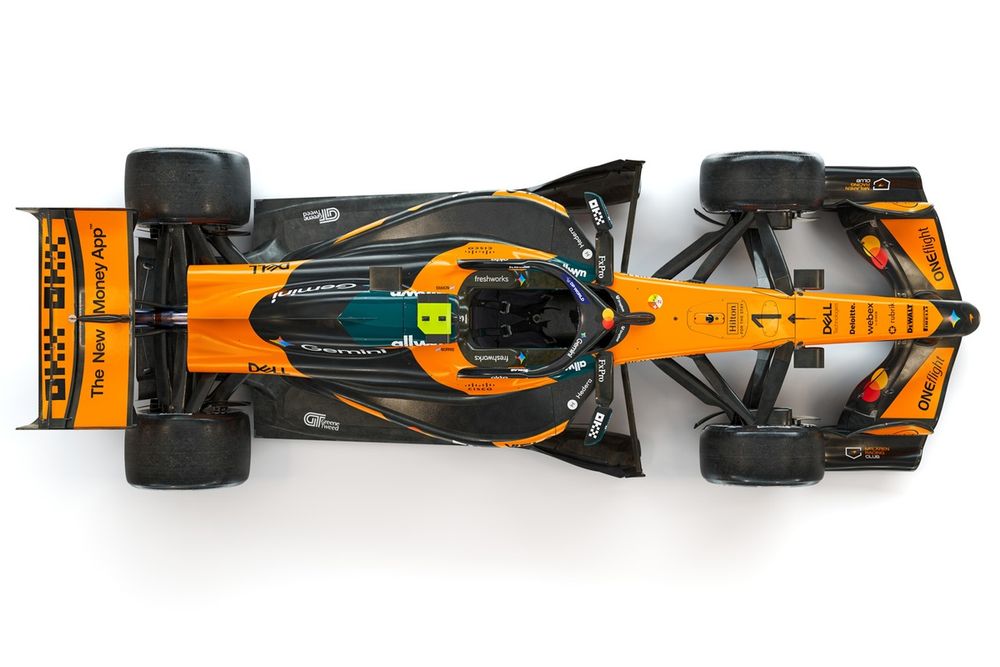
Alongside the big ticket items such as a move away from ground-effect floors, a bigger hybrid component and active aerodynamics, Formula 1 cars have also become smaller and safer in 2026.
The wheelbase of the 2026 generation of cars has been reduced from 3,600mm to 3,400mm, while the width has dropped from 2,000mm to 1,900mm. The minimum weight has also decreased from 800kg to 768kg as the FIA pushes to gradually reverse the unwelcome trend of increasing car weights.
The 2026 car’s reduced dimensions should help improve the spectacle by making them more nimble while producing less turbulent air. But as a side-effect, they have also added to the headaches of the designers, who have to find room for aero shapes while also packaging wiring, cooling and other key systems into a dwindling space.
“The car is so much shorter,” McLaren’s chief designer Rob Marshall explained at the launch of the MCL40 in Bahrain. “So, a lot of the packaging for radiators and electrical boxes, which were typically scattered around the car – finding homes for those has been very difficult. There’s just less space to put them all. What’s helped us out is the fuel tank is a bit smaller.”
McLaren MCL40 livery
Photo by: McLaren
In conjunction with the reduced width and length, the FIA has also toughened up several crash tests to improve safety. The biggest change is a stricter frontal crash test featuring a two-stage structure, aimed at protecting drivers against secondary impacts. Those occur when a car makes frontal contact with a wall after an initial impact had already damaged the nose.
“The crash structure is basically all new again,” Marshall said about the front of the MCL40. “The regulations have changed this year where we need to make sure that after a small shunt that’s enough to knock the front wing off – maybe the front half of the nose – the remaining part still serves its function as saving the driver in a secondary crash against another barrier. So that’s significantly complicated to the design work going into the nose.
“As we go rearward, we’ve got the main body of the chassis. Again, all new regulations, much tougher homologation requirements, so the crash tests and the squeezes that go into the chassis are quite brutal this year. A lot of effort and research has gone into trying to make the car able to withstand those.”
Detailing other design elements, Marshall said the new rules around active aerodynamics have given designers scope to play with different ways to install the front wing actuators, as revealed at Barcelona’s shakedown where Mercedes turned up with a front wing design on the W17 that differed from its competitors.
“The new front wing is still sort of arrowhead like the previous generation, but it’s a bit lower and has a much broader and wider footplate,” Marshall said. “The front wing is now actuated much like the old DRS.
“These new cars have got a straight-line mode where both the front and rear wings will move their flaps to reduce the drag on the car and help the car get down the straights faster. There’s quite a lot of freedom on how you actuate that. I think we’ll see different solutions from different cars on the grid.
“The rear wing is similar-ish to last year’s. The actuation mechanism is a bit like old-school DRS, but it’s now mounted on two pylons. It will now operate in conjunction with the front wing.”
We want your opinion!
What would you like to see on Motorsport.com?
– The Motorsport.com Team
Disclaimer : This story is auto aggregated by a computer programme and has not been created or edited by DOWNTHENEWS. Publisher: motorsport.com