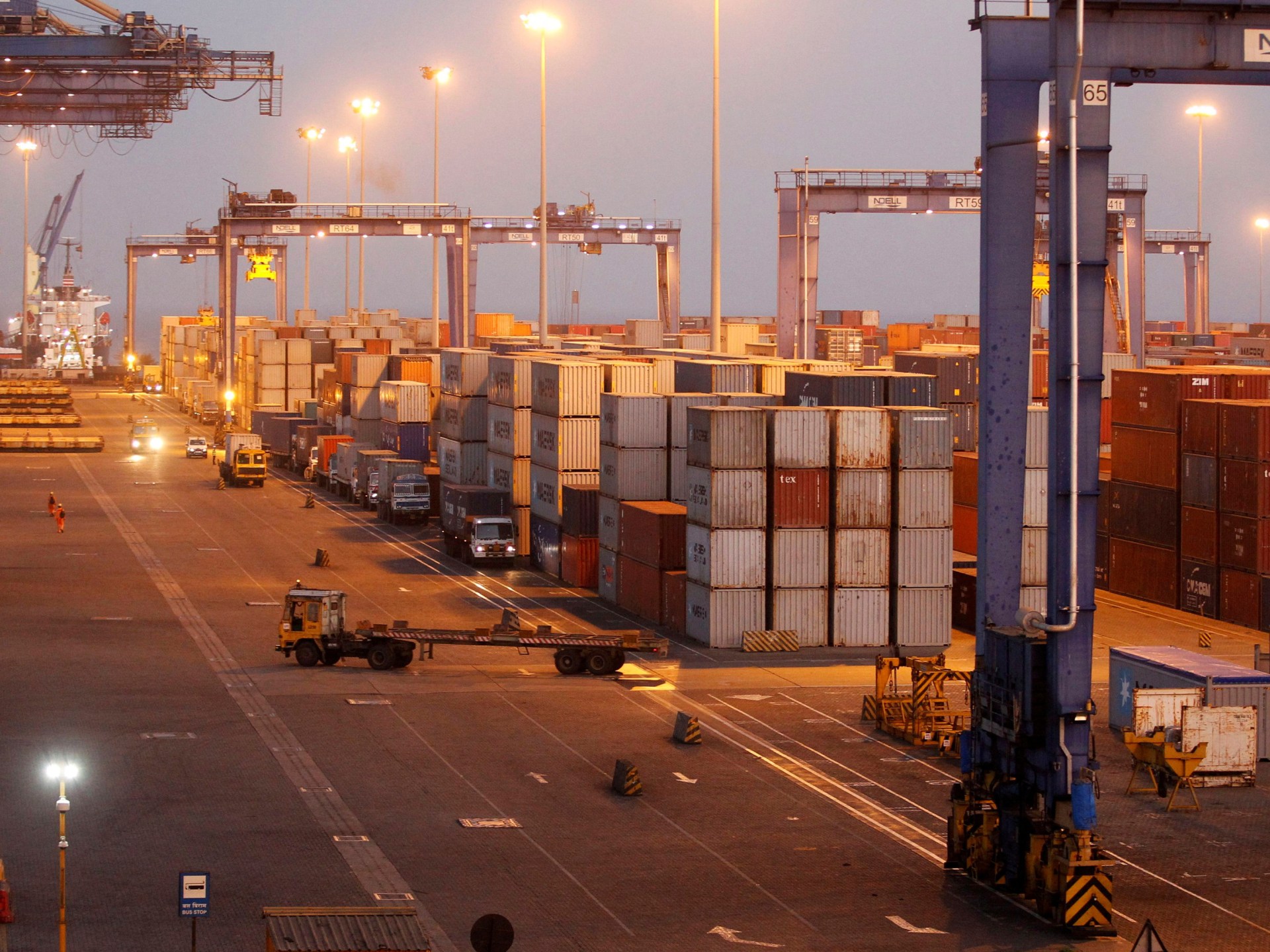
Kolkata, India – Pankaj Chadha has been running a steel manufacturing unit in Mumbai, India’s financial capital, for the past four decades.
The 65-year-old told Al Jazeera that his company exports products mostly to the United States and Mexico, where they are used in various industries.
Recommended Stories
list of 4 itemsend of list
The recent spike in tariffs in both countries, however, has come as a crushing blow for Chadha. Before the tariffs, he had sales of roughly $5m and $8m to the US and Mexico, respectively. But those have since been halved.
“I have lost 50 percent of my business in Mexico and the US since the tariffs came into effect. It is a severe blow to my business as I was focusing on Mexico after the US tariffs, but the future looks bleak there also now,” he said.
US President Donald Trump imposed a 25 percent tariff on India in August and soon tacked on another 25 percent as punishment for its continuing purchase of Russian oil, which, he said, was helping to fund Russia’s war on Ukraine.
Now, within months of those punishing tariffs devastating businesses and jobs across industries in India, including diamond cutting, shrimp farming, and carpet manufacturing, businesses are dealing with equally high tariffs from Mexico, a double whammy, they say.
On January 1, Mexico implemented steep import tariffs ranging from 5 percent to 50 percent on more than 1,400 products from non-free trade nations, including India, Brazil, China, South Korea, Russia, Indonesia and Thailand.
Mexico has free trade agreements (FTAs) with more than 50 countries, including the US, Canada, Japan, and countries in the European Union, Asia-Pacific region, and Latin America.
Advertisement
The North American nation contends that the tariffs have been hiked to boost domestic production, address trade imbalances, and safeguard local employment.
However, Indian businesses have put it down to Mexico safeguarding itself from US wrath over trans-shipment and supply-chain diversion – issues that businesses from countries like China, which are dealing with high US tariffs, can undertake.
Such practices could be used by the US against Mexico in the upcoming review of the trade pact the US-Mexico-Canada Agreement. And this could push Mexico to align its tariff policy with US sensitivities.
The steep hike, however, has the Indian business community worried about its future, especially after years of investments in building those supply chains.
Chadha describes the Mexican tariffs as more disheartening than the ones slapped on by the US, which, Trump said this week, will be lowered to 18 percent at some point, though it’s not clear when.
“The US tariffs were also imposed on our competitors,” said Chadha. “But Mexican tariffs are uneven as they have been implemented on only non-FTA nations, which has put us at a complete disadvantage with our competitors, who have an FTA with Mexico.”
To help alleviate some of the pain, the Indian government in its annual budget, presented on February 1, allowed the manufacturing units in special economic zones (SEZs) to sell a limited portion of their output to domestic buyers at concessional duty rates. Such sales typically attract the high tariff that is imposed on imports of these products, including textiles and leather goods.
The move is an attempt to address drop in demand that these exports-focused manufacturing units have been hit by on account of the punishing US tariffs.
Mexican blow
India exported goods worth $5.6bn to Mexico in 2024, the latest full year data available, led by vehicles and components and followed by electronic equipment. It imported goods worth $4.07bn in that period, with oil and mineral fuels being the lead imports.
India’s steel exports are facing the steepest hike of 50 percent, followed by auto and auto components that have been hit by 35 percent tariffs.
Even labour-intensive sectors like garments and ceramics will face tariffs from 25 percent to 35 percent. The plastic, aluminium and chemicals industries have been affected by tariffs ranging from 5 percent to 50 percent.
The decision has drawn severe criticism from affected countries and industry groups, while China has formally protested by raising concerns about higher consumer prices and supply-chain disruption.
India has so far warned of “appropriate action for the unilateral” tariff hike by Mexico.
Advertisement
Ajay Srivastava, founder of Global Trade Research Initiative (GTRI), told Al Jazeera that India is likely to focus on export diversification, treating the tariff hike as another sign of accelerating erosion of global trade rules rather than a dispute to be fought bilaterally.
The automobile sector, which has a strong market in Mexico, has been badly affected by the tariff hike.
Indian automobile companies exported passenger vehicles worth around $938.35m and motorcycles valued at $390.25m in the financial year ending March 31, 2025.
Even the auto components, which are predominantly used in vehicles meant for export to the US, have been slapped with tariffs of 35 percent, pointed out Vinnie Mehta, director-general of the Automotive Component Manufacturers Association of India (ACMA).
Last year, India exported auto components worth $835m to Mexico.
“Undoubtedly, the exports are clearly suffering due to the tariffs by the US, and the addition of Mexico has created a new challenge. The visible impact would be clear after the end of the second fiscal cycle in March,” Mehta told Al Jazeera.
The automobile industry, however, is shifting gears and pinning its hopes on a strong domestic demand driven by a recent reduction in India’s Goods and Services Tax (GST) from 28 percent to 18 percent, a government move to soften the US tariff blow.
For now, various industry bodies have written to the government to sign a preferential trade agreement with Mexico to provide quick relief for the Indian business sector.
Ajay Sahai, director-general of the Federation of Indian Export Organisations (FIEO), has, however, called the tariff hikes a push for the industry to increase domestic demand and look for diversification.
“The tariffs have proved that excessive dependence on single or two countries could be harmful,” he said, “and diversification is the only solution for survival and market expansion.”
Disclaimer : This story is auto aggregated by a computer programme and has not been created or edited by DOWNTHENEWS. Publisher: aljazeera.com