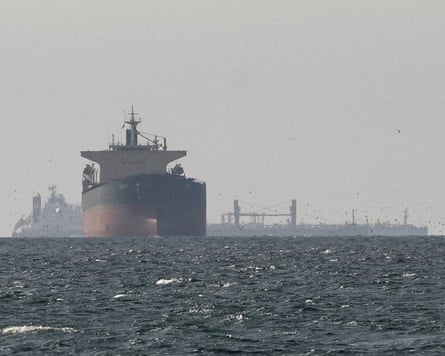
The Reuters news agency is carrying a statement from Iran’s Islamic Revolutionary Guard Corps (IRGC) in response to the US president, Donald Trump, giving Iran 48 hours to reopen the strait of Hormuz to shipping or face the destruction of its energy infrastructure.
In a new statement, the IRGC said Iran will completely shut the strait if Trump proceeds with his threats to target Iranian energy facilities.
The IRGC were quoted as saying that companies with US shares would be “completely destroyed” if Iranian energy facilities were targeted by Washington, and said energy facilities in countries that host American bases would be “lawful” targets.
“We did not start the war and we will not start it now, but if the enemy harms our power plants, we will do everything to defend the country and the interests of our people,” the statement reads.
Iran has already effectively closed the vital waterway, but a relatively small number of vessels from friendly countries have been able to transit it.
The effective closure of the strait, which carries one-fifth of global seaborne crude oil, one-fifth of LNG shipments and one-third of the most widely used fertiliser, has led to a spike in global energy prices, including in the US where consumers are being hit hard.
Hezbollah has reported missile attacks on Israeli positions near border.
In separate statements, the group said it targeted gatherings of Israeli troops at the Marj site opposite the town of Markaba, as well as in Jal al-Hammar, south of Odaisseh. It also said it carried out a third missile barrage targeting Israeli soldiers in the Taybeh project area.
The claims have not yet been independently verified.
Kuwait has filed a complaint before the International Civil Aviation Organization (ICAO) regarding dangerous airspace disruptions caused by Iranian attacks, the country’s Civil Aviation says.
It said:
Iran’s attacks are a blatant violation of international conventions, as they exposed passenger safety to serious risks.
Iran’s critical water and energy infrastructure have suffered extensive damage due to US and Israeli strikes on tens of thousands of civilian sites, officials said on Sunday.
ISNA news agency reported that energy minister Abbas Aliabadi said:
The country’s vital water and electricity infrastructure has suffered heavy damage following terrorist and cyber attacks by the United States and the Zionist regime.
The attacks targeted dozens of water transmission and treatment facilities and destroyed parts of critical water supply networks.
Iran’s Red Crescent chief Pirhossein Kolivand said the total number of damaged civilian sites “has reached 81,365 based on the latest field assessments”. He said the figure includes residential and commercial units, schools, medical centres and vehicles.
He added:
Behind every damaged unit stands a family, a life, a memory, a livelihood, and a future that has collapsed beneath the rubble of war and violence.
Journalists in Tehran have reported damage to multiple residential buildings and other civilian infrastructure.
On Sunday, ISNA news agency reported that strikes had damaged a hospital in the southern city of Ahvaz, in Khuzestan province.
Other media, including Fars news agency, showed images of rescuers pulling bodies from the rubble of destroyed buildings in the northern city of Tabriz.
It was not immediately clear when those strikes took place.
Israel’s military says it has detected a wave of Iranian missiles heading towards the country, a Telegram update from the Israel Defense Force says.
It said that people in affected areas would receive mobile alerts and urged them to follow the standard procedure of taking shelter.
The Israeli military says it is working to intercept the threat, and that a precautionary alert has been sent to mobile phones in the relevant areas.
The Iranian state broadcaster, IRIB, also reported that a new wave of missile attacks has begun.
Separately, the UAE’s defence ministry says it has intercepted four ballistic missiles and 25 drones launched from Iran on Sunday.
In total, the UAE’s air defences have now intercepted 345 ballistic missiles, 15 cruise missiles, and 1,773 drone since “the start of Iran’s blatant aggression”, it said in a post on X.
Israeli media are reporting multiple “impacts” in central Israel after the latest Iranian missile barrage.
Israel’s Kann broadcaster shared a photo of what appeared to be a crater near a parking lot, without noting the exact location.
The Times of Israel cited Israel’s emergency medical service as saying it has not received reports of injuries.
Turkish foreign minister Hakan Fidan discussed steps to end the war between Iran, the United States and Israel with counterparts from Iran and Egypt, as well as US officials and the European Union, a Turkish diplomatic source told Reuters on Sunday.
The source said Fidan had held separate calls with Iranian foreign minister Abbas Araqchi, Egyptian foreign minister Badr Abdelatty, European Union foreign policy chief Kaja Kallas, and US officials, without elaborating further.
The Israel Defense Forces says it has launched fresh strikes on southern Lebanon. In a statement shared on Telegram, it said ground and air forces were involved in the attacks.
Lebanon’s national news agency, citing the health ministry, is reporting that Israeli has waged deadly air attacks in the southern Lebanese towns of al-Sultaniyah and as-Sawana.
The attack on Al-Sultaniyah killed three people and wounded three others, while the attack on as-Sawana killed one person and injured four, according to the report.
Israeli defence minister Israel Katz has told forces to destroy bridges over the Litani River – which Israel says is used by Hezbollah – saying he wants troops to escalate the destruction of homes in targeted villages.
Airstrikes destroyed two bridges over the river linking southern Lebanon with the rest of the country earlier this week, the IDF said.
Lebanon’s national news agency has reported that an Israeli attack has targeted southern Lebanon’s Qasmiyeh Bridge. Footage shared by Israel’s Kann broadcaster appears to show a series of explosion simultaneously on and near the bridge, with a cloud of smoke rising up.
Qasmiyeh Bridge is a key route along the coastal highway, and its destruction would effectively cut off parts of southern Lebanon from the rest of the country.
An AFP correspondent saw smoke rising from the site north of the city of Tyre after the bombardment of the Qasmiyeh bridge, located on a main highway linking villages in the Tyre district with others further north.
Al Jazeera Arabic reported that there has been Israeli artillery shelling and airstrikes in several towns in southern Lebanon. Shelling was reported in Arnoun, Zawtar al-Sharqiyah and Yahmar al-Shaqif. An airstrike was also reported on the outskirts of Yahmar al-Shaqif.
Iranian ballistic missile barrages wounded more than 100 people in southern Israel on Saturday – here drone footage shows widespread damage to two Israeli cities.
In a visit to Arad in southern Israel, where more than 80 people were injured by Iranian missile strikes on Saturday, prime minister Benjamin Netanyahu said it was a “miracle” no one was killed.
Speaking on Sunday, he urged the Israeli public not to be “complacent”, saying they need to go into shelters during missile alerts.
He said:
There was a full 10 minutes from the alert until the missile fell.
The missile fell here, between the buildings. And if everyone had gone during those minutes into the protected spaces, into the shelters beneath every building here, no one would have been harmed.
Do not be complacent, do not be indifferent.
When you hear the first alert, go immediately to the protected space.
Iranian missile strikes have wounded about 200 people in southern Israel, after air defence systems failed to intercept projectiles that hit two cities close to a nuclear facility.
Among the injured in the attacks on Arad and Dimona were a 12-year-old boy and a five-year-old girl, both reported to be in serious condition. The Israeli broadcaster Channel 13 reported early indications of possible deaths, though there was no official confirmation.
In Tel Aviv, 15 more people were injured on Sunday in a separate attack involving a cluster bomb. The attacks are adding to mounting pressure on Israel’s air defence systems, with Iranian strikes increasingly testing their limits.
A mass-casualty incident was declared at Soroka hospital in Beersheba, as emergency teams responded to multiple impact sites.
Eli Bin, the chief executive of Magen David Adom, Israel’s ambulance service, said some people were believed to be trapped in damaged buildings in Arad. He described the scene as “an event of enormous magnitude”, adding that there were concerns for individuals who remained unaccounted for. You can read the full story here:
The head of the World Health Organization, Tedros Adhanom Ghebreyesus, has warned that strikes around nuclear sites in Iran and Israel had pushed the war to a “perilous stage”.
“The war in the Middle East has reached a perilous stage with strikes reportedly hitting the Natanz Enrichment Complex in Iran, and the Israeli city of Dimona, where a nuclear facility is located,” he wrote in a post on X. “No indications of abnormal or increased off-site radiation levels have been reported.”
“Attacks targeting nuclear sites create an escalating threat to public health and environmental safety.”
“I urgently call on all parties to exercise maximum military restraint and avoid any actions that could trigger nuclear incidents.”
The WHO chief’s comments come after an Iranian missile hit the Israeli town of Dimona, near the site of a nuclear facility, in what Iran said was retaliation for strikes on its own nuclear site at Natanz.
Dimona hosts a facility just outside the main town widely believed to possess the Middle East’s sole nuclear arsenal, although Israel has never admitted to possessing nuclear weapons.
Iran said on Tuesday that an unspecified projectile had hit an area near the Bushehr nuclear power plant. No damage to the plant or injuries to staff were reported.
Israel has repeatedly launched deadly strikes on Beirut’s densely populated southern suburbs since its renewed offensive of Lebanon that began on 2 March – killing over 1,000 people, including at least 118 children, injuring over 2,500 others, and displacing over a million.
The Israeli defence minister, Israel Katz, said the military has been told to accelerate the demolition of Lebanese homes in frontline villages close to the border, “in line with the model applied in Gaza’s Rafah and Beit Hanoun,” which have mostly been flattened in Israeli attacks during the ongoing Israeli war on Gaza.
Katz said the military was instructed to “accelerate the demolition of Lebanese houses in the contact villages in order to thwart threats to Israeli communities”.
He also claimed the IDF was ordered to destroy bridges over the Litani River – located 30km from Israel’s border with Lebanon – to prevent Hezbollah – the Lebanese militant group – “moving south” with weapons. Earlier this week, Israeli airstrikes destroyed two bridges over the river connecting southern Lebanon with the rest of the country.
The renewed Israeli assault on Lebanon began on 2 March after Hezbollah launched rockets into northern Israel in response to the killing of the former Iranian supreme leader, Ali Khamenei, in joint US-Israeli airstrikes.
The IDF ordered civilians in southern Lebanon to “move immediately to areas north of the Litani River”, in a sweeping order reportedly affecting hundreds of thousands of people.
Israel has since sent ground troops into southern Lebanon in what many fear could lead to an occupation in the south of the country. The International Commission of Jurists said in a statement on the renewed Israeli war on Lebanon:
The forcible transfer of civilians, when not justified by imperative military necessity and the security of the civilians involved, is prohibited and, in certain circumstances, may amount to a war crime.
In light of Israeli finance minister Bezalel Smotrich’s statement threatening to turn Beirut’s southern suburbs into “another Khan Younis”, a city in the Gaza Strip, as well as of statements by Israeli defence minister Israel Katz on 16 March that displaced civilians in southern Lebanon “will not return home until northern Israel is safe”, and of the announced establishment of a buffer zone in the south of the country, the ICJ is gravely concerned that the IDF displacement orders, combined with ground incursions and the destruction of civilian infrastructure, such as the Litani bridge and residential buildings, may evidence a deliberate policy of forcibly removing the civilian population from territory the IDF is about to gain control of, including by making civilian life untenable in the affected areas.
This is consistent with an IDF’s pattern already documented in the Gaza Strip of forcible transfers of the civilian population.
Seven people were killed in a helicopter crash in Qatar’s territorial waters, Qatar and Turkey said earlier today.
The Qatari and Turkish defence ministries said the helicopter crashed after suffering a technical malfunction, which the Qatari ministry said was during “routine duty”.
Four of those killed were Qatari armed forces personnel, one was from the Qatar-Turkey joint forces and two were technicians, the Turkish and Qatari defence ministries said.
In a post on X, Iran’s parliament speaker Mohammad Baqer Qalibaf warned that critical infrastructure and energy facilities in the Middle East could be “irreversibly destroyed” if Iranian power plants are attacked. He wrote:
Immediately after the power plants and infrastructure in our country are targeted, the critical infrastructure, energy infrastructure, and oil facilities throughout the region will be considered legitimate targets and will be destroyed in an irreversible manner, and the price of oil will remain high for a long time.
The comments come after Donald Trump gave Iran 48 hours to reopen the strait of Hormuz to shipping or face the destruction of its energy infrastructure.
On Saturday evening, the US president wrote on Truth Social that the US would “hit and obliterate” Iranian power plants – “starting with the biggest one first” – if Tehran did not fully reopen the strait within 48 hours, or 23:44 GMT on Monday according to the time of his post.
The internet blackout in Iran has entered its 23rd day, according to internet monitoring group NetBlocks. It said:
After 528 hours, Iran is entering a 23rd day isolated from the world as the regime-imposed internet blackout continues in its fourth week.
The measure adds to the wartime distress of millions of civilians who lack independent sources of information and alerts.
Those without access to Starlink or alternative ways to communicate – which are often expensive – are cut off, not only from the outside world but the blackout also severely curtails Iranian’s ability to communicate with each other, making mobilisation, for example, much more difficult.
Russia has emerged as a key beneficiary of the US-Israeli war on Iran, with the Trump administration having issued a 30-day waiver for countries to buy sanctioned Russian oil and petroleum products stranded at sea to ease surging oil prices driven by the escalating conflict.
Russia has been under US and European sanctions since it launched its full-scale invasion of Ukraine in February 2022. Analysts warned the easing of sanctions would grant Moscow a significant financial windfall to be used to continue to wage its war.
Asked if Russian President Vladimir Putin is gaining from the easing of sanctions, a move condemned by many European countries, Zelenskyy told the BBC:
Putin will want a long war. For Putin, a long war in Iran is a plus. In addition to energy prices, it means the depletion of US reserves and the depletion of air defence manufacturers – so we have a depletion of resources.
So, it is beneficial for Putin that the resources do not go to Ukraine against whom he has directed his army and is fighting with. He needs to weaken us and this is a long process. The Middle East is one of the ways to do that.
In an interview with the BBC recorded during a visit to London in the week, the Ukrainian president Volodymyr Zelenskyy talked about the impact of Donald Trump’s attention being diverted from Russia’s war on Ukraine to the US-Israeli war with Iran. He said:
I have a very bad feeling about the impact of this war on the situation in Ukraine and the focus of America is more on the Middle East than on Ukraine, unfortunately.
Therefore, you see that our diplomatic meetings, trilateral meetings are constantly postponed. There is one reason: war in Iran.
Zelenskyy said that although trilateral meetings have been postponed, Kyiv and Washington officials are still talking daily, and that Washington and Moscow are speaking daily. He continued:
The American side, because of this war in Iran, said that it was ready to host both sides in America. We confirmed our participation but the Russians are against meeting in the United States of America.
That’s why for the time being we try to focus on America proposing a date and place. Ukraine will support any date and any place but certainly not in Russia.
The IDF said yesterday that the Iranian regime posed “a global threat”, claiming the country’s missiles “can reach London, Paris or Berlin”, without offering any evidence to back up its claim.
The statement was issued following a reported attempted Iranian strike on the joint UK-US base on Diego Garcia – in the Chagos Islands – on Thursday night into Friday morning.
Tehran fired two intermediate-range ballistic missiles at the Chagos island but neither hit, the Iranian news agency Mehr reported. One of the missiles was shot down by a US warship, while the other failed in flight, according to the Wall Street Journal, citing multiple officials.
There are doubts Iran even has missiles capable of reaching Diego Garcia, which is about 4,000km from Iran.
Speaking to the BBC’s Sunday with Laura Kuenssberg programme this morning, the UK’s housing secretary, Steve Reed, refused to say how close Iran’s long-range missiles came to reaching Diego Garcia.
He suggested Israel’s warning that Iran has developed long-range missiles capable of reaching Europe is exaggerated. Reed said:
There is no specific assessment that the Iranians are targeting the UK or even could, if they wanted to. We have the finest military in the world. We are perfectly capable of protecting this country.
Reed said the IDF’s statement was “conditional”, adding “there is no assessment to substantiate what’s being said”.
Disclaimer : This story is auto aggregated by a computer programme and has not been created or edited by DOWNTHENEWS. Publisher: theguardian.com