-
Turkey’s defence ministry on Monday said a ballistic missile fired from Iran was intercepted in Turkish airspace by Nato defence systems, in the second such incident in five days.
-
The UAE’s Ministry of Defence confirmed that it had detected 15 ballistic missiles today, destroying 12, while three fell into the sea. The ministry said it detected 18 drones, intercepting 17, with one crashing within UAE territory, BBC News reported earlier.
-
Qatar air defences intercepted 17 ballistic missiles and six drones on Monday, the Qatari ministry of defence said on X. The air attacks came from Iran, the ministry said.
-
Iran has named Mojtaba Khamenei to succeed his slain father Ali Khamenei as supreme leader, signalling that hardliners remain in charge.
-
Iran’s foreign ministry spokesperson downplayed the likelihood of a ceasefire as long as attacks continue, Iran’s Student News Network reported on Monday, adding that Iran would continue to defend itself.
-
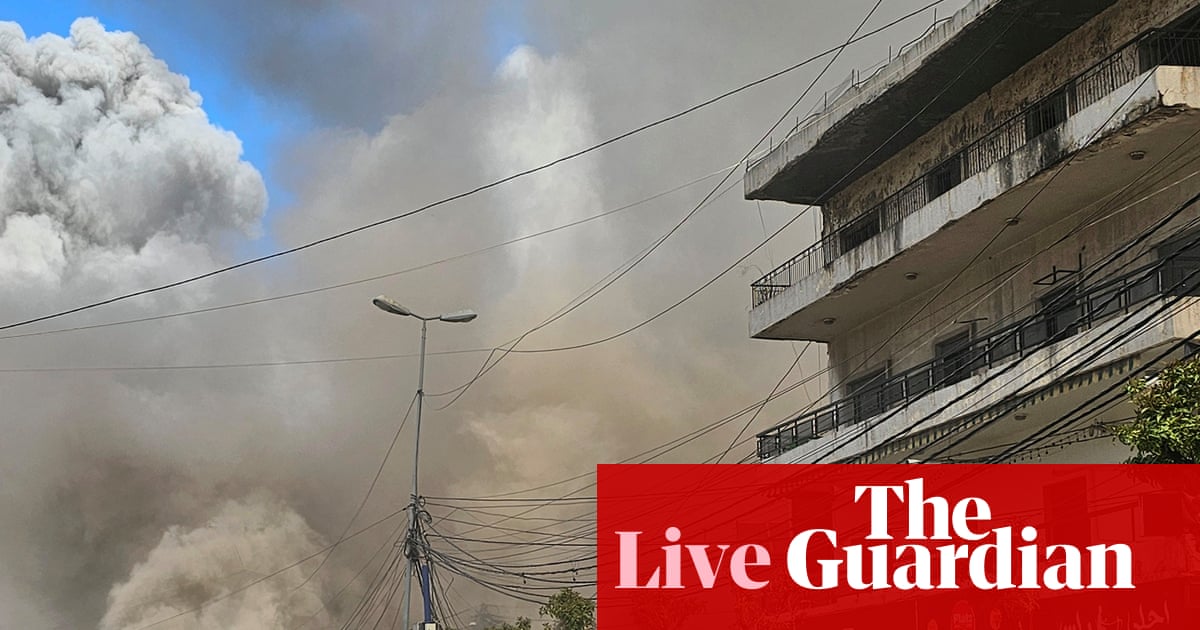
Fresh missile and drone strikes by Israel and Iran reverberated across the Middle East as the war entered its 10th day. The Israeli military said on Monday it had begun a “wide-scale wave of strikes” in Tehran, Isfahan and southern Iran after a man was killed in an airstrike fired at central Israel earlier. The Israeli military also said Monday that it had begun targeting Al-Qard Al-Hassan, a US-sanctioned financial organisation that Israel has accused of financing the Iran-backed Hezbollah, in the southern suburbs of Beirut.
-
Lebanon’s ministry of public health said Israeli forces killed two paramedics and injured six more in two separate airstrikes on Monday, the state-run National News Agency reports.
-
Human Rights Watch (HRW) on Monday said the Israeli military unlawfully fired white phosphorus munitions in the town of Yohmor in southern Lebanon. The highly toxic white phosphorus can be used by militaries to obscure operations and is not listed a chemical weapon under the Chemical Weapons Convention (CWC), but use of it against humans in a civilian setting is considered a violation of Protocol III of the Convention on Certain Conventional Weapons (CCCW).
-
Cyprus will not engage in any military operations surrounding the Iran conflict but will focus on its humanitarian role, president Nikos Christodoulides said on Monday. It comes as Cyprus’s foreign minister said there are “questions” about the future of the UK’s military bases on the island after the drone strike last week.
-
Unicef, a UN agency, estimates that at least 83 children have been killed and 254 wounded in Lebanon since the start of the conflict – during which time an estimated 700,000 people – including around 200,000 children – have been displaced from their homes.
-
Residents in Tehran are still reeling from “apocalyptic” scenes unfolding across their city after airstrikes on oil depots over the weekend filled the sky with black smoke and covered the streets in soot. “The situation is so frightening it’s hard to describe,” one resident told the Guardian. “Smoke has covered the entire city. I have severe shortness of breath and burning in my eyes and throat, and many others feel the same. But people still have to go outside because they have no choice. Many places reopened today, but closed again because it’s impossible to stay outdoors.”
-
EU and Middle Eastern leaders are holding talks on how Europe can better support countries most affected by the US-Israeli war on Iran and on bringing the conflict to an end. The president of the European Council, António Costa, and European Commission president, Ursula von der Leyen, said they had invited Middle Eastern leaders to take part in a video conference on Monday.
-
The war has sent oil prices surging and Asian stock markets into a nosedive. Global oil prices rose past $100 (£74) a barrel for the first time since 2022 as fallout from the war continues to wipe 20m barrels of oil from the market each day.
Israeli attacks on Lebanon have killed 486 people, including dozens of children, Lebanese state news reported today, citing the country’s health ministry.
Unicef, the UN’s children’s agency, said today that a “staggering” number of children have been killed in Israeli strikes on the country, with at least 83 children killed – more than 10 each day – and 254 wounded since 2 March.
The figures “are a stark testament to the toll that conflict is taking on children”, Unicef’s Middle East director Edouard Beigbeder told Sky News earlier. He added:
As military strikes continue across the country, children are being killed and injured at a horrifying rate, families are fleeing their homes in fear, and thousands of children are now sleeping in cold and overcrowded shelters.
Further, more than 1,300 people have been injured since the Israeli attacks began on 2 March, after Hezbollah fired rockets towards northern Israel in response to repeated Israeli attacks and the assassination of Iran’s late supreme leader Ali Khamenei.
At least 600,000 people have been displaced in the country since fighting escalated last week, sparking fears of a humanitarian catastrophe in Lebanon. In a statement today, the Lebanese president, Joseph Aoun, issued unusually fierce and direct criticism of Hezbollah for setting off a renewed Israeli offensive with a rocket barrage last week.
He told senior European officials in a phone call today that Lebanon was trapped between an Israeli assault which “show no respect for the laws of war” and “an armed group operating outside the law in Lebanon which has no regard for the interests of Lebanon and the lives of its people”.
In further comments, Donald Trump has said Mojtaba Khamenei selection as the the next supreme leader of Iran is a “big mistake”.
He told NBC News:
I think they made a big mistake. I don’t know if it’s going to last. I think they made a mistake.
The US president has previously said the late ayatollah’s son would be an “unacceptable” choice (see here) and Israel vowed to target any successor (see here).
Trump also said it’s “too soon to talk about” seizing Iran’s oil but added that he “doesn’t rule it out”.
Mojtaba Khamenei has been chosen to replace his father as Iran’s supreme leader, while the country continues to be heavily bombarded by US and Israeli forces.
In today’s edition of The Latest podcast, Lucy Hough speaks to diplomatic editor Patrick Wintour about concerns that the move could lead to a further escalation of war in the Middle East, after Donald Trump warned that Khamenei was an “unacceptable” choice.
Defence and security editor
Ukraine’s president has said he dispatched interceptor drones and operators to protect US bases in Jordan last week, one of 11 countries that had asked Kyiv for help as the US-Israeli war against Iran continued into its 10th day.
Volodymyr Zelenskyy said in an interview that he had responded to a US request for help in defending Jordan last week as Ukraine seeks to improve relations with Gulf and Middle Eastern countries coming under attack from Iran.
Zelenskyy posted on social media that “there are 11 requests from countries neighbouring Iran, European states, and the US” and that some had been met with “concrete decisions and specific support”.
Help for Jordan, where the US has maintained a sizeable presence at the Muwaffaq Salti airbase, was requested on Thursday, Zelenskyy told the New York Times. A Ukrainian team departed the next day.
Satellite imagery indicates that the radar used by a US Thaad air defence system at the base in Jordan was damaged or even knocked out by Iranian attacks, one of several apparently hit across the region.
Orysia Lutsevych, at the Chatham House thinktank, said Ukraine was “trying to show it is an asset, including to the US and other allies” by offering to share its war experience in exchange for help and goodwill.
Zelenskyy also recognises that Iran and Russia are friendly, amid US reports that Moscow is sharing targeting information with Tehran. “If Russia sends intelligence to Iran – Ukraine will send specialists and interceptors to defend these bases and energy and water infrastructure,” Lutsevych added.
Over the past week, the Ukrainian president has spoken to the leaders of Saudi Arabia, the UAE, Kuwait, Bahrain, Qatar and Jordan, according to Kyiv. “It is very important to coordinate for security both in Europe and in the Middle East,” Zelenskyy said after speaking to the Saudi crown prince, Mohammed bin Salman.
Ukraine has faced near-nightly attacks from swarms of Shahed-136 drones since September 2024. Originally designed in Iran, the technology was transferred to Russia, allowing Moscow to make them in large numbers.
Tackling them forced Kyiv to develop low-cost air defence capabilities to prevent large numbers of the delta-winged attack craft getting through, with interception rates of over 85% or 90%. On Saturday morning, Ukraine’s airforce reported stopping 453 out of 480 incoming drones.
Here’s the full report:
Further to that, Israel’s foreign minister Gideon Sa’ar has said that “it is clear” that Mojtaba Khamenei continues the “very extremist and mad policies of his father”, the assassinated ayatollah Ali Khamenei.
Asked whether Iran’s new supreme leader is target for Israel, Sa’ar ominously told CNN:
Well, you’ll have to wait and see.
Sa’ar described the newly named supreme leader as a “hardliner” who is also “anti-American” and “anti-western”, and claimed, “you can see already the cracks inside his regime.”
It is clear that the hardliners are still calling the shots there in Tehran. And frankly with these people you cannot do anything serious if you want to solve conflict.
In that interview with the New York Post, Donald Trump said he was “not happy” with Mojtaba Khamenei being chosen as Iran’s new supreme leader.
Asked about his plans for the late ayatollah’s son, Trump was coy, telling the paper:
Not going to tell you. Not going to tell you. I’m not happy with him.
It followed overt threats from the US president ahead of Khamenei’s election, after Trump made clear he considered him an “unacceptable” choice. On Sunday, he told ABC News that the new leader “is not going to last long” if “he doesn’t get approval from us”.
Trump told Axios last week that “Khamenei’s son is a lightweight” and that he must be involved in the selection of the new supreme leader “like with Delcy [Rodriguez] in Venezuela”.
Donald Trump has announced that he will hold a news conference at 5.30pm ET today from the ballroom at Trump National Doral Miami before he heads back to DC from Florida.
As the US-Israeli war on Iran enters its second week, the president said in his post on Truth Social that there have been “many important meetings and phone calls taking place today”.
This will be his first official press conference since the war began, and we’ll bring you all the key lines here later.
-
Turkey’s defence ministry on Monday said a ballistic missile fired from Iran was intercepted in Turkish airspace by Nato defence systems, in the second such incident in five days.
-
The UAE’s Ministry of Defence confirmed that it had detected 15 ballistic missiles today, destroying 12, while three fell into the sea. The ministry said it detected 18 drones, intercepting 17, with one crashing within UAE territory, BBC News reported earlier.
-
Qatar air defences intercepted 17 ballistic missiles and six drones on Monday, the Qatari ministry of defence said on X. The air attacks came from Iran, the ministry said.
-
Iran has named Mojtaba Khamenei to succeed his slain father Ali Khamenei as supreme leader, signalling that hardliners remain in charge.
-
Iran’s foreign ministry spokesperson downplayed the likelihood of a ceasefire as long as attacks continue, Iran’s Student News Network reported on Monday, adding that Iran would continue to defend itself.
-
Fresh missile and drone strikes by Israel and Iran reverberated across the Middle East as the war entered its 10th day. The Israeli military said on Monday it had begun a “wide-scale wave of strikes” in Tehran, Isfahan and southern Iran after a man was killed in an airstrike fired at central Israel earlier. The Israeli military also said Monday that it had begun targeting Al-Qard Al-Hassan, a US-sanctioned financial organisation that Israel has accused of financing the Iran-backed Hezbollah, in the southern suburbs of Beirut.
-
Lebanon’s ministry of public health said Israeli forces killed two paramedics and injured six more in two separate airstrikes on Monday, the state-run National News Agency reports.
-
Human Rights Watch (HRW) on Monday said the Israeli military unlawfully fired white phosphorus munitions in the town of Yohmor in southern Lebanon. The highly toxic white phosphorus can be used by militaries to obscure operations and is not listed a chemical weapon under the Chemical Weapons Convention (CWC), but use of it against humans in a civilian setting is considered a violation of Protocol III of the Convention on Certain Conventional Weapons (CCCW).
-
Cyprus will not engage in any military operations surrounding the Iran conflict but will focus on its humanitarian role, president Nikos Christodoulides said on Monday. It comes as Cyprus’s foreign minister said there are “questions” about the future of the UK’s military bases on the island after the drone strike last week.
-
Unicef, a UN agency, estimates that at least 83 children have been killed and 254 wounded in Lebanon since the start of the conflict – during which time an estimated 700,000 people – including around 200,000 children – have been displaced from their homes.
-
Residents in Tehran are still reeling from “apocalyptic” scenes unfolding across their city after airstrikes on oil depots over the weekend filled the sky with black smoke and covered the streets in soot. “The situation is so frightening it’s hard to describe,” one resident told the Guardian. “Smoke has covered the entire city. I have severe shortness of breath and burning in my eyes and throat, and many others feel the same. But people still have to go outside because they have no choice. Many places reopened today, but closed again because it’s impossible to stay outdoors.”
-
EU and Middle Eastern leaders are holding talks on how Europe can better support countries most affected by the US-Israeli war on Iran and on bringing the conflict to an end. The president of the European Council, António Costa, and European Commission president, Ursula von der Leyen, said they had invited Middle Eastern leaders to take part in a video conference on Monday.
-
The war has sent oil prices surging and Asian stock markets into a nosedive. Global oil prices rose past $100 (£74) a barrel for the first time since 2022 as fallout from the war continues to wipe 20m barrels of oil from the market each day.
The UAE’s Ministry of Defence confirmed that it had detected 15 ballistic missiles today, destroying 12, while three fell into the sea.
The ministry said it detected 18 drones, intercepting 17, with one crashing within UAE territory, BBC News reported earlier.
The UAE has been subjected to more than 1,400 attacks since the conflict began – including attacks with cruise and ballistic missiles, and drones – of which “the vast majority were intercepted and neutralised” by the country’s armed forces, Jamal Al Musharakh, the UAE’s ambassador to the United Nations in Geneva, said.
He said the “unprovoked targeting” of civilian infrastructure such as desalination and energy plants, was “unacceptable”. “Tragically, these attacks have resulted in four civilian fatalities, as well as 114 minor injuries,” the ambassador said.
In an interview with the New York Post, Donald Trump said today that he’s “nowhere near” deciding whether to send US troops into Iran to secure the stockpile of highly enriched uranium there.
“We haven’t made any decision on that. We’re nowhere near it,” Trump said when asked about reported discussions between Israel and the United States on possibly deploying special forces to Isfahan to seize and secure the material.
Trump claimed last month – without evidence – that Tehran was beginning to rebuild the nuclear program that he claimed had been “obliterated” by US strikes in June last year.
Iran denies seeking a nuclear arsenal, saying its enrichment of uranium is strictly for civilian use.
Disclaimer : This story is auto aggregated by a computer programme and has not been created or edited by DOWNTHENEWS. Publisher: theguardian.com