In case you’re just joining us, here’s a snapshot of the key developments as the US-Israel war on Iran dramatically expands across the Middle East.
-
Israeli and US warplanes launched a fresh wave of strikes across Iran, where the Iranian Red Crescent Society said more than 500 people had been killed since the conflict began.
-
The Israeli air force said on Tuesday morning it was attacking Tehran and Beirut simultaneously with “extensive strikes” against the Iranian regime and Hezbollah.
-
The Israeli military issued new evacuation orders for dozens of locations in Lebanon earlier on Tuesday.
-
Hezbollah said it had launched drones at northern Israel.
-
Iranian attacks were reported on oil infrastructure and other targets across a 2,000km swathe of the region.
-
Casualties and destruction were reported across at least nine countries.
-
Iran’s Revolutionary Guards claimed it attacked a US air base in Bahrain, “destroying the base’s main command headquarters”, without providing evidence.
-
Israeli prime minister Benjamin Netanyahu said the US and Israel’s war against Iran may take “some time” but not years.
-
US president Donald Trump repeated his calls for Iranians to rise up and overthrow their leaders, and said the air campaign could last weeks.
-
The US embassy in the Saudi capital of Riyadh was hit by a drone strike, causing a fire to break out.
-
The state department urged that all US citizens leave more than a dozen Middle Eastern countries due to risks related to ongoing escalations.
-
There was confusion over the status of navigation in the strait of Hormuz after Iran’s Revolutionary Guards threatened to “burn any ship” seeking to navigate the waterway – a vital route for oil and gas – while US Central Command reportedly later said the strait was not closed.
-
US secretary of state Marco Rubio claimed the US attacked Iran after learning that ally Israel was going to strike, which would have meant retaliation against US forces. He also said the US military’s “hardest hits” on Iran were yet to come.
Iran’s women’s football team declined to sing their national anthem ahead of their opening match of the Asian Cup in Australia on Monday, their first fixture since the war in the Middle East began.
Every member of the team stood silently, facing straight ahead, during the anthem prior to kick-off in their Group A match against South Korea, who went on to win 3-0 at the Gold Coast Stadium in Queensland. Iran’s head coach, Marziyeh Jafari, and her players declined to comment on either the war or the death of their long-serving leader, Ayatollah Ali Khamenei, when asked by the media.
With the conflict in the Middle East spreading to Lebanon – the Iranian-backed militant group Hezbollah launched missiles and drones toward Israel in retaliation for the killing of Iran’s supreme leader and the Israeli military responded with heavy airstrikes and a ground incursion – at least 30,000 people have been displaced, according to the United Nations.
AFP reports that Babar Baloch, spokesman for the UN refugee agency, said that “conservartive estimates” suggest that nearly 30,000 people were hosted and registered at shelters, with many more forced to sleep in their cars on the side of roads.
On Tuesday, Israeli defence minister Israel Katz said that he and Benjamin Netanyahu approved for the IDF to advance and seize additional areas in Lebanon in order to prevent any more rockets launched at Israeli border settlements.
The International Atomic Energy Agency has confirmed that the entrance buildings of Iran’s Natanz Fuel Enrichment Plant sustained some damage in the recent strikes.
However, there was no additional impact detected at the nuclear facility itself, nor were any radiological consequences expected, said the IAEA, which made its assessment based on the latest available satellite imagery.
The underground nuclear facility had been “severely damaged” in the June strikes, the IAEA said.
The Iranian Red Crescent has updated the total death toll in the US-Israeli war on Iran to 787, a more than 40% increase from the humanitarian relief organisation’s earlier numbers.
However, in its latest update, the Norway-based human rights group Hengaw said the death toll on day three had reached at least 1,500, including 200 civilians and 1,300 members of the Iranian forces.
There have been at 1,039 recordeed attacks on 504 locations, according to the Iranian Red Crescent.
Anthony Albanese has discussed the situation facing stranded Australians in the Middle East with, Sheikh Mohammed Bin Zayed Al Nahyan, the president of the United Arab Emirates.
About 24,000 Australians are in the UAE, many stranded due to global flights disruptions caused by bombings by the Iranian regime, in retaliation to weekend strikes by the US and Israel.
The two leaders were able to exchange views on the current situation in the Middle East, and Albanese thanked the president for support for Australians stranded by the conflict.
The pair also discussed the importance of the resumption of commercial flights as soon as possible.
Albanese also spoke with his New Zealand counterpart Christopher Luxon on Tuesday.
They exchanged views on the the Middle East and discussed the consular challenges brought about by the conflict.
The Port of Duqm in Oman was targeted by several drones, one of which struck a fuel tank, according to the country’s state news agency.
There were no casualities.
Israel has hit back at the Spanish government’s refusal to give the US permission to use jointly operated military bases on its territory to attack Iran, accusing the Spanish prime minister, Pedro Sánchez, of being on the wrong side of history.
Sánchez has explicitly condemned the US and Israel’s “unilateral military action” against Iran, warning that it is contributing to “a more hostile and uncertain international order”. The rebukes have been reinforced by his government’s refusal to allow the US to use bases in Rota and Morón for the continuing strikes against Iran.
In a post on X on Monday evening, Israel’s foreign minister, Gideon Sa’ar, accused Sánchez – a staunch critic of Israel’s prosecution of the war in Gaza – of pandering to terrorists and oppressive regimes.
“First, Hamas thanked Sánchez,” wrote Sa’ar. “Then the Houthis thanked Sánchez. Now Iran thanks him. Is that being on the “right side” of history?”.
Sa’ar also retweeted criticism of Sánchez from the US Republican senator Lindsey Graham, who wrote: “The current government in Spain is becoming the gold standard of pathetically weak European leadership that has lost its moral way, apparently reluctant to condemn the terrorist regime in Iran and have nothing but criticism for the United States.”
On Saturday, Sánchez said Donald Trump and Benjamin Netanyahu’s offensive was making the world less stable and called for a lasting political solution to the conflict.
He returned to the theme in a speech in Barcelona on Sunday. “Today, more than ever, it’s vital to remember that you can be against a hateful regime – as Spanish society is as a whole when it comes to the Iranian regime – and, at the same time, against an unjustified and dangerous military intervention that is outside international law,” he said.
Donald Trump said the relationship between the US and UK is “not like it used to be” and that Keir Starmer “has not been helpful” in the US and Israeli war on Iran.
In his second interview with a British newspaper in two days, Trump told The Sun: “It’s very sad to see that the relationship is obviously not what it was”.
“I never thought I’d see that. I never thought I’d see that from the UK.”
In an address to the Commons on Monday, Starmer said the UK will not join the US and Israel in offensive strikes but will focus on “defensive actions” – a drone hit the RAF Akrotiri base in Cyprus on Sunday and two more drones were shot down heading in that direction on Monday. On Sunday night, Starmer announced that the UK would allow the US to use British bases in its operations in Iran.
Trump told The Sun that the prime minister “has got his own difficulties” and that the UK was not “such a recognisable country”, specifically calling out London and its mayor Sadiq Khan. “London is a very different place, with a terrible Mayor. You have a terrible Mayor there, some terrible people,” Trump said.
The Israeli military has deployed additional soldiers to southern Lebanon as part of the Israeli Defense Forces’ efforts to provide additional security for the residents of northern Israel, the IDF said on Telegram.
According to Reuters, military spokesman Lieutenant Colonel Nadav Shoshani told an online briefing of reporters that troopers are “only at the borderline area in a defensive manner to prevent attacks against civilians and very strategic important points”.
The AFP reports that Israeli defence minister Israel Katz said Tuesday he has instructed the military to take control of more positions in Lebanon following an attack from Hezbollah, the Iranian-backed militant group.
“Prime Minister Benjamin Netanyahu and I have authorized the Israel Defense Forces to advance and take control of additional strategic positions in Lebanon in order to prevent attacks on Israeli border communities,” Katz said in a statement.
The Guardian’s Emma Graham-Harrison and Seham Tentash report that with the war in Iran, Israel has closed all border crossings into Gaza indefinitely, imposing a siege that has already pushed up food prices and threatens to plunge 2 million people into a new hunger crisis.
After more than two years of war, and with Israeli forces in control of about 60% of the territory, almost all of Gaza’s food must be brought in.
Humanitarian groups feeding much of the population say the supplies they had on Saturday, when the war began, will only last a few more days.
“If [the borders] stay closed, World Central Kitchen will run out of food this week,” said the organisation’s founder and chief, José Andrés, in a post on social media.
“We are cooking 1m hot meals every day. We need food deliveries every single day.”
Read more here:
In case you’re just joining us, here’s a snapshot of the key developments as the US-Israel war on Iran dramatically expands across the Middle East.
-
Israeli and US warplanes launched a fresh wave of strikes across Iran, where the Iranian Red Crescent Society said more than 500 people had been killed since the conflict began.
-
The Israeli air force said on Tuesday morning it was attacking Tehran and Beirut simultaneously with “extensive strikes” against the Iranian regime and Hezbollah.
-
The Israeli military issued new evacuation orders for dozens of locations in Lebanon earlier on Tuesday.
-
Hezbollah said it had launched drones at northern Israel.
-
Iranian attacks were reported on oil infrastructure and other targets across a 2,000km swathe of the region.
-
Casualties and destruction were reported across at least nine countries.
-
Iran’s Revolutionary Guards claimed it attacked a US air base in Bahrain, “destroying the base’s main command headquarters”, without providing evidence.
-
Israeli prime minister Benjamin Netanyahu said the US and Israel’s war against Iran may take “some time” but not years.
-
US president Donald Trump repeated his calls for Iranians to rise up and overthrow their leaders, and said the air campaign could last weeks.
-
The US embassy in the Saudi capital of Riyadh was hit by a drone strike, causing a fire to break out.
-
The state department urged that all US citizens leave more than a dozen Middle Eastern countries due to risks related to ongoing escalations.
-
There was confusion over the status of navigation in the strait of Hormuz after Iran’s Revolutionary Guards threatened to “burn any ship” seeking to navigate the waterway – a vital route for oil and gas – while US Central Command reportedly later said the strait was not closed.
-
US secretary of state Marco Rubio claimed the US attacked Iran after learning that ally Israel was going to strike, which would have meant retaliation against US forces. He also said the US military’s “hardest hits” on Iran were yet to come.
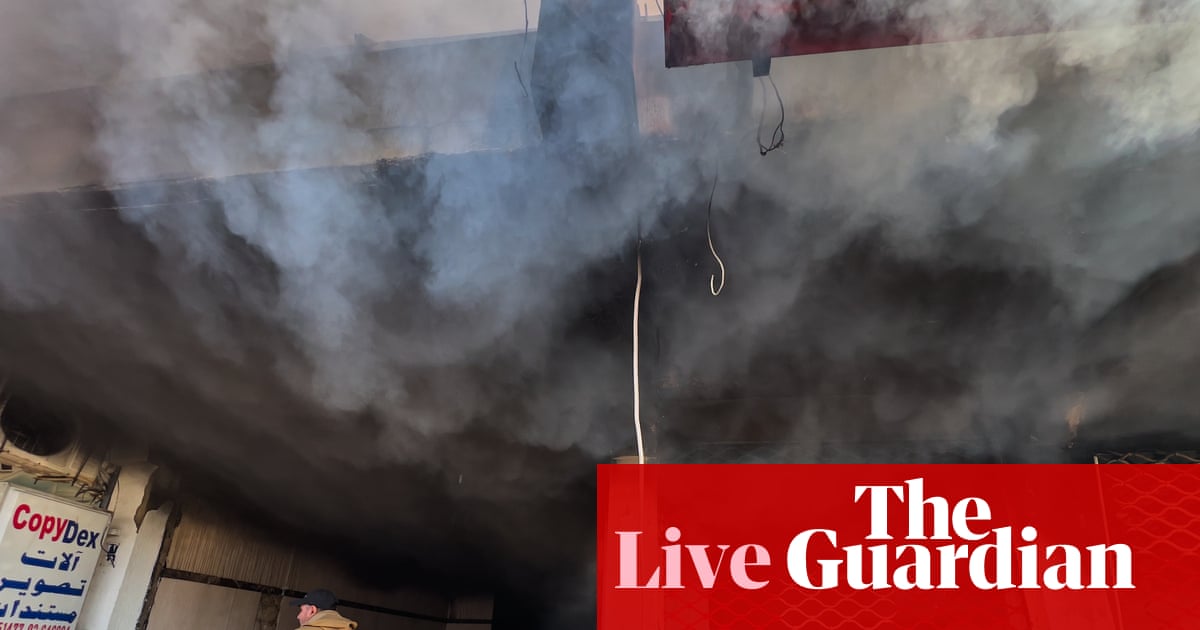
Here are some of the latest images coming in from Beirut and Tehran as the Israeli air force said it was attacking the Lebanese and Iranian capitals simultaneously with a wave of extensive strikes.
The US state department has reportedly ordered the departure of non-emergency government personnel and family members from Qatar and Kuwait.
The move came after the department said earlier on Tuesday it had ordered non-emergency personnel and their families to leave Bahrain and Jordan.
It also announced it had ordered staff in Iraq to leave a day earlier, amid Iran’s retaliation over US-Israeli strikes.
The department said in a post on X before the latest order that it had updated travel advisories for Bahrain and Jordan “to reflect the ordered departure of non-emergency US government personnel and family members of government personnel”.
In an updated travel advisory on Iraq, the department said it had on Monday “ordered non-emergency US government employees to leave Iraq due to security concerns”.
The use of AI tools to enable attacks on Iran heralds a new era of bombing quicker than “the speed of thought”, experts have said, amid fears human decision-makers could be sidelined.
Robert Booth and Dan Milmo report that Anthropic’s AI model was reportedly used by the US military in the barrage of strikes as the technology “shortens the kill chain” – meaning the process of target identification through to legal approval and strike launch.
The US and Israel, which previously used AI to identify targets in Gaza, launched almost 900 strikes on Iranian targets in the first 12 hours alone, during which Israeli missiles killed Iran’s supreme leader, Ayatollah Ali Khamenei.
Academics studying the field say AI is collapsing the planning time required for complex strikes – a phenomenon known as “decision compression”, which some fear could result in human military and legal experts merely rubber-stamping automated strike plans.
See the full story here:
Disclaimer : This story is auto aggregated by a computer programme and has not been created or edited by DOWNTHENEWS. Publisher: theguardian.com