
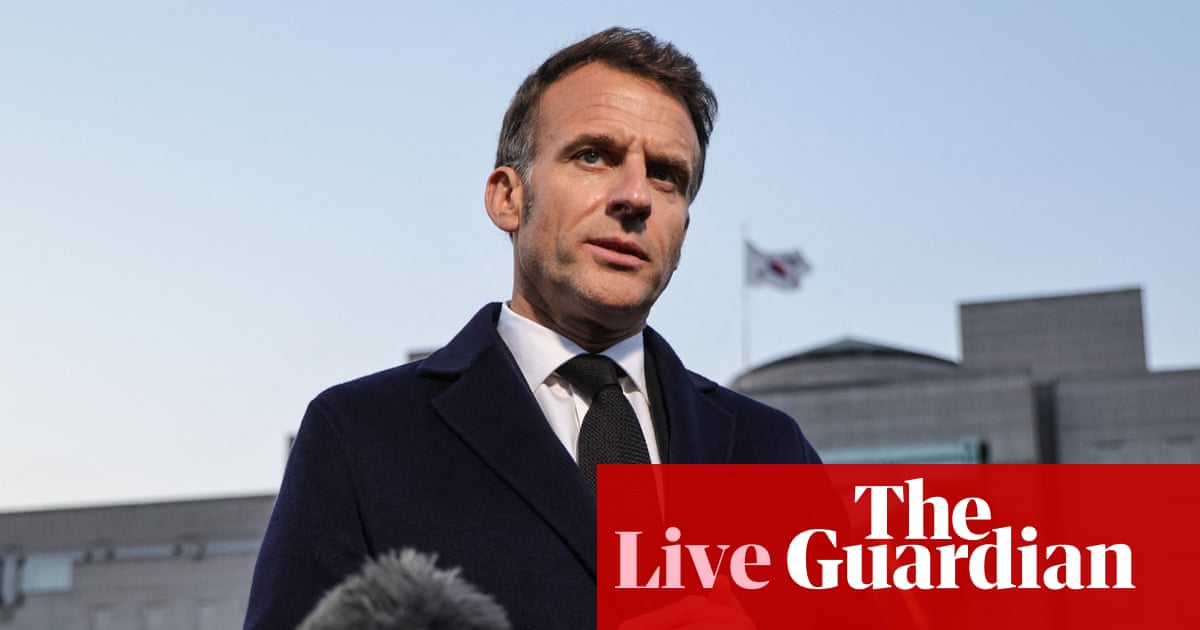
The French president, Emmanuel Macron, has hit out at Donald Trump, saying he was undermining Nato by creating “daily doubt about his commitment” to the alliance.
The US president, in interviews to various media yesterday, made disparaging comments about Nato, calling it a “paper tiger” and threatening to pull the US out of it. Trump has been especially critical of the alliance for refusing to heed his demands to secure the strait of Hormuz by force, provoking the ire of European leaders.
Macron warned that Trump’s comments questioning the US commitment to the alliance “erode its very substance” as he urged leaders to “be serious”.
“I believe that organisations and alliances like Nato are defined by what is left unsaid – that is, the trust that underpins them, and that has often been the case, incidentally, with military and strategic matters,” he said durinng a state visit to Seoul in South Korea.
“If you cast doubt on your commitment every day, you erode its very substance.”
He continued: “We need to be serious, and if you want to be serious, you don’t go around saying the opposite of what you said the day before.
“I think there is too much talk.”
Macron said it “unrealistic” to reopen the Hormuz strait by force, telling reporters that it would expose navies to Iranian attacks. He said securing the strait could only be done “in coordination with Iran” after a ceasefire.
For the latest European reactions to the war in the Middle East and all the other news from across the continent, follow our Europe live blog here:
It has been almost three months since Peyvand Naimi, 30, was arrested in connection with the mass street protests that spread across Iran in January before being brutally suppressed. Since then, he has been detained for more than a month in solitary confinement, appeared in a televised forced confession, and has undergone two mock hangings, beatings, interrogation, psychological torture and starvation.
He has been accused of involvement in the deaths of security agents during the protests and of celebrating the death of Iran’s former supreme leader, Ali Khamenei, but his family insist he has done nothing wrong and that no formal charges have been made. He has been denied access to a lawyer; his relatives fear he now faces execution.
“My whole body was shaking when I heard about the torture he has endured,” says Zahra Hosseini*, a close relative. “It’s unbelievable. I am very worried.”
Naimi’s uncertain fate comes amid concerns that a surge in executions is taking place in Iran and has been “overshadowed” by the US-Israeli war on Iran. At least 145 people are confirmed to have been killed in 2026 so far, with an additional 400-plus executions reported but not verified, according to Iran Human Rights.
Read the full report here:
Israeli defence minister Israel Katz has warned that Hezbollah chief Naim Qassem would pay an “extraordinarily heavy price” for escalating attacks during the ongoing Jewish holidays.
“I have a clear message for Naim Qassem… you and your associates will pay an extraordinarily heavy price for the intensified rocket fire directed at Israeli citizens as they gathered to celebrate Passover Seder,” Katz said in a video statement.
Austria has rejected US requests for military overflights of its territory since the start of the conflict in the Middle East in line with its policy of neutrality, a defence ministry spokesman told AFP on Thursday.
“There have indeed been requests and they were refused from the outset,” Colonel Michael Bauer said, adding that every time a similar request “involves a country at war, it is refused”.
Austria has been a neutral country since 1955. It is surrounded to the north, south, and east by Nato members, with neutral Switzerland to the west.
Germany and China both want to restore the freedom of navigation in the strait of Hormuz and agree that individual states must not control sea lanes or levy tolls for passage, the foreign ministry in Berlin said on social media platform X on Thursday.
China can exert its influence on Iran to bring about a negotiated solution and an end to hostilities against the Gulf states, added the ministry.
Iran’s two largest steel plants have been forced out of action by several waves of US and Israeli attacks, the companies have said.
“Our initial estimate is that restarting these units will take at least six months and up to one year,” Mehran Pakbin, deputy head of operations at the Khuzestan Steel Company, was quoted as saying by the Mizan Online website on Thursday.
Mobarakeh Steel Company in the central province of Isfahan said that its “production lines have completely shut down following the high volume of attacks”.
Both plants have suffered repeated strikes since last week.
The UK foreign secretary, Yvette Cooper, is chairing a meeting of almost three dozen nations to discuss measures to help reopen the strait of Hormuz.
She condemned “Iranian recklessness” for “hitting global economic security”, adding that the UK is seeking to lead a diplomatic initiative to restore access to the maritime route being targeted by Iran in retaliation for the US-Israeli campaign against it.
She said there were more than 25 attacks on vessels in the strait and 20,000 seafarers trapped on 2,000 ships.
“Iranian recklessness towards countries who were never involved in this conflict… is not just hitting mortgage rates and petrol prices and the cost of living here in the UK and in many different countries across the world, it is hitting our global economic security,” she said.
Speaking ahead of the virtual meeting, she said military planners are being convened to look at how to de-mine the strait as past of efforts to secure the vital sea passage, the Press Association news agency reported.
“Alongside today’s discussions, we are also convening military planners to look at how we marshal our collective defensive military capabilities, including looking at issues such as de-mining or reassurance once the conflict eases,” she said.
For more UK reaction to the Middle East war and other news, you can follow our UK politics blog here:
The Philippines said Iran has pledged to allow safe passage of oil shipments through the strait of Hormuz.
Officials said a “productive phone conversation” between the Philippine foreign secretary, Theresa Lazaro, and her Iranian counterpart, Abbas Araghchi, had opened the door to crucial oil shipments.
“The Iranian foreign minister assured the secretary that Iran will allow the safe, unhindered, and expeditious passage through the strait of Hormuz of Philippine-flagged vessels, energy sources, and all Filipino seafarers,” the Philippine foreign affairs department said in a statement.
The Philippine president, Ferdinand Marcos, declared a state of “national energy emergency” last week as a result of the Middle East war, which his administration said posed “an imminent danger of a critically low energy supply”.
The French president, Emmanuel Macron, has hit out at Donald Trump, saying he was undermining Nato by creating “daily doubt about his commitment” to the alliance.
The US president, in interviews to various media yesterday, made disparaging comments about Nato, calling it a “paper tiger” and threatening to pull the US out of it. Trump has been especially critical of the alliance for refusing to heed his demands to secure the strait of Hormuz by force, provoking the ire of European leaders.
Macron warned that Trump’s comments questioning the US commitment to the alliance “erode its very substance” as he urged leaders to “be serious”.
“I believe that organisations and alliances like Nato are defined by what is left unsaid – that is, the trust that underpins them, and that has often been the case, incidentally, with military and strategic matters,” he said durinng a state visit to Seoul in South Korea.
“If you cast doubt on your commitment every day, you erode its very substance.”
He continued: “We need to be serious, and if you want to be serious, you don’t go around saying the opposite of what you said the day before.
“I think there is too much talk.”
Macron said it “unrealistic” to reopen the Hormuz strait by force, telling reporters that it would expose navies to Iranian attacks. He said securing the strait could only be done “in coordination with Iran” after a ceasefire.
For the latest European reactions to the war in the Middle East and all the other news from across the continent, follow our Europe live blog here:
Here are some of the latest images on the newswires as conflict deepens across the Middle East:
As we get more reaction from Donald Trump’s national address on Iran, here is a recap of the key moments from the US president’s speech:
War to continue for another ‘two to three weeks’
Trump once again gave a vague timeline of when the US will likely wrap up its military campaign against Iran, saying it will take another “two to three weeks”.
We’ve heard similar comments made before by Trump and other US officials, who have offered mixed messages about when the war – now approaching its sixth week – could end.
Trump initially said (exactly a month ago) that the war was projected to lastfour to five weeks, although he did add that it could “go far longer than that”. Just a day before those comments, in an interview with the Daily Mail, he predicted “it’ll take four weeks — or less”. About a week later, on 9 March, he said he thought the war “is very complete, pretty much”.
Pete Hegseth, the US secretary of defence, usually declines to give a definitive timeline. On 4 March, he said: “You can say four weeks, but it could be six, it could be eight, it could be three.”
Other nations should secure strait of Hormuz
In an attempt to shift responsibility away from the US, Trump repeated his call for other nations to help secure the strait of Hormuz, which has been effectively shut since the beginning of the war, triggering a global fuel crisis.
There was no mention of the deadline he set for Iran to open the strait, which was extended to Monday, but Trump said it was up to the countries that receive oil through the key shipping route to “take care of that passage”. The bulk of the oil that is carried through the strait heads to Asian countries, the majority of which are probably more sympathetic to Iran than they are of the US or Israel (China has blamed their attacks against Tehran for the closure of the strait, see the post here).
With no solution to the closure of the strait, Trump’s speech has spooked the markets, with brent crude – the international standard – jumping 4.9% to $106.16 a barrel, while gold dipped 2% to $4,718.70 an ounce and silver lost 4.9% to $72.39 an ounce (for the latest updates on the economic impact of the war, follow our business live blog here).
Justifying war to US public
As part of his plea for patience from US voters, Trump said the the two world wars and conflicts in Korea, Vietnam and Iraq took longer than the current Iran war.
Action in Iran has spanned 32 days by comparison, Trump said, and has been “so powerful, so brilliant” that “one of the most powerful countries” is “really no longer a threat”.
He promised things will get better, telling Americans that he personally rescued the US from the “dead and crippled country” it was a year ago.
No mention of pulling US out of Nato
Ahead of the speech, Trump gave interviews to the Telegraph and Reuters news agency indicating that he was considering withdrawing the US from Nato, likening the alliance to a “paper tiger”. He told Reuters that he would express his “disgust” with Nato in the address.
Despite the verbal attacks, he did not mention Nato in his speech, much to the relief of his allies. Besides, he would face significant legal and political hurdles if he wants to make good on his threats.
No mention of talks, either
Last week there were a flurry of reports of potential talks between the US and Iran, with Pakistan stepping in as mediator. The Trump administration had reportedly offered Iran a 15-point plan to bring about a ceasefire, while the White House said talks were ongoing. Hours before his address, Trump wrote on Truth Social that “Iran’s New Regime President” had asked the US for a ceasefire, suggesting negotiations were taking place.
Iran have been quick to deny these reports, with officials countering the US’s ceasefire proposal with their own conditions to end the war. Responding to Trump’s claim yesterday that Iran had asked for a ceasefire, an Iranian official said it was “false and baseless”.
Strikes in Iran have caused extensive damage to a century-old medical centre in the capital Tehran, the country’s health ministry spokesperson said.
“The aggression against Pasteur Institute of Iran – a century-old pillar of global health and member of International Pasteur Network – is a direct assault on international health security,” Hossein Kermanpour wrote in a post on X, with images of a heavily damaged building.
He called on the World Health Organisation and International Committee of the Red Cross to “condemn this attack, assess damages and support reconstruction”.
China has blamed US and Israeli strikes on Iran for the effective shutdown of the strait of Hormuz, which has been at a near halt for a month, saying these attacks were the “root cause” of the problem.
In a national address last night, Donald Trump said countries that receive oil through the major shipping route, which carries about a fifth of the world’s oil, “must take care of that passage” themselves.
When asked by reporters to comment on the US president’s remarks, the Chinese foreign ministry spokesperson, Mao Ning, said: “The root cause of interruptions to navigation through the strait of Hormuz is the United States and Israel’s illegal military operations against Iran.”
UK petrol and diesel prices jumped by a record amount in March, as the oil supply shock caused by the Iran war quickly rippled to forecourts.
New data from the RAC shows that the average price of a litre of unleaded petrol rose by 20p from 132.83p on 1 March to 152.83p by the end of the month. That surpasses the previous all-time biggest monthly jump of 16.6p recorded in June 2022, following Russia’s invasion of Ukraine.
Diesel prices have risen even more sharply – up 40p in March to an average of 182.77p from 142.38p. That’s almost twice as large as the previous record rise of 22p recorded in March 2022.
Follow our business live blog for the latest economic and financial news:
In further comments to Iranian state media, Ebrahim Zolfaqari,, the spokesperson for the Iranian military’s operational command headquarters, Khatam al-Anbiya, claimed Tehran has hidden stockpiles of arms and munitions.
Reacting to Donald Trump’s address to the nation last night, Zolfaqari said: “The centres you think you have targeted are insignificant, and our strategic military productions take place in locations of which you have no knowledge and will never reach.”
In his statement, carried by Press TV, the Iranian state broadcaster’s English-language outlet, Zolfaqari said the US and Israel “know nothing about [Iran’s] vast and strategic capabilities”.
Oil prices have spiked and stocks sank after Donald Trump, in an address from the White House, offered no timeline to the end of the war on Iran and no solution to the closure of the strait of Hormuz that has crippled global markets.
The price of Brent crude, the global benchmark for oil, jumped by over 6% this morning to $107.63 a barrel – yesterday, hopes of de-escalation in the Middle East had pushed it below the $100/barrel mark.
All the major stock markets in the Asia-Pacific region have fallen, after the US president used his primetime address to vow to hit Iran “extremely hard” for another two to three weeks.
The UK is reeling from the biggest shock to its mortgage market since Liz Truss’s mini-budget in 2022, after the Iran war drove up borrowing costs. New research from the data provider Moneyfacts shows how the cost of fixed-rate mortgages has surged over the last month, making it harder for new borrowers to get onto the housing ladder – and meaning those remortgaging face a surge in repayments.
For the latest news on the economic impact of the war, you can follow our business live blog here:
An Iranian military spokesperson said Tehran will continue with the war until the US and Israel face “permanent regret and surrender”, Reuters news agency reported.
Ebrahim Zolfaqari,, the spokesperson for the Iranian military’s operational command headquarters, Khatam al-Anbiya, said Iran would step up its military actions with “more crushing, broader and more destructive” attacks, according to a statement carried by state media.
Joe Kent, the former US counter-terrorism chief who resigned from Donald Trump’s administration over the US and Israel’s war against Iran, has urged the president to end the conflict “before we lose more lives”.
Responding to Trump’s address to the nation, he wrote on X:
We do not honor our fallen by getting more of our best men & women killed in the Middle East.
We honor our fallen by learning from our past & only shedding American blood in defense of our nation.
The best time to get out of a war of choice is now, before we lose more lives.
Kent, who resigned as national counter-terrorism center director on 17 March, previously said he could not continue in his role “in good conscience” due to the war in Iran that Trump started without congressional authorisation alongside Israel in late February.
New York-based think tank, the Soufan Center, has said that Donald Trump’s speech suggests he “is willing to leave the strait of Hormuz off the table, leaving other nations to deal with the consequences”.
Trump’s message was that the United States can sustain its own economic and energy ecosystem, while countries dependent on regional exports will either have to buy from the United States or manage the strait themselves.
While Trump explicitly thanked US allies in the Persian Gulf for their cooperation and allyship, an expedited US withdrawal without securing the strait will leave many of these countries, whose economies are dependent on energy exports, in the lurch.
Shrinking fuel stocks and soaring prices are leading countries around the world to burn coal, ration fuel, shorten work weeks and tell citizens to stay at home.
Here is how the world is responding as the Iran war oil crisis deepens.
The United States
The federal government has not moved to increase subsidies or support households struggling to pay bills, but it has continued its “drill, baby, drill” policy of expanding fossil fuel production while blocking renewable projects. Last week, the Trump administration announced it would pay the French company TotalEnergies $1bn of taxpayer money to kill plans to construct windfarms off the US east coast, and instead direct investments into oil and gas.
The UK, Australia, New Zealand and Canada
The UK has encouraged people to stay calm as fuel prices rise, steering clear of calls to curb demand and limiting its action to financial support for people who use oil to heat their homes. The chancellor, Rachel Reeves, is considering plans to put extra cash into a council-run fund to help vulnerable people during financial crises, but has ruled out the universal support offered during the last energy crisis.
The IEA has warned governments against providing blanket subsidies in response to the crisis and advised them to instead target support to those who need it most. New Zealand has announced weekly cash payments to nearly 150,000 families “in the squeezed middle” as part of a fuel relief package.
Australia has introduced a 50% cut to the fuel excise for three months and released a national fuel security plan. At its current danger level, it encourages motorists to “only buy the fuel you need” and says voluntary choices will help avoid the impact of higher prices. Canada, meanwhile, has refrained from intervening to offset rising prices.
Asia
Coal is coming back across Asia, which has been hit hardest by the energy crisis. India has ordered coal-fired power plants to be run at full capacity and avoid planned outages, while Japan is allowing less-efficient coal plants back on to the electricity market. South Korea has lifted caps on electricity from coal and announced a delay to its planned phaseout. Bangladesh, Thailand and the Philippines are also increasing electricity output from the dirtiest fossil fuel.
China, the world’s second-largest economy, is less exposed to the crisis than its neighbours. In recent years, it has greatly increased energy production – from fossil, nuclear and renewable sources – and built up a vast strategic oil reserve. Its state-run refineries have avoided Iranian crude oil imports for fear of being cut off from international markets, but independent “teapot” refineries have continued to process it for domestic consumption.
South and south-east Asian countries have taken the greatest steps to reduce energy demand. Sri Lanka has introduced fuel rationing and a four-day working week. Vietnam has urged employers to let staff work from home. News anchors in Thailand took off their jackets on air, as the government called on people to use less air conditioning and told officials to wear short-sleeved shirts without neckties. It has also reduced temperatures in government offices to 26-27C and joined other countries in the region in calls to drive less, use more public transport and promote car-sharing.
Disclaimer : This story is auto aggregated by a computer programme and has not been created or edited by DOWNTHENEWS. Publisher: theguardian.com


