Iran’s military on Wednesday said any ships belonging to the United States, Israel or their allies passing through the strategic strait of Hormuz could be targeted.
“Any vessel whose oil cargo or the vessel itself belongs to the United States, the Zionist regime or their hostile allies will be considered legitimate targets,” said the military’s central operational command, Khatam Al-Anbiya, in a statement carried by state TV.
It reiterated that Iran’s armed forces “will not allow a single litre of oil to transit” through the strait.
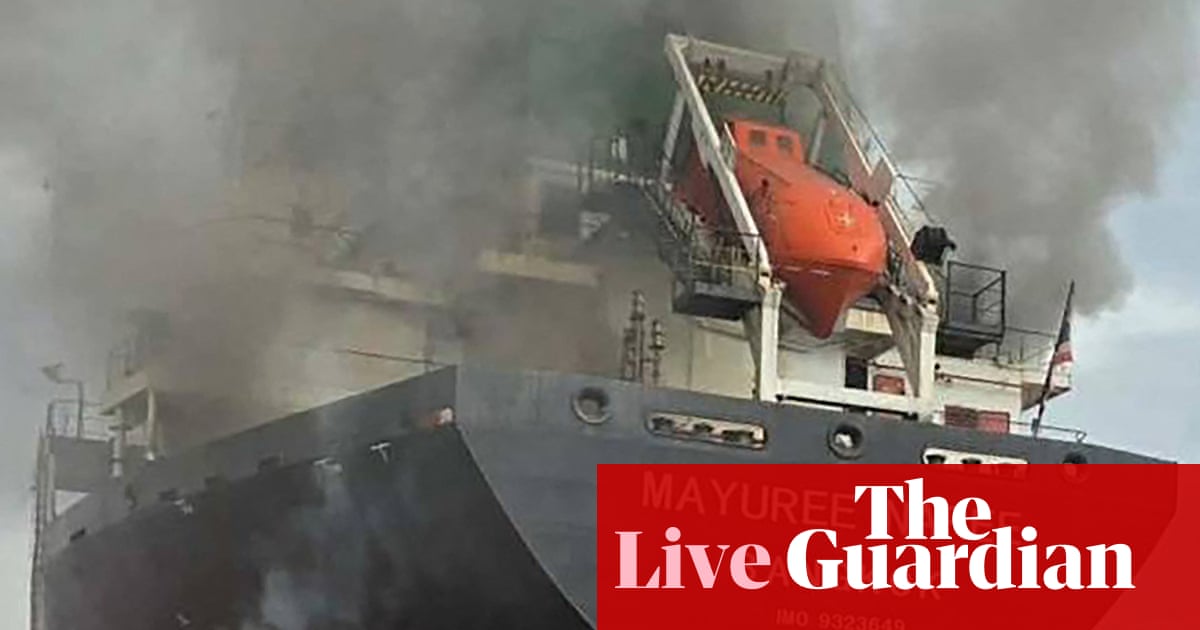
It comes as Iran’s revolutionary guards claimed to have fired at the Thai-flagged bulk vessel Mayuree Naree in the strait earlier today.
In a five-minute interview with Axios on Wednesday, Donald Trump said that the war with Iran will end “soon” because there is “practically nothing left to target”.
“Any time I want it to end, it will end,” Trump said.
The US president later said that the war “is going great”.
“The war is going great,” Trump said. “We are way ahead of the timetable. We have done more damage than we thought possible, even in the original six-week period.
US forces have conducted airstrikes on more than 5,500 targets inside Iran, Admiral Brad Cooper, commander of US Central Command, said in a post on X.
Cooper provided an update on Wednesday on US operations in the Middle East, in which he said US forces “continue delivering devastating combat power against the Iranian regime”.
“I’ve said this before but it bears repeating: US combat power is building. Iranian combat power is declining,” Cooper said. “We remain centreed on very clear military objectives and eliminating Iran’s ability to project power against Americans and against its neighbours.”
Cooper noted that on Tuesday, US conducted strike waves nearly every hour. He characterised the strikes as “unpredictable, dynamic and decisive” and made a point to say that the US military is not just “defending against Iranian threats”. “We are methodically dismantling them,” he said.
At one point, a US strike knocked out a large ballistic missile manufacturing facility in Iran, Cooper said.
“It’s not just about what is shooting at us today,” Cooper said. “It’s also about eliminating the threat in the future.”
The 20 crew members rescued from the Mayuree Naree, the Thai-flagged cargo ship that was attacked in the strait of Hormuz on Wednesday, have been brought ashore at Khasab, Oman, according to Thailand’s ministry of foreign affairs, which said “efforts are underway to rescue the three remaining crew members”.
The ministry said in a statement that the Royal Thai Embassy in Muscat was seeking permission to travel to Khasab, which is currently a no-fly zone.
“Travel by car would take approximately 6 hours and would require passing through the United Arab Emirates. The Embassy has coordinated with the Ministry of Foreign Affairs of Oman to contact the rescued Thai crew members and has also been informed that they are safe. The Ministry is currently coordinating assistance for the remaining three crew members and will continue to investigate the facts surrounding the incident.”
According to statements released by the Thai Marine Department and the Royal Thai Navy, earlier, Mayuree Naree, which is owned by Precious Shipping Public Company Limited, was hit and damaged at the stern while sailing in the Strait of Hormuz after departing from the port of Khalifa, United Arab Emirates. There were 23 Thai crew members on board.
Here are some images coming out of Tehran today:
Israeli defence minister Israel Katz said Wednesday that the joint bombing campaign with the US against Iran would go on “as long as necessary”, insisting the strikes had inflicted heavy casualties on Tehran’s forces.
“This operation will continue without any time limit, as long as necessary, until we achieve all the objectives and decide the outcome of the campaign,” he said, adding that the Iranian leadership was fleeing “like mice into tunnels”.
Katz said hospital morgues in Iran were full, but insisted the casualties were not civilians. He added that strikes would continue in Tehran and across the country “day after day, target after target”.
Katz said strikes would continue “in order to allow the Iranian people to rise up, act, and remove this regime”, adding that “ultimately, that is something that depends on them”.
Iran’s new supreme leader, Mojtaba Khamenei, was injured in the 28 February attack that killed six of his family members, including his father, Tehran’s ambassador to Cyprus has confirmed.
In an interview conducted at his embassy compound in Nicosia, Alireza Salarian elaborated on the circumstances in which Khamenei, 56, was injured, saying he was lucky to survive the strike, which levelled the late ayatollah’s residence.
“He was also there and he was injured in that bombardment but I haven’t seen that reflected in the foreign news,” he told the Guardian. “I have heard that he was injured in his legs and hand and arm … I think he is in the hospital because he is injured.”
Explaining why the cleric had not appeared in public or made any statements since he succeeded his father on Sunday, he added: “I don’t think he is comfortable [in any condition] to give a speech.”
The attack had occurred on the opening day of US-led airstrikes against Iran, when the sprawling presidential complex in the heart of Tehran was targeted. It was the 10th day of the holy month of Ramadan, said the ambassador, and Ayatollah Ali Khamenei was at his residence with several members of his family, including Mojtaba’s wife, Zahra, who was also killed in the attack.
Iranian media reports suggested that Ali Khamenei’s wife, Mansour, died three days after the aerial strike.
Three US B-1 bombers were seen flying back to RAF Fairford in Gloucestershire this morning after what appears to be the first bombing run conducted by the US Airforce from a British airbase since the start of the war with Iran.
Photographs taken around 7am show the B-1s, which can carry 75,000kg worth of munitions, returning from an overnight mission in the dawn light, though it is not known what if any targets were struck in the mission.
They were first spotted taking off late on Tuesday afternoon, a few hours after Pete Hegseth, the US secretary of war, declared “the most intense day of strikes inside Iran” was taking place.
Permission for US bombing of Iran from British bases were initially refused by prime minister Keir Starmer, who then changed his mind on the second day of the conflict, saying the bases could be used to strike Iranian missile launch sites.
Long range photography showed bombs being prepared for loading on Tuesday. Eleven B-1s and 3 B-52 bombers have been deployed to Fairford, which is a home base for US Air Force bombers in Europe.
Iran’s military on Wednesday said any ships belonging to the United States, Israel or their allies passing through the strategic strait of Hormuz could be targeted.
“Any vessel whose oil cargo or the vessel itself belongs to the United States, the Zionist regime or their hostile allies will be considered legitimate targets,” said the military’s central operational command, Khatam Al-Anbiya, in a statement carried by state TV.
It reiterated that Iran’s armed forces “will not allow a single litre of oil to transit” through the strait.
It comes as Iran’s revolutionary guards claimed to have fired at the Thai-flagged bulk vessel Mayuree Naree in the strait earlier today.
-
Three ships were hit by unknown projectiles in the strategic strait of Hormuz abutting Iran. Two of the ships sustained damage, while another, which the Thai navy identified as a Thai bulk carrier, caught fire, forcing the crew to evacuate.
-
In more Hormuz news, US Central Command said that it “eliminated” 16 Iranian mine-laying vessels near the strait of Hormuz. Donald Trump had initially said there had been “no reports” of Iran placing mines in the strait, but warned that if it had, they must be moved “IMMEDIATELY” or Iran would face military consequences “at a level never seen before”. US officials earlier told CBS News that Iran may be preparing to deploy naval mines in the strait to further disrupt the crucial shipping lane. According to CNN, a few dozen mines have been laid in recent days.
-
Iran’s new supreme leader, Mojtaba Khamenei, is “safe and sound” despite war injuries, said Yousef Pezeshkian, a government adviser and the son of Iran’s president, on Wednesday. State television had called Khamenei, 56, a “wounded veteran of the Ramadan war” but never specified his injury. The comments come amid speculation over the health and whereabouts of Khamenei, who has not engaged with the public since he succeeded his late father, Ayatollah Ali Khamenei, three days ago.
-
The Israeli military said it had begun a “wide-scale wave” of strikes on targets in Iran and Lebanon. It followed the IDF saying earlier that it had struck key command centres of the Iranian armed forces in Tehran and Tabriz. In Lebanon, 84 people were killed in Israeli attacks and strikes just yesterday, bringing the overall death toll to 570 since the start of the conflict.
-
Iran launched missiles and drones across the Gulf, including toward Israel, the Israeli military said on Wednesday, and at oil infrastrucure in Saudi Arabia. Saudi Arabia’s defence ministry said early Wednesday it destroyed five drones heading toward the kingdom’s vast Shaybah oil field in the Empty Quarter desert while Kuwait said it downed eight drones over the tiny, oil-rich nation. Bahrain also sounded sirens early Wednesday, warning of an incoming Iranian attack. The warnings came a day after an Iranian attack hit a residential building in the capital, Manama, and killed a 29-year-old woman and wounding eight people.
-
A drone struck a major US diplomatic facility in Iraq on Tuesday in suspected retaliation by pro-Tehran militias over the US-Israeli war on Iran, the Washington Post reported, citing an unidentified security official and an internal US state department alert.
-
Dutch carrier KLM announced on Wednesday that it was cancelling all flights to Dubai up to and including 28 March because of the US-Israeli war on Iran. The announcement came just hours after four people were injured when air defences intercepted two drones near Dubai airport.
Dutch carrier KLM announced on Wednesday that it was cancelling all flights to Dubai up to and including 28 March because of the US-Israeli war on Iran.
“The safety of our passengers and crew is always our top priority,” the airline said in a statement, adding that KLM remains available to help with the repatriation of stranded passengers.
The announcement came just hours after four people were injured after air defences intercepted two drones near Dubai airport.
A Thai bulk carrier was attacked in the strait of Hormuz on Wednesday, with the Thai navy accounting for 20 crew members members rescued so far, the AFP reports.
The Thai-registered Mayuree Naree was attacked in the strait after leaving Khalifa port in the United Arab Emirates, the navy said, adding that the specific details and cause of the attack are under investigation.
“Efforts are currently underway to rescue the remaining three crew members,” the Thai navy said.
The carrier is owned by a Thai transport company, Precious Shipping, the AFP reports, and was heading to Kandla in India.
The strait of Hormuz, which connects the Persian Gulf with the Gulf of Oman, is one of the world’s most strategically important choke points. The straight, located south of Iran, would normally have about 100 vessels a day either exiting or entering the Gulf. About one-fifth of the world’s oil passes through the strait.
In response to the US and Israeli airstrikes, Iran has effectively shut the strait, attacking at least 10 ships since the start of the conflict. Iran’s Islamic Revolutionary Guard Corps said earlier this week it will not allow even “one litre of oil” to leave the region if US-Israeli attacks continue.
The US military said it attacked and destroyed 16 Iranian mine-laying vessels near the strait of Hormuz amid reports that Iran has begun laying explosive devices in the strategically vital waterway.
About one-fifth of the world’s oil passes through the strait, and Iran’s Islamic Revolutionary Guard Corps said this week it will not allow even ‘one litre of oil’ to leave the region if US-Israeli attacks continue.
On Tuesday, Donald Trump said in a post on Truth Social that ‘if Iran has put out any mines in the Hormuz Strait, and we have no reports of them doing so, we want them removed, IMMEDIATELY!’
Here is footage of the attacks on mine-laying vessels, released by the US military:
Disclaimer : This story is auto aggregated by a computer programme and has not been created or edited by DOWNTHENEWS. Publisher: theguardian.com