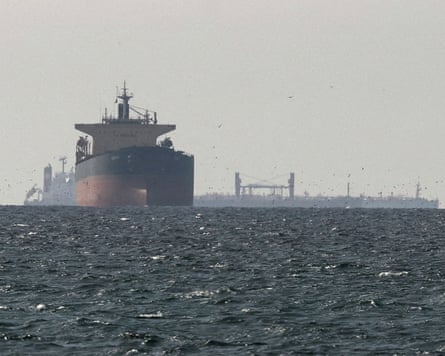
In a brief post on X, Iran’s parliamentary speaker Mohammad Bagher Ghalibaf wrote that situation in the strait of Hormuz “won’t return to its pre-war status”. He did not elaborate further.
The effective shutdown of traffic through the vital shipping route has had significant consequences for the global economy, causing oil and gas prices to soar.
Donald Trump has been (unsuccessfully) pressuring Nato allies and other countries to help the US secure the critical waterway, but enthusiasm has remained low from other countries not wanting to participate in the US and Israel’s war on Iran.
My colleague Peter Beaumont has this explainer on the situation:
A short while ago, Iranian state media reported that the commander of the Basij paramilitary force and a leading figure of Iran’s Revolutionary Guard Corps, Gholamreza Soleimani, has been killed.
The Israeli military earlier announced that it had assassinated Soleimani in an airstrike on Tehran, describing the force under his leadership as a “primary instrument” of repression in Iran.
This is the first confirmation from Iran of his death. It marks the highest level assassination in the war since joint US-Israeli strikes killed the former supreme leader Ali Khamenei on 28 February (Iran has yet to confirm the status of national security chief Ali Larijani, whom Israel claims it killed in an overnight strike on Tehran).
Israeli attacks on residential buildings and civilian infrastructure in Lebanon may amount to war crimes, the United Nations human rights office has said.
It comes as at least 912 people, including 111 children, have been killed and 2,221 wounded in Israel’s assault on its northern neighbour since 2 March, according to the latest figures from the Lebanese public health ministry, with over a million people displaced – nearly one in five of the population.
At a news briefing on Tuesday in Geneva, spokesperson Thameen al-Kheetan said:
In many instances, Israeli airstrikes have destroyed entire residential buildings in dense urban environments, with multiple members of the same family, including women and children, often killed together.
Al-Kheetan warned that “such attacks raise serious concerns under international humanitarian law”.
He noted that displaced Lebanese civilians living in tents along the Beirut seafront were killed in Israeli strikes while other attacks since early March also have killed at least 16 health workers.
International humanitarian law demands distinction between military targets and civilians and civilian objects and insists on feasible precautions being taken to protect civilians. Deliberately attacking civilians or civilian objects amounts to a war crime.
In addition, international law provides for specific protections for healthcare workers as well as people at heightened risk, such as the elderly, women, and displaced people.
Meanwhile, Israel has extended its extensive warnings and displacement orders across southern Lebanon, adding the region between the Litani and Zahrani rivers to the broad swath of Lebanese territory already covered by such measures. These orders may amount to forced displacement, prohibited under international humanitarian law.
He also noted that Hezbollah fighters have continued to launch “indiscriminate barrages of rockets at Israel”, where at least 13 people have been killed since the war began.
Addressing membres of the UK parliament earlier, Volodymyr Zelenskyy told British MPs and peers that 201 Ukrainian anti-drone experts are in the Middle East helping to counteract Iranian drone attacks, and that there are a further 34 “ready to deploy”.
These are military experts, experts who know how to help, how to defend against drones.
Our teams are already in the Emirates, Qatar, Saudi Arabia and on the way to Kuwait. We are working with several other countries. Agreements are already in place.
The Ukrainian president said that he sent these military experts “at the request of our partners, including the United States”.
In the Oval Office earlier, asked whether he has a “day after” plan for Iran, Donald Trump said that if the US left the military operation now it would take “10 years for [Iran] to rebuild”.
He added:
But we’re not ready to leave yet. But we will be leaving in the near future, we’ll be leaving in pretty much the very near future.
He repeated his point that the US has had “great support” from countries in the Middle East but has had “essentially no support” from Nato.
Asked about his relationship with UK prime minister Keir Starmer, Trump said Starmer “hasn’t been supportive”.
He said that Starmer was willing to send two aircraft carriers “after we won” when there was no threat for them because the war was already “won”.
I like him, I think he’s a nice man, but I’m disappointed.
Irish taoiseach Micheál Martin (who was still there) stepped in at this point to state that the transatlantic relationship between Europe and US is still “very, very important”.
He also vouched for Starmer, calling him an “earnest” and “sound” person that the US president has the capacity to get on with.
In response to a later question about Starmer, Trump repeated that he likes the UK prime minister but added that the US-UK relationship was always the best “before Keir came along”.
He then went on a tangent about windmills.
Germany’s foreign minister Johann Wadephul on Tuesday said it was not realistic to expect controlled regime change in Iran and said the war could not have only a military solution.
“There will be no military solution. And to have a controlled regime change, is, I would say, a hypothetical idea, which is not realistic,” he said, speaking alongside his French counterpart in Berlin at an event hosted by the ZEIT media group.
“So chaos in Iran, as bad as the regime is, is also not in our interest and not in the interest of the region and, of course, in the interest of the people living in Iran.“
Several loud explosions were heard Tuesday evening in Iraq’s capital Baghdad, AFP journalists reported, with a security official reporting a drone and rocket attack on the US embassy.
In a restaurant in the city, where diners did not react to the initial sounds of the blasts, a witness told AFP he saw explosions in the sky caused by the embassy’s air defences intercepting projectiles.
Another witness saw a fire on the embassy grounds from her balcony, with the blaze also reported by the security official, who said it was caused by a drone.
A diplomatic adviser to the UAE president, Anwar Gargash, said on Tuesday that his country could join an international effort led by the US to ensure the safety and security of the strait of Hormuz.
Speaking in an online event organised by the American think tank the Council on Foreign Relations (CFR), Gargash said that the UAE does not currently have active talks with Iran.
His comments come amid growing concerns over the security of shipping through the strait of Hormuz.
Kuwait’s defence ministry said earlier that it had detected two ballistic missiles and 13 drones inside the country’s airspace within the last 24 hours.
All were intercepted, it said, but two minor injuries were recorded as a result of falling shrapnel.
The individuals’ conditions are stable and no significant material damage was recorded, it added.
Donald Trump was also asked what progress he’s made in getting allies to help the US with escorting oil tankers through the strait of Hormuz.
“Well, we don’t need any help,” Trump said. Nato allies “agreed” what the US did, he claimed, adding that it was very important that they remove the nuclear threat from Iran.
He repeated his usual lines that they have successfully wiped out Iran’s military, navy and air force, and killed “one of their top people” yesterday – referring to Iran’s national security chief Ali Larijani, whom Israel claims to have killed.
Then circling back to Nato, Trump said they were making “a foolish mistake” and once again framed this issue as a loyalty test for Nato. He said Nato should’ve “been there” for the US, but also that the US didn’t need them anyway. He told reporters:
I think Nato’s making a very foolish mistake. And I’ve long said that, you know, I wonder whether or not Nato would ever be there for us. So this is a this was a great test because we don’t need them, but they should have been there.
Trump continued to berate Nato this morning over their resistance to assist the US in its war on Iran, in particular their ruling out sending warships to the strait of Hormuz. The US president previously warned that Nato faces “a very bad future” if allies failed to help the US reopen the vital waterway.
Back in the Oval Office, asked a follow-up question on French president Emmanuel Macron’s comments that France will not join a taskforce in the strait of Hormuz until the hostilities come to an end, Trump replied that Macron will be out of office soon.
The US president, Donald Trump, has been taking questions from reporters in the Oval Office.
Asked about the resignation of Joe Kent, his former director of national counterterrorism, who said he couldn’t remain in his job because he couldn’t support the conflict in Iran, Trump replied:
Well, I read his statement. I always thought he was a nice guy but I always thought he was weak on security, very weak on security.
I didn’t know him well … But when I read his statement I realised that it’s a good thing that he’s out, because he said Iran was not a threat.
Iran was a threat, every country realised what a threat Iran was.
As my colleague Shrai Popat reported earlier today, Kent, an Iraq war veteran and failed congressional candidate, said he “could not in good conscience” continue serving as the director of the National Counterterrorism Center, due to the ongoing war on Iran.
In his resignation letter to Trump, Kent accused “high-ranking Israeli officials and influential members of the American media” of deploying “a misinformation campaign” that ultimately “sowed pro-war sentiments to encourage a war with Iran”.
“This echo chamber was used to deceive you,” he wrote.
Donald Trump is delaying a diplomatic trip to China that had been planned for months but began to unravel as he pressured Beijing and other world powers to use military might to protect the strait of Hormuz .
Trump said Tuesday while meeting with Irish prime minister Micheál Martin in the Oval Office that he would be going to China in five or six weeks’ time instead of at the end of the month. He said he would be “resetting” his visit with Chinese president Xi Jinping, without elaborating.
Trump’s visit to China is seen as an opportunity to build on a fragile trade truce between the two superpowers, but it has become tangled in his effort to find an endgame to the war in Iran.
Turkey’s top diplomat on Tuesday lashed out at Israel after it claimed to have killed Iran’s powerful national security chief Ali Larijani, denouncing its targeting of Tehran’s leaders as “illegal”.
“Israel’s political assassinations, especially those targeting Iranian statesmen and politicians, are truly illegal activities outside the normal laws of war,” foreign minister Hakan Fidan told a news conference.
Larijani’s death has not been confirmed by Iran, AFP reported.
Three Lebanese soldiers were killed in Israeli strikes on Tuesday, the Lebanese army said, as Israel carried out new raids and again ordered residents of vast parts of southern Lebanon to evacuate.
Lebanon was drawn into the Middle East war when pro-Iran Hezbollah launched rockets towards Israel in response to US-Israeli strikes that killed Iranian supreme leader Ayatollah Ali Khamenei.
Donald Trump has continued to lambast Nato countries over the resistance to assist the US in the war on Iran.
This comes after US allies in Europe and beyond ruled out sending warships to the strait of Hormuz, despite threats from the president that Nato faces “a very bad future” if members fail to help reopen the vital waterway.
“I am not surprised by their action,” Trump wrote on Truth Social. “Because I always considered NATO, where we spend Hundreds of Billions of Dollars per year protecting these same Countries, to be a one way street.”
He said that the member countries “will do nothing for us, in particular, in a time of need” before heralding the success of US forces degrading Iran’s military capabilities, naval forces, and air defenses.
“We no longer “need,” or desire, the NATO Countries’ assistance – WE NEVER DID! Likewise, Japan, Australia, or South Korea,” Trump insisted on social media.
He added:
The United States has been informed by most of our NATO “Allies” that they don’t want to get involved with our Military Operation against the Terrorist Regime of Iran, in the Middle East, this, despite the fact that almost every Country strongly agreed with what we are doing, and that Iran cannot, in any way, shape, or form, be allowed to have a Nuclear Weapon.
Alexander Stubb, the president of Finland, said he believed the implications of the war in the Middle East are “negative on Ukraine” and expressed the fear that the slow moving peace negotiations with Russia could collapse as a result.
The president, on a visit to London, said he believed that the war in the Middle East “takes the focus away, I think, from the peace negotiations in Ukraine” while Russia’s economic and military position has strengthened.
“I hope that the peace negotiations on Ukraine don’t collapse like the negotiations between Iran and the US did,” Stubb said, as at the end of a set of downbeat observations on the state of the war in eastern Europe.
The surge in oil prices, caused by the US-Israel attack, would prop up the Kremlin’s treasury at a point when the Russian economy was “actually doing extremely badly,” he said. Some forecasters predicted a Russian recession later in 2026.
Gulf nations and the US were making heavy use of Patriot interceptors to protect themselves from Shahed drone attacks by Iran which were “taking some of the necessary air defence systems away” from defending Ukraine, Stubb added.
Though Stubb has sometimes been dubbed a “Donald Trump whisperer” for his good relationship with the US president, cemented over a round of golf at Mar a Lago a year ago, he said his personal influence was limited.
“I have no illusions about who can convince president Trump on anything. Especially, I don’t. If I get one idea of 10 in on Ukraine, it’s good,” Stubb said in response to a question from the Guardian at an event at the Chatham House think tank.
Joe Kent’s resignation from the office of the director of national intelligence (ODNI) is being met with derision inside the Trump administration this morning, making it unlikely that it will trigger internal splits or opposition to the war in Iran.
Several senior Trump advisers have long made clear that they have not cared about him or his views for some time, evidenced by the fact that Kent has played no role in any major operation or policy in Trump’s second term.
There does appear to be some anger towards Kent for making such a splashy resignation, however, including from his own former colleagues.
DNI Tulsi Gabbard is set to face a bruising Worldwide Threats Hearing on Capitol Hill this week, where she is now certain to be asked about Kent’s resignation.
Earlier this month, the former US secretary of state under Joe Biden, Antony Blinken, who also was deputy secretary of state and deputy national security adviser during the Obama administration, was asked by Bloomberg about the US-Israeli relationship.
The interview came after the current secretary of state, Marco Rubio, said Israel’s determination to attack Iran and the certainty that US troops would be targeted in response forced the Trump administration to take pre-emptive strikes on Iran, a position that was later walked back on. Blinken’s comments made to Bloomberg were revealing. He said:
This has been a long story when it comes to Iran. And back during the Obama administration the Israelis were pushing President Obama to take military action against Iran and were warning that they would do it themselves if he didn’t and he wouldn’t because he thought the better way to get at the nuclear programme, which is what we were focused on, was through very muscular diplomacy backed up by very, very strong sanctions, that we rallied the world to put in place and then we got the Iran nuclear agreement.
In the days after the October 7 attack on Israel … by Hamas the Israelis were insisting that in the north Hezbollah – from Lebanon – was about to attack and they wanted to strike pre-emptively against Hezbollah and President Biden said ‘look we are with you and we will always be with you in defending Israel and if you are attacked we are there’ but we are not there if you are going to start something.
And we came within about 30 minutes of having a war in the north based on bad information that the Israelis had about an imminent attack from Hezbollah.
Joseph Kent’s resignation letter in full:
After much reflection, I have decided to resign from my position as Director of the National Counterterrorism Center, effective today.
I cannot in good conscience support the ongoing war in Iran. Iran posed no imminent threat to our nation, and it is clear that we started this war due to pressure from Israel and its powerful American lobby.
I support the values and the foreign policies that you campaigned on in 2016, 2020, 2024, which you enacted in your first term. Until June of 2025, you understood that the wars in the Middle East were a trap that robbed America of the precious lives of our patriots and depleted the wealth and prosperity of our nation.
In your first administration, you understood better than any modern President how to decisively apply military power without getting us drawn into never-ending wars. You demonstrated this by killing Qasem Soleimani and by defeating ISIS.
Early in this administration, high-ranking Israeli officials and influential members of the American media deployed a misinformation campaign that wholly undermined your America First platform and sowed pro-war sentiments to encourage a war with Iran. This echo chamber was used to deceive you into believing that Iran posed an imminent threat to the United States, and that should you strike now, there was a clear path to a swift victory. This was a lie and is the same tactic the Israelis used to draw us into the disastrous Iraq war that cost our nation the lives of thousands of our best men and women. We cannot make this mistake again.
As a veteran who deployed to combat 11 times and as a Gold Star husband who lost my beloved wife Shannon in a war manufactured by Israel, I cannot support sending the next generation off to fight and die in a war that serves no benefit to the American people nor justifies the cost of American lives.
I pray that you will reflect upon what we are doing in Iran, and who we are doing it for. The time for bold action is now. You can reverse course and chart a new path for our nation, or you can allow us to slip further toward decline and chaos. You hold the cards.
It was an honor to serve in your administration and to serve our great nation.
Disclaimer : This story is auto aggregated by a computer programme and has not been created or edited by DOWNTHENEWS. Publisher: theguardian.com