
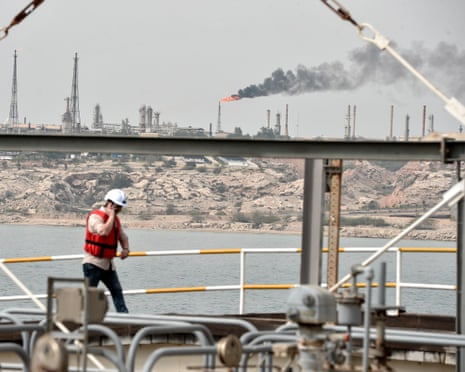
More here on Donald Trump’s comments: he says he wants to “take the oil” in Iran and could seize the export hub of Kharg Island, the Financial Times is reporting, as the US sends thousands of troops to the Middle East.
The newspaper quotes him as saying his “preference would be to take the oil”, comparing the potential move to Venezuela, where the US intends to control the oil industry “indefinitely” following its ousting of president Nicolás Maduro in January.
Trump said in the interview with the FT on Sunday:
To be honest with you, my favourite thing is to take the oil in Iran, but some stupid people back in the US say: ‘why are you doing that?’ But they’re stupid people.”
Such a move would involve seizing Kharg Island, through which most of Iran’s oil is exported, the FT report continues. But an assault on the export hub would be risky, raising the chances of more US casualties and extending the cost and duration of the war.
“Maybe we take Kharg Island, maybe we don’t. We have a lot of options,” Trump said.
It would also mean we had to be there [in Kharg Island] for a while.
Asked about the state of Iranian defence on Kharg Island, he said: “I don’t think they have any defence. We could take it very easily.”
The FT also quoted Trump as stressing that, despite his threats to seize Iranian oil production, indirect US-Iran talks via Pakistani “emissaries” were progressing well.
The paper said that when asked whether a ceasefire deal could be reached in the coming days that would reopen the vital strait of Hormuz, Trump declined to offer specific details, saying:
We’ve got about 3,000 targets left – we’ve bombed 13,000 targets – and another couple of thousand targets to go. A deal could be made fairly quickly.
A generational divide over the Iran war has emerged between older conservatives in the US and their political heirs.
At a conservative conference in Texas, younger attendees spoke of disappointment and even “betrayal” over Donald Trump’s launch of strikes against Iran, saying the president’s actions ran counter to his many pledges to oppose foreign entanglements.
Older conservatives, meanwhile, were looking past Trump’s campaign criticism of military action to topple foreign regimes, arguing the war in Iran was a pragmatic act forced by threats to the US.
The conference also heard pleas for unity from leaders in a challenging midterm election year for Republicans.
There’s more on that and other key Trump administration news in this rundown here:
More here on Donald Trump’s comments: he says he wants to “take the oil” in Iran and could seize the export hub of Kharg Island, the Financial Times is reporting, as the US sends thousands of troops to the Middle East.
The newspaper quotes him as saying his “preference would be to take the oil”, comparing the potential move to Venezuela, where the US intends to control the oil industry “indefinitely” following its ousting of president Nicolás Maduro in January.
Trump said in the interview with the FT on Sunday:
To be honest with you, my favourite thing is to take the oil in Iran, but some stupid people back in the US say: ‘why are you doing that?’ But they’re stupid people.”
Such a move would involve seizing Kharg Island, through which most of Iran’s oil is exported, the FT report continues. But an assault on the export hub would be risky, raising the chances of more US casualties and extending the cost and duration of the war.
“Maybe we take Kharg Island, maybe we don’t. We have a lot of options,” Trump said.
It would also mean we had to be there [in Kharg Island] for a while.
Asked about the state of Iranian defence on Kharg Island, he said: “I don’t think they have any defence. We could take it very easily.”
The FT also quoted Trump as stressing that, despite his threats to seize Iranian oil production, indirect US-Iran talks via Pakistani “emissaries” were progressing well.
The paper said that when asked whether a ceasefire deal could be reached in the coming days that would reopen the vital strait of Hormuz, Trump declined to offer specific details, saying:
We’ve got about 3,000 targets left – we’ve bombed 13,000 targets – and another couple of thousand targets to go. A deal could be made fairly quickly.
Donald Trump has also said he wants to “take the oil in Iran” and could seize the export hub of Kharg Island, the Financial Times is being cited as reporting.
Donald Trump has said a ceasefire deal in the Middle East war could be made fairly quickly, the Financial Times is reporting.
He also said indirect talks between the US and Iran via Pakistani “emissaries” were progressing well, news wires quoted the FT as reporting.
The US president said the number of Pakistan-flagged oil tankers that Iran had allowed to pass through the strait of Hormuz had now doubled to 20, the FT said.
Trump said Iran’s parliamentary speaker had authorised the additional tankers.
The Commonwealth Bank of Australia’s top geopolitical strategist has warned that the Middle East conflict is likely to last “at least into June”, saying Donald Trump will not be able to unilaterally extract himself from his war on Iran.
Madison Cartright said we shouldn’t hope for a repeat of the Taco trade (or “Trump Always Chickens Out”) that had been a feature of his coercive trade policies.
Tariff policy was the prerogative of the president. But he cannot unilaterally decide when to end the war with Iran.
As Australia’s national cabinet sits down to develop a united strategy to deal with the fuel crisis, Cartwright laid out why federal and state leaders should be planning for a longer conflict that stretches the country’s limited fuel reserves.
Any lasting agreement to end the war must include Israel and Iran.
There is no common ground between Iranian demands and US demands at present. There is also a schism between the US and Israel. If the US were to end its participation in the war before meeting its objectives, Israel will likely continue the war.
There is also no guarantee that Iran will open the strait of Hormuz if the US were to abruptly exit the war without negotiating an agreement favourable to Iran first.
Australia’s share market has opened sharply lower this morning as fears of a prolonged Middle East conflict ignite oil prices and trigger a bout of global inflation.
The Australian benchmark S&P/ASX 200 dropped 1% in early trading to hover near the 8,430 point mark. The index is down more than 8% from levels reached late last month, shortly before the conflict erupted.
Market strategy consultant Greg Boland from trading platform Moomoo says selling pressure has intensified as the Iran war outlook worsens.
He says:
The combination of rising volatility, persistent inflation concerns, and ongoing geopolitical uncertainty is keeping investors on the defensive, with markets increasingly pricing a higher-for-longer interest rate environment.
The ASX has been pulled around by sharp moves in the oil price, with rising energy prices fuelling global inflation, which drags down equity markets.
While investors largely ignored the initial strikes against Iran, sentiment has soured due to concerns the US does not have a clean exit strategy that can guarantee a stable resumption of the oil trade, and other freight, through the crucial strait of Hormuz.
The price of the main US benchmark for oil rose over 3% on Monday to once again pass $100 a barrel, while Brent climbed above $115 amid no end in sight to the Middle East war.
A barrel of West Texas Intermediate – the US benchmark – for May delivery rose 3.50% to $103.13 just minutes after Asian markets opened, AFP is reporting.
A barrel of North Sea Brent, meanwhile, rose 2.98% to $115.93.
The UN peacekeeping mission in Lebanon (Unifil) said a peacekeeper was killed when a projectile exploded at one of its positions near the southern Lebanese village of Adchit al-Qusayr on Sunday.
Another peacekeeper was critically injured, it said early on Monday,
“We do not know the origin of the projectile. We have launched an investigation to determine all of the circumstances,” Unifil added in the statement.
Unifil is stationed in southern Lebanon to monitor hostilities along the demarcation line with Israel – an area that is at the heart of clashes between Israeli troops and Iran-backed Hezbollah fighters, Reuters reports.
The mission, which will be halted at the end of 2026, has been sporadically caught in the crosshairs of both Israel and Hezbollah over the past couple of years. Recent incidents underscored the risks.
On 6 March, Ghana’s armed forces said the headquarters of its UN peacekeeping battalion in Lebanon was hit by missile attacks, leaving two soldiers critically injured.
The Israeli air force has intercepted two unmanned aerial vehicles launched from Yemen, the IDF has posted online.
The interceptions occurred over the past hour, it said.
Yemen’s Iran-backed Houthis entered the Middle East war for the first time on Saturday, with the Iran-allied group saying they had fired a salvo of ballistic missiles at Israeli military sites, opening a new front in the conflict.
They added that the attacks would continue until aggression ceased on “all fronts”, indicating against Iran and its proxies such as Hezbollah.
Keir Starmer will gather industry leaders in Downing Street on Monday to address the impact of the Iran war, the British prime minister’s office said.
Starmer expected to meet senior representatives from the energy, shipping and financial services industries amid warnings the UK could suffer serious economic damage as a result of the conflict, PA Media reports.
Discussion is expected to focus on Iran’s ongoing blockade of the vital strait of Hormuz, which has choked oil and gas shipments and supplies of other products such as fertiliser.
The meeting will also hear an update on the situation in the region from Maj Gen Richard Cantrill, the UK’s maritime operations commander.
It comes after the Royal Navy announced it was fitting the transport ship RFA Lyme Bay with mine-hunting drones, understood to be a move intended to provide ministers with options for securing the strait once the situation stabilises.
Downing Street said the aim of the meeting was to hear directly from businesses and discuss how the government and private sector could work together in responding to the conflict.
Participants at the meeting would include representatives from Shell, BP and Centrica, shipping firms Maersk and CMA, banking executives at HSBC and Goldman Sachs and officials from insurer Lloyd’s of London.
With oil prices spiking and Iran continuing to blockade most traffic in the strait of Hormuz, Britain is now expected to face higher inflation and lower growth, while petrol prices have already risen sharply.
Tedros Adhanom Ghebreyesus, the director-general of the World Health Organization (WHO) has said another paramedic was killed in an Israeli strike on an ambulance in southern Lebanon on Sunday, as Israel expands its invasion of the country.
The strike also destroyed a medical warehouse in the same city, he said.
The WHO has verified that Israeli attacks have killed 51 Lebanese health workers since 2 March – including nine paramedics on Saturday.
“Attacks on health facilities must cease immediately,” Tedros said in a post on X.
This cannot become the norm. Health workers are safeguarded under international humanitarian law and should not be targeted.
-
Benjamin Netanyahu announced an expansion of Israel’s invasion of southern Lebanon as his forces target Hezbollah. “I have just instructed to further expand the existing security buffer zone. We are determined to fundamentally change the situation in the north,” the Israeli PM said in a video statement from the Northern Command. Israeli forces are currently occupying the area south of the Litani River, and its destruction of key bridges connecting to the rest of Lebanon and forced displacement of residents have stoked fears of a protracted occupation.
-
Pakistan will soon host talks between the US and Iran, its foreign minister said, as top diplomats from Pakistan, Saudi Arabia, Turkey and Egypt met in Islamabad to discuss ways to de-escalate the war. Neither Washington nor Tehran have yet commented.
-
Earlier, Iran’s parliament speaker Mohammad Bagher Ghalibaf said Iranian forces are “waiting” for US ground troops to arrive so they can “rain fire upon them”, following reports that the Pentagon is preparing for weeks of possible “ground operations” in Iran, and as thousands of US soldiers and marines arrive in the region.
-
Power has reportedly been restored across parts of Iran after Israeli strikes hit “electricity infrastructure”, Iran’s energy minister said.
-
The International Atomic Energy Agency (IAEA) confirmed that Iran’s heavy-water production plant at Khondab, which Israel attacked on 27 March, has “sustained severe damage and is no longer operational”. In a post on X, the IAEA added that the Khondab Heavy Water Research Reactor “contains no declared nuclear material”. The Israeli military had described the site as a “key plutonium production site for nuclear weapons” when it bombed the facility on Friday.
-
A fire at an industrial site in southern Israel has been been brought under control, hours after being declared a “hazardous materials incident” in the area. The IDF said the fire at the Neot Hovav industrial complex may have been caused by “a weapon fragment or interceptor fragment”.
-
Iran’s supreme leader Mojtaba Khamenei thanked the Iraqi people and religious leadership for their support of Iran “in the face of aggression”, Iranian state media reported, without saying how this message was conveyed. More than three weeks on from his appointment as supreme leader, Khamenei has still not been seen or heard from in public since he was injured in the US-Israeli airstrike that killed his father, the late ayatollah Ali Khamenei, his wife and son on the first day of the war.
-
On Palm Sunday, the Pope said God rejects the prayers of leaders who start wars and have “hands full of blood”, in an apparent rebuke to Donald Trump’s administration.
For Christians, Palm Sunday is the start of a holy week that marks Christ’s arrival in Jerusalem days before his crucifixion and resurrection.
On Sunday morning, Israeli police prevented Cardinal Pierbattista Pizzaballa, an archbishop with Catholic jurisdiction across Israel and the Palestinian territories, from entering the Church of the Holy Sepulchre in Jerusalem to conduct mass.
The US, France and Italy criticised the decision. The US ambassador Mike Huckabee, a devout evangelical Christian, said the incident was “an unfortunate overreach”. Italy’s prime minister, Giorgia Meloni, called the incident “an offence not only to the faithful but to any community that respects religious freedom”, and the French president, Emmanuel Macron, said “the free exercise of worship in Jerusalem must be guaranteed for all religions”.
The Israeli prime minister, Benjamin Netanyahu, said there had been no “malicious intent” and the cardinal was prevented from accessing the church because of safety concerns. He added that Israel would try to partly open the church in the coming days.
The International Atomic Energy Agency (IAEA) has confirmed that Iran’s heavy-water production plant at Khondab, which Israel attacked on 27 March, has “sustained severe damage and is no longer operational”.
In a post on X, the IAEA added that the Khondab Heavy Water Research Reactor “contains no declared nuclear material”. The Israeli military had described the site as a “key plutonium production site for nuclear weapons” when it bombed the facility on Friday.
That same day, the IDF also launched strikes on a uranium processing site in the central Iranian city of Yazd, describing the site as a “unique facility in Iran used for the production of raw materials required for the uranium enrichment process”.
Here’s the IAEA’s post regarding the plant in Khondab:
Based on independent analysis of satellite imagery and knowledge of the installation, the IAEA has confirmed the heavy water production plant at Khondab, which Iran reported had been attacked on 27 March, has sustained severe damage and is no longer operational. The installation contains no declared nuclear material.
The Israeli military said it is currently carrying out strikes on what it called targets belonging to the Iranian regime across Tehran.
In a brief statement, the IDF said its forces are “currently striking Iranian terror regime targets across Tehran”, without providing further details on the locations targted or the scale of the operation.
It comes after Iran’s energy minister said that attacks on “electricity infrastructure” in Tehran, the wider Tehran Province and Alborz Province earlier caused power to be cut off.
Mostafa Rajabi Mashhadi said on state TV that “shrapnel struck one of the electricity pylons at the entrance to the city of Karaj” in Alborz Province, causing the power losses.
Iran’s Fars news agency has since reported that electricity has been restored to most areas of the capital and Karaj.
“Operational teams from the electricity industry are still working to restore power to the few remaining areas as quickly as possible,” it added.
Pakistan’s foreign minister has said his country will soon host talks between the US and Iran – though there was no indication of whether the talks would be direct or indirect, and the two sides have yet to comment.
Speaking after top diplomats from Turkey, Egypt and Saudi Arabia met in Islamabad to discuss how to end the war, Ishaq Dar said that “Pakistan is very happy that both Iran and the US have expressed their confidence in Pakistan’s facilitation” of the talks, which he said will happen in the “coming days”.
He added that foreign ministers from Turkey, Egypt and Saudi Arabia have backed Islamabad’s peace efforts. They are set to meet again on Monday.
The European council’s president has reiterated the EU’s solidarity with Gulf countries targeted by ongoing Iranian attacks, as he called on all parties to “de-escalate and give diplomacy a chance”.
“The EU stands in solidarity with the Gulf cooperation council countries in the face of continued Iranian air strikes and drone attacks targeting civilians and infrastructure in the region,” António Costa wrote on X.
These attacks must stop immediately.
Costa held a call with UAE president sheikh Mohamed bin Zayed Al Nahyan today. During the call, he reiterated “that the EU stands by the United Arab Emirates, which has been among the hardest hit”.
“The EU continues to urge all parties to de-escalate and give diplomacy a chance, in the interest of security and stability in the Middle East,” he added.
Disclaimer : This story is auto aggregated by a computer programme and has not been created or edited by DOWNTHENEWS. Publisher: theguardian.com








