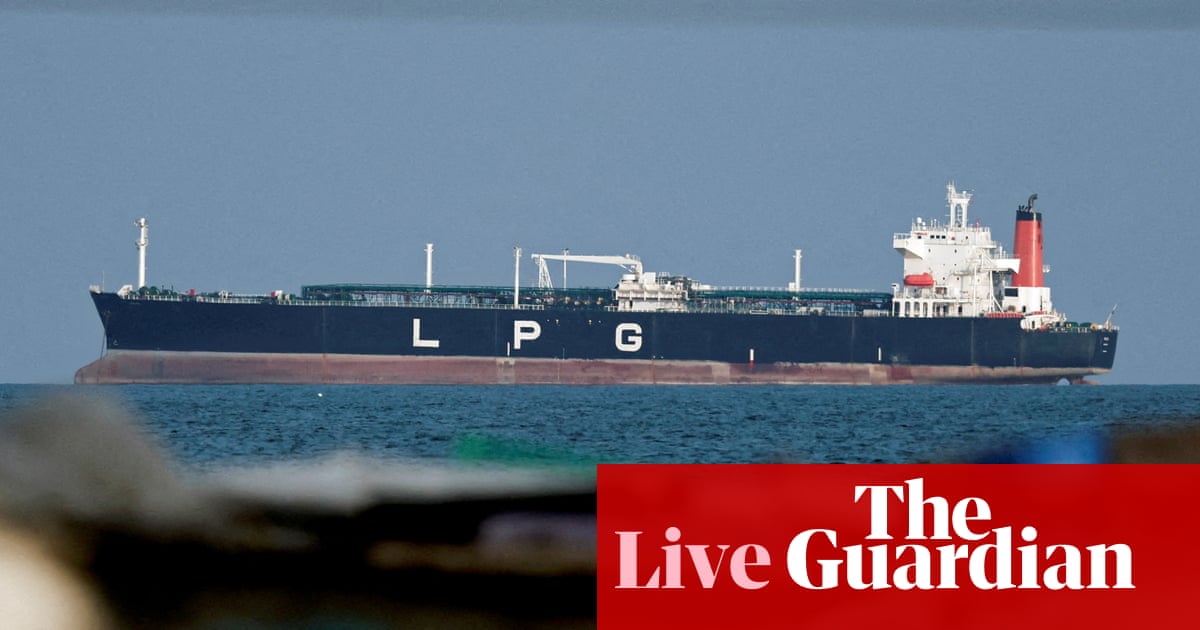
Here’s a snapshot of the latest key developments in the US-Israel war on Iran to bring you up to speed.
-
The Israeli army said on Monday it had begun what it described as “limited ground operations” against Hezbollah in southern Lebanon. It said that before the troops’ entry into the area, it conducted air force and artillery strikes against “numerous terrorist targets in order to mitigate threats”.
-
Donald Trump warned that Nato faced a “very bad” future if US allies failed to assist in opening up the strait of Hormuz, the Financial Times reported. Trump has urged a string of countries to send warships to the region but the response has been muted. Japan and Australia have declined to send ships.
-
Flights are “gradually” resuming at Dubai international airport, according to its operator, after a “drone-related incident” earlier sparked a fuel tank fire nearby. No injuries were reported, the city’s media office said.
-
The US has started moving more than 2,000 marines from the Japanese island of Okinawa to the Middle East, according to news reports.
-
Japan said it was beginning the release of its strategic oil reserves after the International Energy Agency indicated earlier that the release would begin in Asia and Oceania before other regions.
-
Oil prices climbed again amid mounting supply fears, with brent crude – the international benchmark – rosing 1.8% to $104.98 a barrel during early trading on Monday.
-
British prime minister Keir Starmer discussed with Trump the need to reopen the strait of Hormuz, a Downing Street spokeswoman said on Sunday. Starmer also spoke with Canadian prime minister Mark Carney about the impact of the strait’s continued closure on international shipping.
-
Italy’s military said there had been a drone attack on the Ali Al Salem airbase in Kuwait hosting Italian and US forces, but that all its personnel were safe.
-
A rocket attack on Baghdad international airport in Iraq wounded five people, Iraqi authorities said. The airport houses a US diplomatic facility.
A spokesperson for China’s foreign ministry, Lin Jian, was asked a question this morning about Donald Trump suggesting he may delay his heavily anticipated trip to China later this month if Beijing does not help to secure the strait of Hormuz.
“Head-of-state diplomacy plays an irreplaceable, strategic guiding role in China-US relations,” Jian was quoted as having replied.
According to the BBC, the spokesperson said Beijing and Washington had “maintained communication” regarding Trump’s visit, which had been scheduled for 31 March to 2 April.
When asked about Trump’s comments calling for countries, including China, the UK and France, to send warships to help keep the strait of Hormuz open, Jian said the recent tensions have disrupted trade routes and undermined peace.
“China reiterates its call for all parties to immediately cease military operations,” he said, adding that Beijing was “committed to promoting de-escalation”.
Germany’s foreign minister, Johann Wadephul, has said Berlin does not see a role for Nato in addressing the effective closure of the strait of Hormuz, after Donald Trump said in an interview in the FT that it would be “very bad for the future” of the alliance if allies do not help secure the shipping lane.
Speaking in Brussels ahead of a meeting of the EU foreign affairs council, Wadephul said:
I don’t see that Nato has made any decision in this direction or could assume responsibility for the strait of Hormuz.
If that were the case, then the Nato bodies would address it accordingly.
Bahrain’s defence ministry said air defence systems have responded to attacks this morning. The ministry said four missiles and three drones were fired.
Meanwhile, monitoring organisation Netblocks said the internet blackout in Iran has entered its 17th day.
“Over the last day a decline has been tracked in reserved telecoms network infrastructure, further reducing VPN availability and sending some whitelisted users and NIN services offline,” Netblocks said.
Those without access to Starlink or alternative ways to communicate – which are often expensive – are cut off, not only from the outside world but the blackout also severely curtails Iranian’s ability to communicate with each other, making mobilisation, for example, much more difficult.
According to the Hareetz newspaper, Israel is considering a French proposal in which Lebanon would formally recognise Israel in exchange for guarantees that there would be no more Israeli airstrikes and that Israeli troops would pull back from five locations in the country’s south that provide vantage points or are situated across from communities in northern Israel. Israel has maintained troops in the five areas of southern Lebanon in violation of the November 2024 ceasefire agreement.
A source told Hareetz that the Israeli prime minister, Benjamin Netanyahu, is undecided on the French proposal. It reports that officials in Washington expect America’s “patience” for the war in Lebanon to be exhausted once the “main” war on Iran is over.
This means there is a narrow window of opportunity for negotiation with Lebanon, whose government would likely pay a heavy diplomatic price for officially recognising Israel, Hareetz reports. Axios reports that under the French proposal, Israel and Lebanon would begin US and French backed negotiations on a “political declaration” to be agreed within one month.
Israel’s latest war on Lebanon was triggered on 2 March, after Hezbollah fired rockets into northern Israel following joint US-Israeli attacks on Iran, which killed the country’s supreme leader.
The Lebanese health ministry said yesterday that 850 people, including many children, have been killed in Israeli attacks since 2 March.
A fire broke out on Monday after a drone attack on an industrial oil facility in the UAE’s Fujairah, officials have said.
The Media Office in Fujairah said a drone targeted the Fujairah Oil Industry Zone, causing an “advanced” fire. The civil defence teams are trying to control the fire, which did not result in any immediate casualties.
The Fujairah Oil Industry Zone hosts the Middle East’s largest commercial storage capacity for refined products.
It also serves as a vital global hub for trading and bunkering located outside the strait of Hormuz, one of the world’s most important shipping channels, which is now effectively closed.
Bloomberg reported yesterday that oil-loading operations at Fujairah had restarted after it was targeted by a drone strike on Saturday.
In a post on X, the Abu Dhabi Media office said a Palestinian civilian was killed in Abu Dhabi after an incident involving a missile falling on a civilian vehicle in the al Bahyah area of the UAE capital.
“The public is advised to obtain information only from official sources and to avoid spreading rumours or unverified information”,” it added.
The UAE is among the Gulf countries whose air defences have been regularly intercepting ballistic missiles and drones from Iran. The country’s Ministry of Defence said this morning that they were responding to missile attacks from Iran, with their fighter jets intercepting drones and “loitering munitions”.
Donald Trump is suggesting he may delay his much-anticipated visit to China at the end of the month as he seeks to ramp up the pressure on Beijing to help reopen the strait of Hormuz and calm oil prices that have soared during the Iran war.
In his interview on Sunday with the Financial Times, Trump said China’s reliance on oil from the Middle East means it ought to help with a new coalition he is trying to put together to get oil tanker traffic moving through the strait. Trump said “we’d like to know” before the trip whether Beijing will help. “We may delay,” Trump said in the interview.
As Associated Press reports, the uncertainty underscores just how much the US-Israeli strikes on Iran have reshaped global politics in the past two weeks. Calling off the face-to-face visit with Chinese President Xi Jinping could have its own major economic consequences: Relations between Washington and Beijing have been fraught as both sides have threatened the other with steep tariffs over the past year.
The White House did not immediately respond to requests for comment.
Donald Trump’s comments about the risk to Nato if allies do not contribute to the military effort to secure the Strait of Hormuz have been played down by a UK cabinet minister.
The UK appears unlikely to agree to the US president’s call for allies to contribute warships to a mission to protect shipping passing through the waterway from Iranian attacks. However, ministers are drawing up plans to send minesweeping drones to the area.
Work and pensions secretary Pat McFadden told Times Radio: “There’s a lot of rhetoric, always, in this presidency.
“Underneath that, there is a good and close relationship between the United Kingdom and the United States. I’m confident that will continue. We speak to one another all the time.
“But that doesn’t mean that we will always have to support every intervention and every action that the United States chooses to take.”
EU member states will discuss what can be done from the European side to keep the Strait of Hormuz open, the EU’s foreign policy chief Kaja Kallas said on Monday.
“It is in our interest to keep the Strait of Hormuz open and that’s why we are also discussing what we can do in this regard from the European side,” she said, speaking to journalists ahead of a EU foreign affairs meeting in Brussels.
Here’s a snapshot of the latest key developments in the US-Israel war on Iran to bring you up to speed.
-
The Israeli army said on Monday it had begun what it described as “limited ground operations” against Hezbollah in southern Lebanon. It said that before the troops’ entry into the area, it conducted air force and artillery strikes against “numerous terrorist targets in order to mitigate threats”.
-
Donald Trump warned that Nato faced a “very bad” future if US allies failed to assist in opening up the strait of Hormuz, the Financial Times reported. Trump has urged a string of countries to send warships to the region but the response has been muted. Japan and Australia have declined to send ships.
-
Flights are “gradually” resuming at Dubai international airport, according to its operator, after a “drone-related incident” earlier sparked a fuel tank fire nearby. No injuries were reported, the city’s media office said.
-
The US has started moving more than 2,000 marines from the Japanese island of Okinawa to the Middle East, according to news reports.
-
Japan said it was beginning the release of its strategic oil reserves after the International Energy Agency indicated earlier that the release would begin in Asia and Oceania before other regions.
-
Oil prices climbed again amid mounting supply fears, with brent crude – the international benchmark – rosing 1.8% to $104.98 a barrel during early trading on Monday.
-
British prime minister Keir Starmer discussed with Trump the need to reopen the strait of Hormuz, a Downing Street spokeswoman said on Sunday. Starmer also spoke with Canadian prime minister Mark Carney about the impact of the strait’s continued closure on international shipping.
-
Italy’s military said there had been a drone attack on the Ali Al Salem airbase in Kuwait hosting Italian and US forces, but that all its personnel were safe.
-
A rocket attack on Baghdad international airport in Iraq wounded five people, Iraqi authorities said. The airport houses a US diplomatic facility.
Flights are resuming at Dubai International Airport, according to its operator, after a “drone-related incident” sparked a fuel tank fire nearby earlier.
The airport announced on X: “Flights to and from DXB are gradually resuming to selected destinations, following the temporary suspension implemented as a precautionary measure.”
It advised passengers to check with their respective airlines for updates on specific flights.
Dubai International Airport is usually the world’s busiest airport for international flights. It has faced heavy disruption since the start of the US-Israel war on Iran.
The Israeli army said on Monday it had begun what it described as “limited ground operations” against Hezbollah in southern Lebanon.
The military said in a statement quoted by AFP:
In recent days, IDF troops from the 91st division have begun limited and targeted ground operations against key Hezbollah strongholds in southern Lebanon, aimed at enhancing the forward defence area.
This activity is part of broader defensive efforts to establish and strengthen a forward defensive posture, which includes the dismantling of terrorist infrastructure and the elimination of terrorists operating in the area, in order to remove threats and create an additional layer of security for residents of northern Israel.
The Israeli military said that before the troops’ entry into the area, the Israel Defence Forces conducted air force and artillery strikes against “numerous terrorist targets in order to mitigate threats in the operational environment”.
Three foreign residents who were in a building in Dubai struck by a drone were taken into custody after sending photographs or messages to family members confirming they were safe, according to a campaign organisation.
The Detained in Dubai group said the residents were at home when a drone hit and caused an explosion, and immediately after they photographed the damage and sent the image privately to family to reassure them that they had survived.
The organisation, which provides legal assistance to people in the United Arab Emirates, claimed in a statement:
Instead of receiving support as victims of the incident, the residents were detained by Dubai police after authorities requested to see their phones.
The chief executive of Detained in Dubai, Radha Stirling, said authorities should take a measured and compassionate approach towards residents who were reacting instinctively during a traumatic moment.
The group’s claims and the arrests could not immediately be independently verified.
Peter Beaumont reported last week that a 60-year-old British man – understood to be a tourist – was among 20 people who had been charged in the UAE under cybercrime laws in connection with filming and posting material related to Iranian attacks on the country.
As mentioned earlier, Dubai authorities temporarily suspended flights at the city’s international airport on Monday after a “drone incident” caused a fire in the vicinity, with no injuries reported.
Here are some of the latest images coming in from the widening war in the Middle East.
Air defences in the United Arab Emirates are responding to missile and drone attacks from Iran, the ministry of defence has said.
“… The sounds heard in scattered areas of the country are the result of the air defense systems intercepting ballistic missiles, as well as fighter jets intercepting drones and loitering munitions,” the ministry said in a post on X.
Pictures have come in after Dubai authorities announced a temporary suspension of flights at the city’s international airport after a fire in the area.
A “drone-related incident” incident impacted a fuel tank, the media office in the Gulf financial hub said on Monday. It later added that authorities had extinguished the blaze that broke out.
The office also said no injuries had been reported.
Disclaimer : This story is auto aggregated by a computer programme and has not been created or edited by DOWNTHENEWS. Publisher: theguardian.com