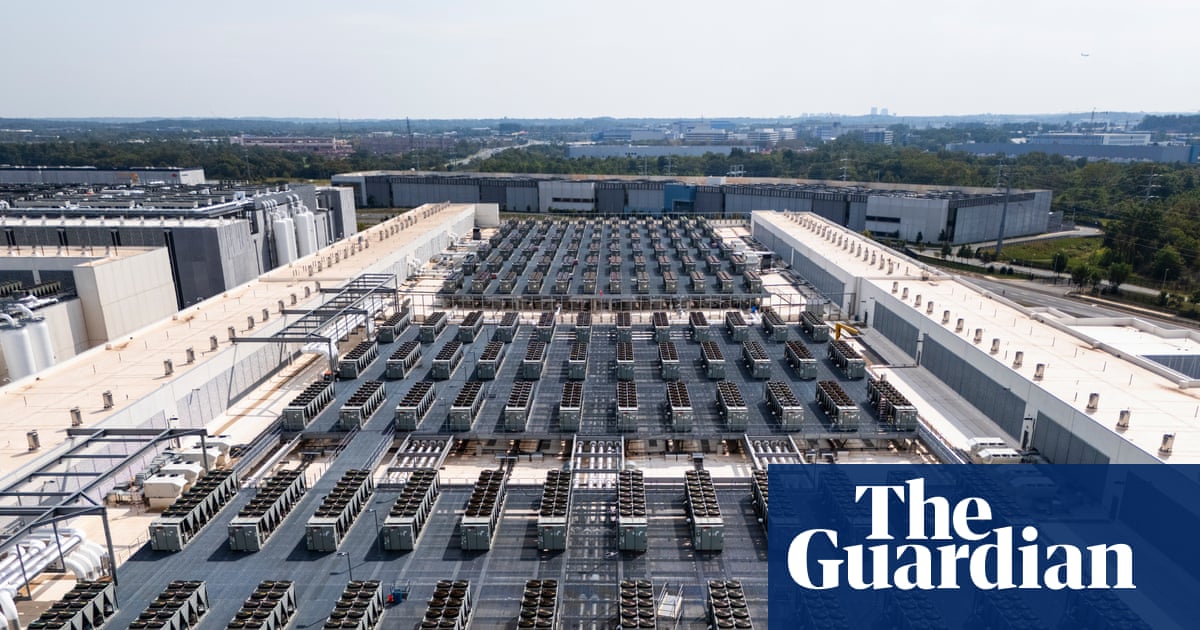
A coalition of more than 230 environmental groups has demanded a national moratorium on new data centers in the US, the latest salvo in a growing backlash to a booming artificial intelligence industry that has been blamed for escalating electricity bills and worsening the climate crisis.
The green groups, including Greenpeace, Friends of the Earth, Food & Water Watch and dozens of local organizations, have urged members of Congress halt the proliferation of energy-hungry data centers, accusing them of causing planet-heating emissions, sucking up vast amounts of water and for exacerbating electricity bill increases that have hit Americans this year.
“The rapid, largely unregulated rise of data centers to fuel the AI and crypto frenzy is disrupting communities across the country and threatening Americans’ economic, environmental, climate and water security,” the letter states, adding that approval of new data centers should be paused until new regulations are put in place.
The push comes amid a growing revolt against moves by companies such as Meta, Google and Open AI to plow hundreds of billions of dollars into new data centers, primarily to meet the huge computing demands of AI. At least 16 data center projects, worth a combined $64bn, have been blocked or delayed due to local opposition to rising electricity costs. The facilities’ need for huge amounts of water to cool down equipment has also proved controversial, particularly in drier areas where supplies are scarce.
These seemingly parochial concerns have now multiplied to become a potent political force, helping propel Democrats to a series of emphatic recent electoral successes in governor elections in Virginia and New Jersey as well as a stunning upset win in a special public service commission poll in Georgia, with candidates campaigning on lowering power bill costs and curbing data centers.
This threatens to be a major headache for Donald Trump, who has aggressively pushed the growth of AI but also called himself the “affordability president” and vowed to cut energy costs in half in his first year.
However, household electricity prices have increased by 13% so far under Trump and the president recently lashed out in the wake of the election losses, calling affordability a “fake narrative” and a “con job” created by Democrats. “They just say the word,” Trump said last week. “It doesn’t mean anything to anybody. They just say it – affordability.”
Yet about 80 million Americans are currently struggling to pay their bills for electricity and gas, with many voters regardless of political party blaming data centers for this, according to Charles Hua, founder and executive director of PowerLines, a nonpartisan organization that aims to reduce power bills.
“We saw rising utility bills become a core concern in the New Jersey, Georgia and Virginia elections which shows us there is a new politics in America – we are entering a new era that is all about electricity prices,” Hua said.
“Nobody in America wants to pay more for electricity and we saw in Georgia a meaningful chunk of conservative voters vote against the Republican incumbents, which was staggering.”
Hua said the causes of the electricity cost rises are nuanced, with aging transmission lines and damage caused by extreme weather also adding to utilities’ costs on top of the surging demand for power.
But it is the growth of data centers to service AI – with electricity consumption set to nearly triple over the next decade, equivalent to powering 190m new homes – that is the focus of ire for voters as well as an unlikely sweep of politicians ranging from Bernie Sanders on the left to Marjorie Taylor Greene on the far right.
More broadly, almost half of Americans say the cost of living in the US, including power, food and other essentials, is the worst they can ever remember it being.
This focus on affordability has provided a new line of attack for an environmental movement that has struggled to counter Trump’s onslaught upon rules that reduce air and water pollution. The president has called the climate crisis a “hoax” and clean energy a “scam” and has slashed support for and even blocked new wind and solar projects, even though renewables are often the cheapest and fastest options for new power generation.
At the current rate of growth, data centers could add up to 44m tons of carbon dioxide to the atmosphere by 2030, equivalent to putting an extra 10m cars onto the road and exacerbating a climate crisis that is already spurring extreme weather disasters and ripping apart the fabric of the American insurance market.
But it is the impact upon power bills, rather than the climate crisis, that is causing anguish for most voters, acknowledged Emily Wurth, managing director of organizing at Food & Water Watch, one of the groups behind the letter to lawmakers.
“I’ve been amazed by the groundswell of grassroots, bipartisan opposition to this, in all types of communities across the US,” she said. “Everyone is affected by this, the opposition has been across the political spectrum. A lot of people don’t see the benefits coming from AI and feel they will be paying for it with their energy bills and water.
“It’s an important talking point,” Wurth said of the affordability concerns. “We’ve seen outrageous utility price rises across the country and we are going to lean into this. Prices are going up across the board and this is something Americans really do care about.”
Disclaimer : This story is auto aggregated by a computer programme and has not been created or edited by DOWNTHENEWS. Publisher: theguardian.com