

Key posts
What’s new in cinemas this week
Hello and welcome to this week’s film review wrap – the big movies landing in cinemas this week.
If you want to stay in touch with all the latest movie news from across the globe, as well as reviews, please sure to sign up to our newsletter.
Must-see movies, interviews and all the latest from the world of film delivered to your inbox. Sign up for our Screening Room newsletter.
Bloody remake of cult horror a worthy addition to the canon
By Sandra Hall
Silent Night Deadly Night ★★★½
(MA15+) 97 minutes
Look up homicidal Santa movies online and you’ll find that there are so many of them that they’ve been designated the “Evil Santa Canon”.
High on the list of fan favourites is the original version of Silent Night, Deadly Night, which was unlucky enough to be released in the same week in 1984 as Wes Craven’s Nightmare on Elm Street.
Nonetheless, it managed to become much more notorious since its advertising, which featured Father Christmas wielding an axe, was found to be so offensive that the film was pulled from cinemas after just one week. In the horror business, you can’t do better than that, and it went on to acquire a cult following as well as spawning a series of sequels and “re-imaginings”.
The latest re-boot is written and directed by Mike P. Nelson, a specialist in the genre, with the backing of Bloody Disgusting, a production company whose title speaks for itself. Nelson remembers spotting the Silent Night, Deadly Night poster in a video store when he was five and while it was years before he was able to see the film itself, it seems that it remained a cherished memory.
Even so, he didn’t want to make a copy of the original. The essentials are here. Once again we’re treated to a tale of perverted innocence focusing on Billy Chapman (Rohan Campbell), a young man whose career as a killer in a Santa suit is sparked by his tragic childhood, and he still falls for Pam (Ruby Modine) after he gets a job in the stockroom of her father’s store where she sells Christmas decorations. Grappling with a few management issues of her own, she somehow recognises him as a soulmate, although she’s yet to know what she’s in for.
The first film spent a lot of time on the death of young Billy’s parents and his subsequent stay in a Catholic orphanage run by a sadistic Mother Superior. This version spares us the orphanage in favour of a brief but potent flashback to Billy’s years with a homicidal foster mother who becomes his initial victim.
It’s the first of a series of satirical flourishes which make the blood-drenched murder montages a little easier to stomach. Nelson’s most inspired set-piece takes place at an “I’m Dreaming of a White Power Christmas” party decorated with golden swastikas draped in Christmas lights. Billy puts on his Santa suit, takes up his axe and manages to dispatch the whole guest list despite the efforts of the hostess, who’s kitted out in a customised SS outfit accessorised with a semi-automatic machine gun.
Billy is also in continual dialogue a voice in his head. Named Charlie, this voice has an instinct as to who’s evil and who’s not and I suppose Billy’s attempts to follow its advice could tempt you to hail a moral crusader – if it weren’t for his unnerving fondness for overkill.
All up, the film is a memorable addition to the canon but its extreme enthusiasm for bloodletting and its grisly aftermath mark it as being strictly for the converted
Silent Night, Deadly Night is in cinemas Thursday
Video-game vibe as runaway express heads for trouble
By Jake Wilson
Pets on a Train
★★
(PG) 87 minutes
Even by the standards of CGI family entertainment, there’s a piecemeal quality to Pets on a Train, which was made in France but aims to keep its origins under wraps, at least in the version released in Australia, an English-language dub with a mostly Canadian voice cast.
Pets on a Train: Trapped on a runaway express.Credit: NIXCO
The story starts out shortly before Christmas in a city on the US west coast, judging from the palm trees, the Spanish mission architecture and the gags at the expense of showbiz stereotypes, though the cityscapes are done in a quasi-realistic style that evokes a European cartooning tradition – Tintin rather than Disney or Dr Seuss.
More in the Hollywood mould is the wide-eyed yet slippery hero Maurice (voiced by Wyatt Bowen), a daredevil raccoon who prefers to be known as the Falcon and fancies himself as a master criminal, though his typical exploits don’t go far beyond swiping hot dogs from street carts.
Lured into taking part in a more elaborate heist, he’s double-crossed by a malignant badger (Chimwemwe Miller) and finds himself trapped on a runaway train hurtling towards all-but-certain destruction.
While there are no human passengers on board, a number of animals are locked in cages in the luggage compartment, among them a suspicious police dog (Tristan D. Lalla), a snobbish greyhound (Terrence Scammell), and quite a few others (too many, in fact, for any of them to emerge as characters we can fully invest in). Can our hero set them free, win their trust and lead them to safety?
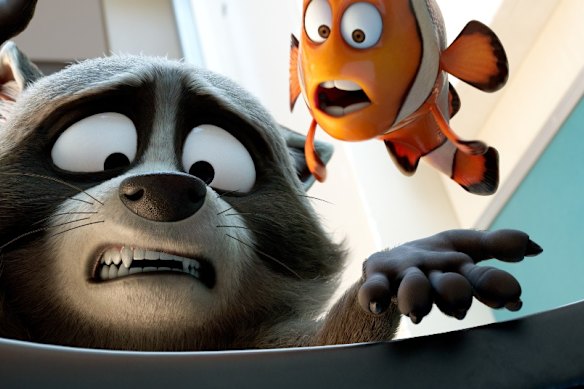
The characters face a series of puzzles in Pets on a Train.Credit: © TAT productions, Apollo Films Distribution, France 3 Cinéma, Kinologic
At this point in the story, the view out the window looks a lot like the Mojave Desert, which geographically is logical enough. Then without much warning we find ourselves in a different landscape altogether, the train winding round grey, misty mountains as if we’d progressed from one level to the next in a video game.
Indeed, a video game is what Pets on a Train mostly resembles – treating a whimsically arbitrary, blatantly derivative plot line as the basis for a series of logic puzzles, which the characters must band together to solve before time runs out.
For co-directors Benoit Daffis and Jean-Christian Tassy, the biggest puzzle would have been how to make the most of limited resources. But like calculating directors of B-movies everywhere, they find ways to use music, sound and abrupt editing to make it feel as if we’re getting more spectacle than we really do.
They also deliver one moment of genuine surrealism, although you could almost blink and miss it. A minute or so into the opening credits, the train is zooming towards the station in the middle of the city when for no apparent reason it topples over, landing on its side in an empty park.
The next bit is straight out of Monty Python, or else The Lego Movie. A giant hand reaches into the shot and picks up the train, presumably to replace it on the track – at which point we cut away, and the story continues as if none of this had occurred.
Some questions do linger, though. If the whole movie that follows takes place on an impossibly elaborate model train set, who’s really at the controls? God? Santa, who shows up at almost the same moment as a mascot for a nearby store? A fortunate child who got their presents early?
As with everything in Pets on a Train, it’s best not to overthink this, especially as Daffis and Tassy don’t break the fourth wall anywhere near as blatantly elsewhere. But even at under 90 minutes, the film drags on long enough that I did start to wonder if a second Christmas miracle might save some time.
Pets on a Train is in cinemas Thursday
Friendship, rivalry and an ancient art form collide in this Oscar hopeful
By Jake Wilson
FILM
Kokuho ★★★½
(M) 175 minutes
The conventions of kabuki theatre may be culturally specific, but the allure of male bonding transcends all borders. That’s the biggest takeaway from Kokuho – Japan’s official entry in the Best International Feature category at next year’s Oscars, and a sumptuous spectacle that is far less ponderous than the nearly three-hour running time might suggest.
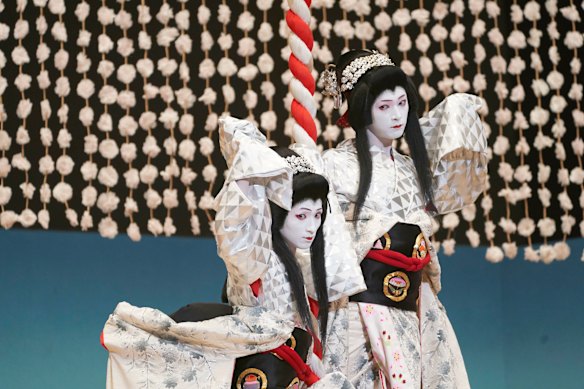
Ryusei Yokohama and Ryo Yoshizawa star as friends and rivalsCredit: Palace Films
Spanning close to half a century, the action starts out in the 1960s, when the adolescent heroes embark on the rigorous training required to become onnagata, the actors who take on the star female roles in this traditionally all-male form.
Family background is destiny for both, in different ways. The soft-faced but ambitious Kikuo (Ryo Yoshizawa) is the son of a yakuza whose death he failed to avenge, which may be one reason he devotes himself body and soul to this new vocation. Shunsuke (Ryusei Yokohama), the son of the company’s lead actor (Ken Watanabe), is more of a potential rebel, with doubts about his talent and even about whether kabuki is where he belongs.
From the outset, they’re set up as rivals, which they are – but they also resemble brothers, or even twins. One early scene has Shunsuke giving Kikuo a lift home from school on his bike, the pair of them riding along together under the cherry blossoms in their royal-blue uniforms (at this point, they’re played by a younger pair of actors, Soya Kurokawa and Keitatsu Koshiyama).
On stage, they start out similarly twinned, in matching robes and makeup as wisteria spirits or temple maidens fated to transform themselves into snakes. As with the members of a boy band, their closeness is part of their glamour, though they’ll part and reunite more than once over the decades to come.

Ryo Yoshizawa in a scene from Kokuho.Credit: Palace Films
The director Lee Sang-il plays a very straight bat with this material, leaving it to the viewer to supply the subtext. There’s an implied relationship between the tragic nature of kabuki and what we see happening behind the scenes, but the connections are broad rather than specific as far as I can judge (admittedly, without the additional captions supplied along with the English-language subtitles, it would be hard for an outsider to guess what the plays are about).
What the film might be saying about gender identity is also left up to the viewer. For both Kikuo and Shunsuke, transforming into a kabuki heroine is a lifelong effort that takes everything they’ve got. But this is a matter of professional skill, and seemingly says nothing about who they are out of character – as everyone around them understands, including the women in their lives.
Still, there is a single, painful scene where Kikuo crosses paths with a group of oafs who fail to get the point. And while the bond between these two guys never goes beyond friendship, it only gets more charged over the years – most visibly in a backstage scene where Shunsuke helps Kikuo with his makeup, while Kikuo, envying Shunsuke’s ancestral connection to the art form, says, “I wish I could drink a cup of your blood”.
Kokuho is in cinemas Thursday
James L. Brooks returns to film – maybe he should have stuck with The Simpsons
By Sandra Hall
Ella McCay ★★★
(M) 115 minutes
Ella McCay is writer-director James L. Brooks’ first film in 13 years and it has brought him back to his beginnings as a master of the workplace comedy.
It all started in 1970 when he moved the American TV sitcom out of the home and into the office with The Mary Tyler Moore Show, following it up with Lou Grant, a spinoff set in a newspaper newsroom. In 1987, he further honed his technique on the big screen with Broadcast News. Then he changed tack and by 1990, most of his energy was going into The Simpsons, which he launched with Matt Groening.
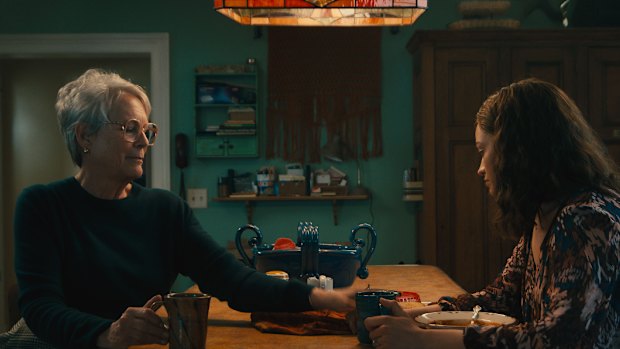
Kitchen table drama: Jamie Lee Curtis and Emma Mackey.
Ella McCay has a political setting, but Brooks has bypassed contemporary Washington to look back to 2008. Ella (Emma Mackey) has just become a state governor because her boss and mentor, affectionately known as Governor Bill (Albert Brooks), has been promoted to Obama’s cabinet. But it doesn’t take long for us to realise the goings-on in the governor’s office will be upstaged by Brooks’ other longstanding preoccupation – family discord.
Ella’s childhood has been blighted by her father’s womanising. Played by an ever-grinning Woody Harrelson trying hard to convince us of his larrikin appeal, Eddie McCay has now resurfaced in Ella’s life, pleading for her forgiveness because his latest conquest has threatened to break up with him if he can’t make peace with his children.
Ella’s younger brother Casey (Spike Fearn) is even less inclined to say yes to this proposal than she is. He’s afflicted with chronic anxiety after breaking up with his own girlfriend and can barely get a word out without an elaborately choreographed array of twitches and a lot of mumbling.
Ella’s Aunt Helen (Jamie Lee Curtis at her most forthright, which is saying something), is the only one Ella can rely on. Her husband Ryan (Slow Horses′ Jack Lowden) ought to fill that role but he’s a little too enthusiastic about the perks that go with the job of governor to think about her feelings.
Brooks has said one of his aims with this film was to pay tribute to the screwball comedies of the 1940s, but nobody in those movies wallowed in their neuroses the way this bunch does. The essence of screwball lay in the nonchalance with which the actors carried off the jokes. Here, the humour is supposed to lie in the cast’s exaggerated responses to the slightest setbacks. But to make that work you need inspired dialogue, which the script fails to supply.
The only character in touch with reality is Ella. Mackey, who got her breakthrough as the admirably self-sufficient Maeve Wiley in the British TV series Sex Education, makes Ella into a rational and articulate human being whose only fault lies in her over-earnest approach to wanting to do the right thing.
There are needless digressions and distractions. The Casey subplot is given too much space and just as the action is accelerating, a minor character with no real connection to the rest of the plot gets to air his grievances as a single father with a lengthy monologue that is neither funny nor poignant.
It’s frustrating. There’s a lot of talent at work and Brooks has a story with plenty of satirical potential in Ella’s adventures as an idealist trying to achieve something within a system that demands skills in compromise and horse-trading. But he never shows much sign of wanting to get to grips with it. Sad to say, he hasn’t regained his form.
In cinemas Thursday
Most Viewed in Culture
Disclaimer : This story is auto aggregated by a computer programme and has not been created or edited by DOWNTHENEWS. Publisher: www.smh.com.au




