
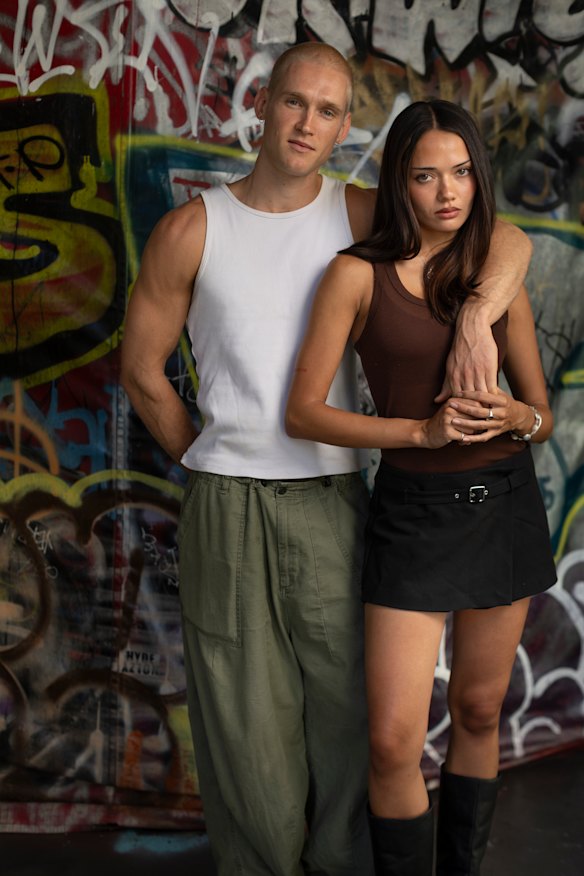

“Melbourne people are much better dressed than Sydney people,” says Natalya Lusty, Melbourne University professor of cultural studies.
There’s not a moment’s hesitation or element of dress diplomacy, from the fashion expert.
Before Sydney’s style set has a chance to draw breath or rebuild their egos with a brisk walk from Bondi to Bronte in the latest athleisure wear from PE Nation, historian Hilary Davidson from New York’s Fashion Institute of Technology weighs in with the knockout blow.
“Melbourne people dress better, more avant-garde, with more attention to detail and form.
“The difference in how people dress is noticeable the second you step into the airport,” Davidson says. “The street style and level of polish in Melbourne was more on par with New York or London – two cities I’m in regularly – by comparison with Sydney.
“People in Melbourne can dress more, and wear more black clothing because the climate is more like London, New York, Milan or Tokyo… Sydney is ostentatiously casual or more Los Angeles glam.”
This timely double-punch is music to the pierced ears of Melbourne Fashion Festival chief executive Caroline Ralphsmith, hoping to capitalise on an inter-city rivalry stretching back to the gold rush era of the 1850s that prevented either city from becoming the capital of Australia in 1901. (No one is claiming Canberra as a style hub.)
“I think there’s a level of creativity and a little bit of daringness that sits in a Melbourne cohort,” Ralphsmith says. “I find that when I go to Sydney, I’m a little bit more out there than many of my Sydney contemporaries. That’s probably because I’m wearing something from a Melbourne designer.”
But Kellie Hush, the fashion director of Sydney-based Australian Fashion Week, defends north-of-Wodonga wardrobes.
“Sydneysiders are Australia’s best dressed,” Hush says. “We are playful with colour, athleisure and we dress up for the night. We are not a desk-to-cocktail culture and show that you can embrace the fun of fashion with serious attention to detail.”
At Monday’s opening night of the Melbourne Fashion Festival’s ticketed runway program, Ralphsmith is leaning into the cities’ differences with a show dedicated to exuberant colour, featuring Sydney designers Camilla, Gary Bigeni, Leo Lin and Romance Was Born, followed by Melbourne Noir, with local designers Blair Archibald, Con Ilio and Strateas Carlucci.
“I think everyone thinks Melbourne’s very black, but let’s do both sides of our personality in one night,” Ralphsmith says. “I’m really hoping that goes off with an absolute bang.”
That bang might help shift the festival’s bottom line into the black, after last year filing a loss of $711,390, with a revenue of $4.57 million down from $5.75 million for the 2024 financial year.
Seats for all the festival shows were still available on Friday, but Ralphsmith is confident that Melbourne’s style set will show up fashionably late at the box office.
“There’s some good momentum behind some of the shows, but overall, we’re looking pretty strong.”
Ralphsmith could have been reaching for the sold-out sign more quickly if the show was called Sydney Noir. Melbourne might be first in the style stakes, but Sydney is racing ahead with its growing appetite for black outfits.
In the past three months, there were 36 per cent more searches for “black dresses” on the website of e-tailer The Iconic in Sydney than in Melbourne.
“This idea that black is still associated with a certain kind of chic, cool Melbourne vibe is very outdated,” Lusty says. “It’s not what I see when I go to fashion events or academic events. Of course, there’s always a number of people in a room, whether in Sydney or Melbourne who are wearing black.
“I still have friends in the art world and academics who wear nothing but black, but most of them are actually in Sydney, not in Melbourne.”
Among younger students, Lusty says that the popularity of vintage and workwear aesthetics reduces chances of a fashion blackout.
“What I love about Generation Z is that they are confident about putting outfits together and don’t need to resort to black, which can be a uniform, or fallback, for conservative types.”
Nadia Bartel, founder of fashion label Henne, whose Prahran store became a destination for tennis WAGs, including Caroline Daur, in Melbourne for the Australian Open, keeps black on the back shelf. Black accounts for only 24 per cent of the brand’s range.
“When we look at the data, women in Sydney are purchasing more black than those in Melbourne,” Bartel says. “The idea of Melbourne being the ‘black uniform’ capital feels more like perception than reality.”
Melbourne dress designer Effie Kats is unwilling to walk away from the dark side completely.
“Black remains part of Melbourne’s fashion DNA, but it’s no longer the whole story.”
Make the most of your health, relationships, fitness and nutrition with our Live Well newsletter. Get it in your inbox every Monday.
From our partners
Disclaimer : This story is auto aggregated by a computer programme and has not been created or edited by DOWNTHENEWS. Publisher: www.smh.com.au


