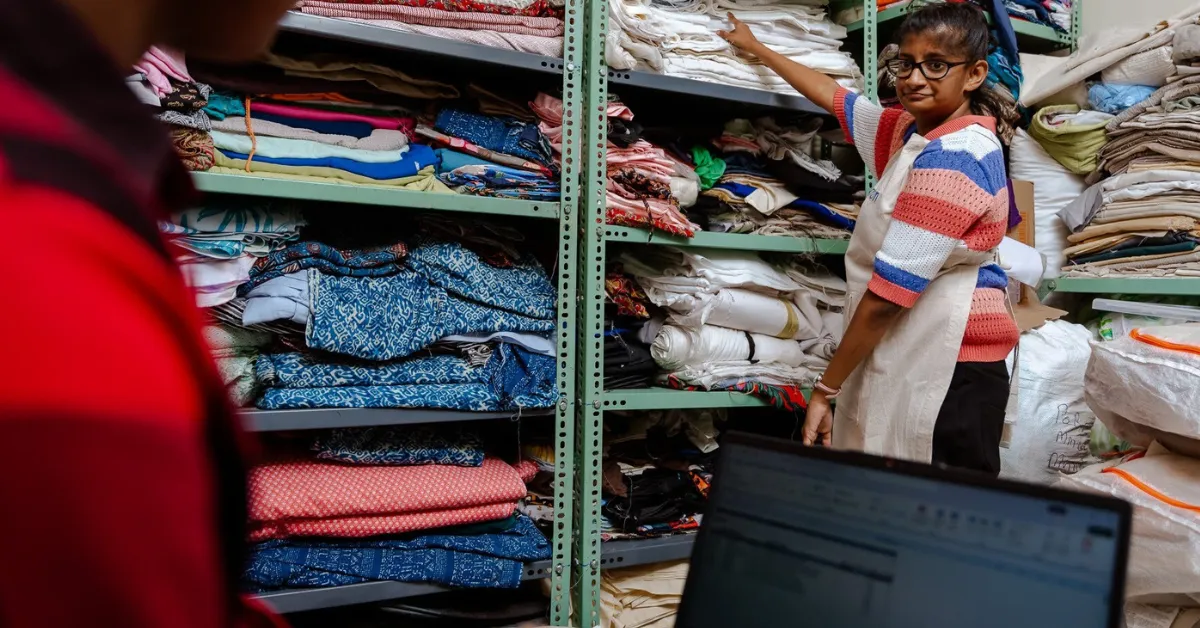
“For the longest time, I wanted the same things everyone else wants — to wake up each morning with purpose, to earn my own money, to be trusted with responsibility, and to be known for my work rather than my diagnosis. I was not asking for sympathy. I was asking for a chance to belong,” says Akanksha Mhatre, a master artisan at Karmann.
When school ended, the silence was louder than ever for many young adults with intellectual and developmental disabilities (IDD). Structure disappeared. So did opportunity. Jobs were scarce, and independence felt distant.
“I wanted to work, to support my mother, to build a future together. But no jobs were waiting for someone like me,” adds Divyank, another artisan at Karmann.
Across India, thousands of adults with IDD face this abrupt transition at 18 — trained in classrooms but left without pathways into dignified work. Families are left navigating a landscape with few answers, and employment, if available at all, is often rooted in charity rather than capability.
In 2011, three special educators — Beverly Louis, Dilshad Mehershahi and Geetanjali Gaur — decided to challenge that reality.
What began as Mann, a transition space for young adults with disabilities in Mumbai, has since grown into Karmann, a sustainable manufacturing brand that directly employs people with disabilities, upcycles textile waste, and has generated over two crore rupees in revenue while creating dignified livelihoods for 50 artisans.
A question that refused to be ignored
The three women met in their early twenties while training as special educators, at a time when their own futures felt expansive and full of possibility. Teaching young adults the same age made the contrast impossible to ignore.
“We were beginning our adult lives,” Beverly recalls. “We were meant to have careers, independence, the power to choose — but our students were being trained for lives that held far fewer possibilities.”
The question that stayed with them was simple yet uncomfortable: why should disability determine how limited or expansive someone’s life could be?
In 2010, that question became action. With limited financial backing, almost no business training, and deep conviction, they formed Mann, which officially began operations in January 2011 in Mumbai. It was conceived as a transition ecosystem for young adults with disabilities who had completed school and were otherwise left without direction, opportunity or community.
“In the beginning, Mann did not prioritise providing jobs. It was about learning how to live well as an adult — making friends, building routines, developing independence, and feeling like you had a place in the world,” Geetanjali tells The Better India.
But employment soon revealed itself as the missing piece.
When work becomes identity
Operating with minimal resources, Mann initially relied on volunteers and peer learning. Over time, some graduates began assisting teachers in classrooms, helping newer students manage routines and skills.
“They were exceptionally capable,” Beverly says. “And more importantly, we saw how being employed changed how they saw themselves.”
Their confidence grew. Families began to relate to their children differently, recognising responsibility and capability where dependence had once been assumed. Respect followed.
“That is when it became obvious to us that employment is not just about income. It is about dignity and identity,” she explains.
/filters:format(webp)/english-betterindia/media/media_files/2026/03/05/disabled-artisans-karmann-mumbai-2026-03-05-19-50-59.png)
Employability was gradually integrated into Mann’s approach. Students were trained for roles across hospitality, retail, manufacturing, food and beverage, corporate offices and marketplaces. Over time, it evolved into a large-scale training organisation, now working with 50 to 60 paid trainers and supporting the transition of over 1,200 people with disabilities every year.
Yet, a gap remained.
The exclusion no one wanted to confront
For individuals with higher support needs, mainstream employment often proved unsustainable. Despite training and motivation, workplaces were rarely equipped to provide consistent accommodation.
“We could see people slipping through the cracks. The problem was not that they could not work; the system did not know how to include them,” Geetanjali explains.
The vulnerability became stark amid the COVID-19 pandemic. As industries shut down, many Mann graduates lost their jobs overnight, undoing years of stability.
In October 2020, a decisive conversation took place with Sudhir Shenoy, a long-time supporter of Mann and an investor and mentor. He challenged the founders to rethink their dependence on external employers.
“He asked us why we were not building something of our own — something that could employ people with disabilities directly, while also creating a business that could stand on its own,” she recalls.
That question led to Karmann.
From disruption to direction
The pilot phase for Karmann began in October 2020, in the midst of lockdowns and uncertainty. By February 2021, the founders had developed a clearer plan, and operations began in earnest. The brand officially launched in 2022.
Karmann was envisioned as a sustainable manufacturing brand that would directly employ people with disabilities — particularly those with higher support needs — while creating useful, everyday products made entirely from textile waste. The aim was not decorative craft, but well-designed, high-utility items people would buy because they were practical and durable.
/filters:format(webp)/english-betterindia/media/media_files/2026/03/05/disabled-artisans-karmann-mumbai-2026-03-05-19-53-15.png)
“We wanted to work with waste in a way that felt meaningful. Not just reducing landfill, but turning discarded fabric into things people actually use,” Beverly says.
The organisation sources textile waste from mills, brands, corporates, family networks and well-wishers — including surplus denim, end-of-range fabric and discarded stock that would otherwise have no second life. While Mann had been working with waste materials since 2011, Karmann made upcycling the foundation of its product identity. Every bag, garment or accessory begins as something overlooked.
The relationship between the two entities is clear: Mann trains, and Karmann employs.
The team at Mann leads role-based training and on-site preparation, ensuring students understand the full production process. Once graduates are employment-ready, Karmann becomes their employer.
“That continuity allows people to grow with confidence,” she adds.
Learning the language of scale
The first year of the startup was marked by experimentation and refinement. The team began with sustainable corporate gifts and utility products — fabric organisers, bags and everyday accessories — designed for repeated use rather than novelty value.
Early orders came from donors and well-wishers who believed in the vision. In its first year, the company generated around Rs 40 lakhs in revenue.
“We spent a lot of time refining what we made,” Geetanjali says. “Understanding which products worked, which did not, and how waste could be transformed without compromising quality.”
/filters:format(webp)/english-betterindia/media/media_files/2026/03/05/disabled-artisans-karmann-mumbai-2026-03-05-19-55-03.png)
Gradually, the product range expanded to include apparel, accessories, pet products, parental hampers, travel organisers, stationery and customised corporate gifting — all unified by the principle of high-utility products made from reclaimed textiles.
Today, Karmann has generated around Rs 2 crore in revenue and upcycled more than 10,000 kilograms of textile waste since 2021. It employs 50 artisans with disabilities alongside 20 staff members, and operates from its headquarters in Mumbai, with manufacturing units in Maharashtra, Kashmir and Gujarat.
Its clients include Reliance, Tata-Trent, Godrej, Aditya Birla, L&T, and Culver Max.
What work makes possible
For Akanksha, working at Karmann means more than sewing.
“I am involved from start to finish. Knowing that something I made from waste will be used by someone every day gives me pride,” she says. Her income has brought independence, travel and greater confidence.
Shalakha, known for her precise craftsmanship, specialises in detailed work such as kantha embroidery, potlis and organisers.
/filters:format(webp)/english-betterindia/media/media_files/2026/03/05/disabled-artisans-karmann-mumbai-2026-03-05-19-59-54.png)
“I like working with fabric that already has a history,” she says. “There is something special about taking what has been discarded and revamping it into something beautiful and useful.” Her earnings allow her to contribute to her household with assurance.
At his workstation, Divyank works with intense focus, remodelling discarded fabric into sturdy products. “My work supports my mother. And it feels good knowing nothing I make is wasted,” he says.
Mahima, who works on assembly and finishing, values the collective nature of production. “I like being part of the whole process,” she says. “Everyone is making something together.”
Corporates looking to support inclusive employment and social impact can partner with Karmann in several ways.
Karmann offers corporate gifting and bulk catalogue options, where companies can purchase upcycled products made by artisans with intellectual and developmental disabilities, turning procurement into purposeful impact and livelihood support.
Additionally, organisations can explore collaborations by sourcing textile waste or fabric surplus to feed into Karmann’s production process, supporting both sustainability and employment goals.
Holding the centre while growing
Challenges remain — particularly in hiring senior talent and expanding marketing reach while maintaining the integrity of both the products and the workplace.
“Passion does not scale by itself,” Beverly reflects. “Structure matters.”
Quality remains central.
/filters:format(webp)/english-betterindia/media/media_files/2026/03/05/disabled-artisans-karmann-mumbai-2026-03-05-19-56-50.png)
“Our artisans bring focus and individuality. Each product carries both care and character,” Geetanjali adds.
Karmann aims to expand into new product categories, strengthen sales channels and achieve threefold growth over the next two years, while continuing to employ more people with disabilities and upcycle increasing volumes of textile waste.
“Our understanding of inclusion has not changed,” she says. “It has only intensified.”
Across workshops in Mumbai, Kashmir and Gujarat, people with intellectual and developmental disabilities are not waiting to be included. They are making products, earning livelihoods, and crafting their own futures.
You can support these beautifully crafted, upcycled products by visiting Karmann’s official website and exploring their sustainable offerings.
All pictures courtesy Geetanjali Gaur
Disclaimer : This story is auto aggregated by a computer programme and has not been created or edited by DOWNTHENEWS. Publisher: thebetterindia.com