

Frankie McCamleyLondon
 BBC
BBCA year after disarming a knife attacker in London’s Leicester Square, Abdullah Tanoli reflects on the moment he saved an 11-year-old girl’s life and what compelled him to intervene.
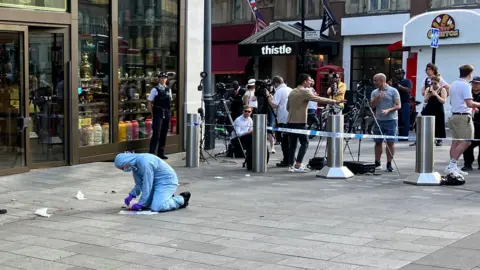
Police sirens were still sounding and the pavement was stained with blood when I first met Abdullah Tanoli in August 2024.
It was only a few hours after he had intervened in a knife attack on a young girl in central London.
Abdullah stood nearby, calm and composed, having just disarmed a man who had stabbed the 11-year-old child multiple times.
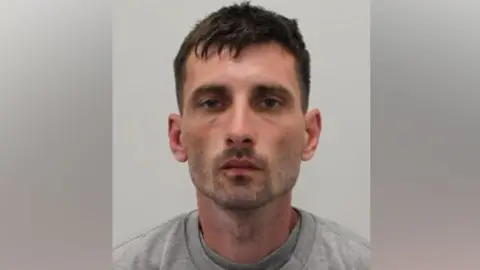
The attacker, 33-year-old Ioan Pintaru, was sentenced on Tuesday to indefinite detention in a high security mental hospital.
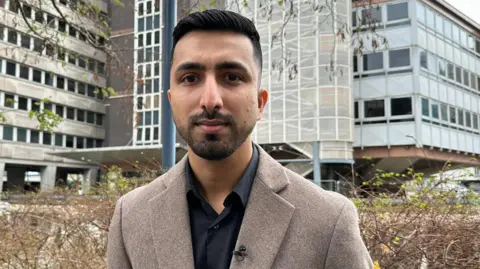
On the week of the sentencing, I met Abdullah again, this time outside his new office in Croydon. He has since left his job as a security guard and been promoted into management, recognised not only by his employers but across the country.
Awards for bravery have followed, as has the label “hero”. He accepts the thanks graciously but never boasts.
“It was just an ordinary day,” he tells me, as shoppers were enjoying the rare sunshine in the capital.
That morning, Abdullah was working as a security guard at a TWG store when, at about 11:30, he heard screams coming from outside.
“Not normal screaming,” he says. “You know when a child is just crying. But when someone is being hurt, that scream is different.”
When he looked out, he saw the 11-year-old girl, who cannot be named for legal reasons, being held in a headlock by a man later identified as Ioan Pintaru. The Romanian national was stabbing her repeatedly, eight times, in the face, neck and shoulder.
Abdullah recounts what he saw plainly, without embellishment.
“I never thought I would see something like that,” he says. “At that moment, the only thing in my mind was to save the child.”

He knew the man had a knife. He knew the danger.
“Yes, I could see it,” he says. “I could have been killed.”
He says he did not think about himself, the fact that he has no close family in the UK to care for him if he was injured, or what the extent of any injuries could be.
“I did not know the child. I did not know her religion, her race. I did not know the attacker,” he says.
“The only thing was humanity. When one human is in danger, you have to save them.”
Abdullah ran towards the attacker without knowing how he would stop him. He had no specialist training for a knife attack.
“I jumped on him,” he says. “I grabbed the hand with the knife, twisted it, and we went to the floor.”
He managed to force the knife free, kick it away and pin the man down.
For about five minutes, which he says felt like a lifetime, Abdullah held him there until police arrived.
Strangers rushed to help the child.
“Most people stayed back,” he says. “And that is understandable. Safety first. But if you know you can save someone, you should.”
The girl and her mother, both Australian nationals visiting London on holiday, were moved inside the shop, away from further danger.
Abdullah only caught brief glimpses of the child as she was treated.
“It was horrible to see,” he says quietly. “I never imagined I would witness something like that.”
Pinatru pleaded guilty to possession of a knife and wounding with intent to do grievous bodily harm. He was sentenced to indefinite detention high-security hospital by an Old Bailey judge.
Abdullah does not criticise the process.
“I respect the law,” he says. “Judges know what they are doing. Whatever the sentence is, I will respect it. Actions have consequences. Justice will be served.”
‘Thank you’
A week after the attack, the child’s mother contacted Abdullah on social media.
“She said, ‘We want to thank you from the bottom of our hearts. We do not want to go to the media. We want to thank you personally’.”
They told him he would always be part of their family.
Abdullah’s voice softens as he says: “I consider her like my younger sister.”
The child has since undergone surgery and made a steady recovery.
“If you see her now,” Abdullah smiles, “she looks normal. I am very relieved.”
They remain in contact, sharing messages and photographs – a bond formed in the worst of circumstances but sustained by gratitude.
Returning to Leicester Square, Abdullah says, feels like coming home, though the memories come with it.
“People know me there,” he says. “But every time I go back, it takes me to that day.”
When people call him a hero, he admits it feels good, not out of ego, but because his actions were acknowledged.
“I chose this country,” he tells me. “I came here as a student. I did my master’s degree. I stayed on a work visa.
“And now the people here, they have supported me. They sent letters, gifts. They invited me to places.
“I am really happy I chose the UK.”
Disclaimer : This story is auto aggregated by a computer programme and has not been created or edited by DOWNTHENEWS. Publisher: BBC







