My suburb has an identity crisis. For a start, is it even a suburb? On our Wikipedia page, it is called an “official bounded locality”, which sounds like bureaucratic waffle. But it’s true that it’s a “locality” because it didn’t grow like most suburbs but was created as a private master-planned estate.
Governed by the City of Frankston, yet burdened with an incongruous Cranbourne postcode, Sandhurst is a unique suburb in Melbourne that confuses both outsiders and residents. In the early 2000s it rose out of the south-east green wedge, transforming the gently undulating grazing land of Skye and Carrum Downs, into landscaped idealism.
Sandhurst sits within Melbourne’s south-eastern sandbelt, hard up against one of the state’s fastest-growing residential corridors and a long way from Victoria’s original Sandhurst, as Bendigo was known until 1891. Half of the 309-hectare residential estate is devoted to open space and golf, including two 18-hole championship courses; the other half includes 2500 residential lots of generous proportions – an increasingly rare luxury.
Sandhurst is unmistakably a golfer’s paradise, not least because the Australian PGA Academy is based here. As someone who prefers books to sport, it was an unlikely relocation from the Mornington Peninsula for us, but the native vegetation and wetlands proved irresistible. As were the enthusiastic invitations from neighbours and residents to join in the golfing fun. And so the lessons began – as an academic with no hand-eye co-ordination, it was tentative at first. But with a clinic of equally determined golf novices we mastered the basics and became a regular group of tenacious tee-mates. The free glass of champagne our coach offered clinic participants was a strong motivator in those early days.
Of course, there are challenges in becoming a golfer on these competition standard fairways: the Champions Course’s sixth, a long par-three demanding a confident strike over water; or the North Course’s infamous “WoeBetide”, with its multiple bunkers and mischievous design. It’s easy to find yourself in the aptly named “Purgatory” at hole seven too. There is reward in resolve!
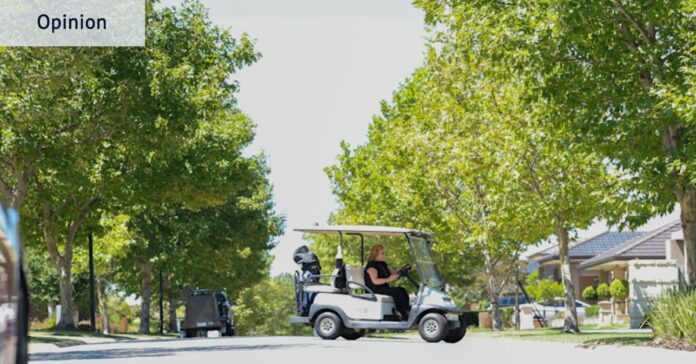
But the true delight isn’t only in conquering a challenging fairway – it’s in the quirky, unexpected pleasures that come with life here. Garages come with extra space for the carts and there are special paths for them across the suburb, where golfers tend to coast along with a cheerful, unspoken superiority over walkers and cyclists. I never imagined the joy of owning a golf cart – neighbours tipping out a loved one on the way home from clubhouse drinks; me using my phone to navigate from one playground to the next with my grandchildren; and then there’s tarting up the cart for festive golf at Christmas. Hello, Rudolph.
People ask what it’s like to live in a suburb where the fairways and greens weave their way directly through the houses. We don’t get anywhere near as many golf balls on the doorstep as you might think – the course has been designed to minimise the impact, so golf balls aren’t landing on my rooftop on a John Daly basis. I do recognise the sound of a well-hit ball from my balcony though, and identify with that golfer’s smug sense of satisfaction. On the other hand, when you’re playing, it’s worth remembering that there are 2000 golf wardens located among those houses beside the course, so you don’t want to be caught getting up to dodgy scoring like a certain Donald.
Still, according to the club, only around 30 per cent of residents in Sandhurst are golfers, which is a testament to the suburb’s other virtues. Chief among them is the preservation of its red river gums, many over a century old, in our parks and open spaces. A boulevard of plane trees winds through the estate too, offering green serenity in summer and colour in autumn.
The estate also contains an island, in a suburb that is something of an island itself in its own way. Sandhurst Island sits within the estate’s central lake system, providing direct water frontage. This blend of expansive waterways, lush greenery, and softened textures creates a sense of breathing room.
A feature of Sandhurst that visitors will notice is its relaxed, monochromatic visage, which is the result of a firmly protected colour scheme under body corporate regulations. House colours are mostly within a range of sandy tones, roofs are non‑reflective and usually grey or brown and houses don’t have front fences. Some people might think this is monotonous, but since moving here I’ve come to appreciate how these rules keep the streetscape open and allow nature to emerge.
This calm is occasionally disturbed by the less celebrated habits of the gums – shedding leaves and bark during dry seasons, littering gardens and walkways. It does, at least, give residents something to complain about. For some, it is practically a national sport, complete with a local Facebook page seemingly devoted to grievances.
Overall, though, Sandhurst is a tight-knit community, rich in clubs and social activity. All residents here pay owners corporations fees to one of two owners corporations, and choral, camping, caravanning and craft groups coexist alongside swimming, tennis, basketball and gym pursuits at the communal facilities. There is even a tea society devoted to matcha traditions, fostering friendships through ritual. The neighbourliness here is next‑level, only tempered by the ongoing quest to improve one’s golf handicap – with Friday night dinner at the Sandhurst Clubhouse or Members’ Bar a regular fixture.
Sandhurst also benefits from its central location and connection to much of what Victoria offers. For me, Sandhurst to the east and the canal suburb of Patterson Lakes to the west share an unlikely connection, standing like complementary pillars on either side of the Peninsula Gateway, guiding the way to the coast. And if the beach is not your thing, Sandhurst is near multiple major arterials: EastLink, Peninsula Link, the Mornington Peninsula Freeway, South Gippsland Highway, and the Monash, which long ago forfeited the right to be called a freeway.
There is little to dislike here, aside from the ugly, dilapidated fences scarring the western entrance, or the body corporate fees – rarely disputed in principle but often in their distribution. However, the feeling of driving home through abundant vegetation – absorbing the sights, sounds and scents of nature – offers a genuine resort vibe.
We took a calculated risk with the move to Sandhurst and drained it, landing exactly where we want to be.
Marg Perry is a Melbourne writer with a soft spot for the stories that shape suburban life.
From our partners
Disclaimer : This story is auto aggregated by a computer programme and has not been created or edited by DOWNTHENEWS. Publisher: www.smh.com.au