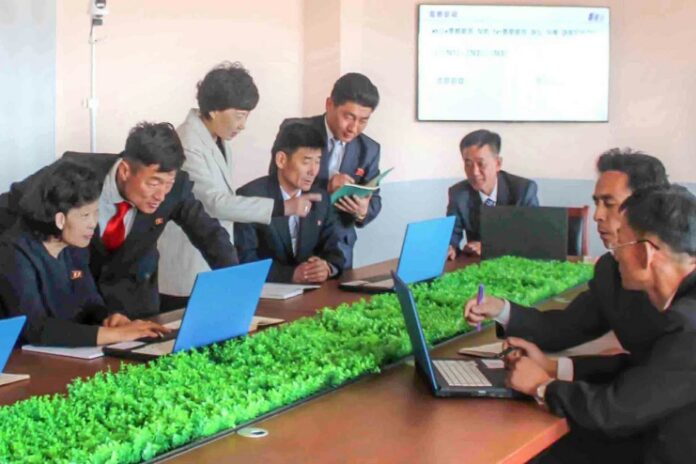
North Korean educational authorities ordered high schools in North Hamgyong province to adopt research-based learning methods in late January, pushing a shift away from rote memorization toward student-led exploration and debate. But teachers say the transition is unworkable, citing poor classroom conditions and subjects that cannot be taught any other way.
A Daily NK source in North Hamgyong province, who requested anonymity for security reasons, said the education department of Orang county issued the directive to local high schools on Jan. 30 to raise students’ academic achievement through research-based learning methods.
The order follows a determination by educational authorities that their push to abandon rote learning had not taken hold in classrooms. Authorities have recently called on teachers to present problems to students and encourage them to find their own materials and debate solutions with peers, rather than delivering one-sided lectures. The shift redefines the teacher’s role from information-provider to research guide.
North Korean education has historically meant students memorizing what teachers explain. The new model asks students to experiment, analyze, and debate problems independently.
Authorities say the goal is to build students’ ability to learn actively and apply knowledge in practice.
A reform colliding with the classroom
In practice, teachers say research-based learning cannot be uniformly applied across all subjects.
“In the past, teachers would unilaterally teach students, and now, the authorities demand that they conduct classes focused on discussions between students, but in the classroom, the extent to which this is applied differs greatly depending on the subject,” the source said.
Social studies classes present a particular problem. Because North Korean social studies heavily emphasizes praise for the socialist system and loyalty to the supreme leadership, students cannot be divided into opposing teams to debate such topics.
“You can perfunctorily mimic debates in subjects like math, physics and chemistry, but you certainly can’t do that in revolutionary history class,” the source said. “Social studies teachers complain that they don’t know what to do if they hear the headmaster or vice headmaster will come to observe their classes.”
The reform is also increasing the administrative burden on teachers. Class observations, textbook research discussions, and quarterly review meetings are all being held more frequently under the banner of implementing research-based learning.
“Teachers are indeed complaining that unnecessary meetings are simply increasing due to the transition to research-type learning, or that this won’t improve teachers’ abilities,” the source said.
A Note to Readers
Daily NK operates networks of sources inside North Korea who document events in real-time and transmit information through secure channels. Unlike reporting based on state media, satellite imagery, or defector accounts from years past, our journalism comes directly from people currently living under the regime.
We verify reports through multiple independent sources and cross-reference details before publication. Our sources remain anonymous because contact with foreign media is treated as a capital offense in North Korea—discovery means imprisonment or execution.
This network-based approach allows Daily NK to report on developments other outlets cannot access: market trends, policy implementation, public sentiment, and daily realities that never appear in official narratives. Maintaining these secure communication channels and protecting source identities requires specialized protocols and constant vigilance.
Daily NK serves as a bridge between North Koreans and the outside world, documenting what’s happening inside one of the world’s most closed societies.
Disclaimer : This story is auto aggregated by a computer programme and has not been created or edited by DOWNTHENEWS. Publisher: dailynk.com