Future Country brings the Indigenous art world’s most exciting new talents to NGV Australia.
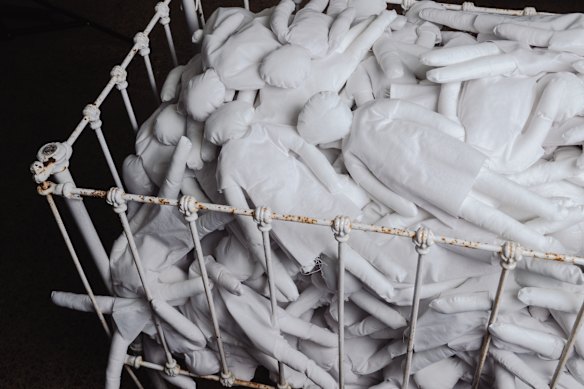
A rusty iron cot cages a jumble of faceless white ragdolls. Crammed in tight, they bulge and spill through the painted white bars, limb jutting out here, head there. They rise in a haphazard pile, hurled in like discarded bodies. A lumpy flood of raw cotton discharges from the bottom of the cot. Above the cot hangs a mobile of white pendants embroidered in white with words such as “care” and “justice”.
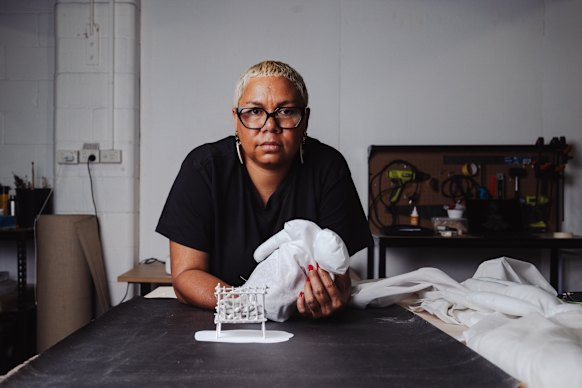
This unnerving sculptural work is by Meanjin/Brisbane-based artist Boneta-Marie Mabo, a Nywaigi, Meriam and Manbarra woman, and eldest granddaughter of the heroic land rights campaigner Eddie Koiki Mabo. Titled Colonial Threads, the artwork is one of eight featured in the exhibition Future Country, which opens at the National Gallery of Victoria on March 20.
The exhibition is the second iteration of the gallery’s First Nations Commissions, a biennial program that features the work of eight emerging Indigenous artists, one from each state and territory, selected by established Indigenous artists who mentor them through the process.
“The mentors nominate a young, up-and-coming artist that they think would be great to realise their most ambitious, most career-defining work to date,” says the gallery’s senior curator, First Nations art, Jessica Clark.
Boneta-Marie Mabo was thrilled to be chosen by Megan Cope, from the Queensland collective ProppaNOW, whom Mabo has long admired.
When we meet via Zoom, Mabo tells me that Cope helped her refine a concept that had been gestating for about 15 years. Those years coincide with Mabo’s time working at Sisters Inside, an Aboriginal-led organisation that supports incarcerated women and girls, and their families. Mabo was disturbed by how often children placed in child protection programs ended up in the youth justice system.
“What I witnessed over 15 years was a very clear pipeline between state care and incarceration, particularly for First Nations girls,” she says.
Wanting to understand why that link was so strong and consistent, Mabo began looking into past policies of child protection and discovered a devastating historical law, Queensland’s Industrial and Reformatory Schools Act 1865; although the act was repealed in 1911, its legacy continues.
Purportedly enacted to “provide for the care and custody of neglected and convicted children,” the act’s definition of a “neglected child” included any child born of an Aboriginal mother. In short, if your mother was Aboriginal, you could be forcibly removed from your family and sent to an industrial or reformatory school or mission.
“It was targeted at women, it was targeted at girls.”
Mabo says the system evolved into the State Children welfare framework and intersected with Aboriginal Protection laws, allowing state control and the removal of children to continue in new legal forms.
“I’m a black woman in this place and so it touches me more that this is the legacy of the place that I grow my daughter in, and so to interrogate it further, made sense for me,” she says, her voice wavering. “I feel emotional talking about this.”
It’s hard not to get emotional talking about it. Even without knowing the historical law that inspired Mabo’s sculptural work, one instinctively understands that something is terribly wrong. A child’s nursery is supposed to be a place of colour and joy; here it is ghostly white, drained of life, the children stripped of identity. The cot, intended as a place of love and protection, is transformed into something menacing and macabre.
Mabo tells me that Cope nudged her to take a less literal approach to the work, to bring together objects that were suggestive or symbolic, rather than definitive. The number of ragdolls, though, are specific and significant – 238 in all, to represent every year of colonisation, each hand-made, by Mabo with the help of her mother and aunt.
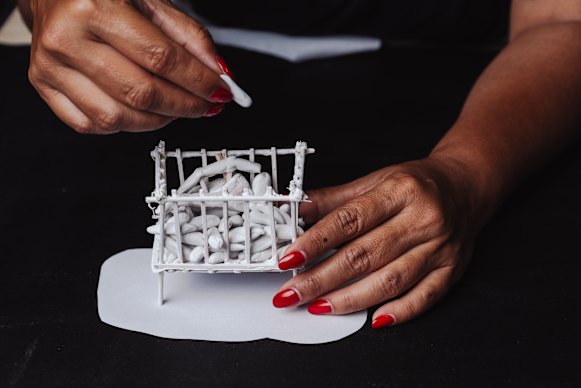
“I wanted to represent every year of colonisation in this place, because even though I’m talking about historical things … the legacy of that legislation still carries on today,” Mabo says.
She points to the dire statistics: “In Queensland we still lock up more children and black children than any other jurisdiction. And I have an intimate understanding of that from 15 years of working in these institutions, specifically with girls.
“For blackfellas, especially black women and girls who have been in those institutions and systems, [this work] is like acknowledgement of the pain, and also, we’re still here, no matter what’s happened. It’s like an honouring for the black woman.”
On the Zoom call with us are two other artists who have been commissioned to make work for Future Country, Jahkarli Felicitas Romanis, from Naarm/Melbourne, and Nunami Sculthorpe-Green, from Nipaluna/Hobart. Over more than an hour, they listen intently to each other’s stories, and the camaraderie that springs up between them is palpable.
“There are so many cool connections between each of our works,” says Mabo. “Even though we come from different places and communities, there’s still such a strength behind what we are sharing.”
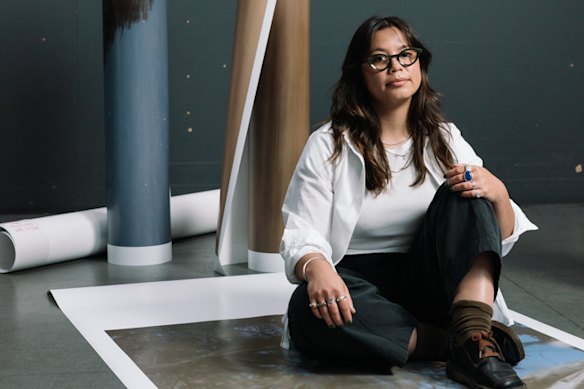
Romanis, a Pitta Pitta woman, born and raised on Wadawurrung Country, has made a giant, six-panel photograph of her ancestral lands, Pitta Pitta Country, in north-western Queensland. Measuring six by nine metres, the photograph rises up a gallery wall and extends out onto the floor, to a soundscape of birdsong Romanis recorded on Country. She has photographed the landscape in reflection, mirrored through the ripples of a watercourse that is part of the spectacular system of rivers and wetlands known as Channel Country.
“I was thinking about what the river might see, or if it had eyes what it might see,” Romanis says. “I understand that’s a very human way of thinking about vision and perspective, but I like to think about what Country feels or perceives … how it perceives me and knows me … after all, Country is a living entity.”
Her photograph alludes to the dispossession endured by her own family. Romanis’ great-grandmother, Dolly, was stolen from her ancestral land and sent to Palm Island, off the coast of Townsville. Her installation, titled Channels, is a response to that rupture, a way of reconnecting to family and Country. The choice of photography as a medium is pertinent – Romanis’ sole physical link to her great-grandmother are photos contained in the archive of the Tindale Genealogical Collection at the South Australian Museum. When Romanis first held these photographs in 2022, she felt as though she were holding her great-grandmother.
As she wrote in The Australian and New Zealand Journal of Art in 2024: “It felt like we had found each other, eighty-four years after her photographs were taken by [anthropologist] Norman Tindale.”
And now Romanis is turning the tables on these archives, reclaiming her ancestry and her country through her own photographs. Her mentor is renowned artist Brook Andrew, whose artworks draw on historical photographs and archives to subvert racist stereotypes, most famously with his image of a 19th century Aboriginal man overlaid with the words “sexy and dangerous”.
Counter to the usual gallery rules, people are invited to walk on Romanis’ vast photograph, to leave their imprint, to metaphorically walk on Country.
“I want people to understand that we all have an impact and that we all have a responsibility to take care of Country and of place for future generations,” Romanis says. “With climate change, and the constant greed for resources, Country is very sick and we need to have awareness of how to care for it, and that begins with giving agency to Aboriginal people, because we have those knowledges.”
Climate change is having an effect on a cultural practice that more than any other symbolises the survival and resilience of Tasmanian Aboriginals despite the ravages of colonisation and the brutal Black War – the shell necklace tradition.
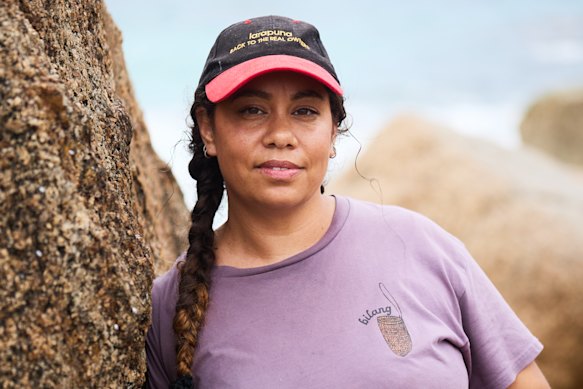
Nunami Sculthorpe-Green, a Palawa and Warlpiri woman, with cultural and family ties to both north-east Tasmania and the Tanami Desert, has created an artwork that pays homage to that tradition and the generations of women who since time immemorial have collected marina shells along the coastlines of Lutruwita/Tasmania to make their long, lustrous necklaces.
“There’s nothing more emblematic for our people, our culture, and our Country than marina shells and the [shell necklace] practice, and I really wanted to honour the women who carried this through,” she says.
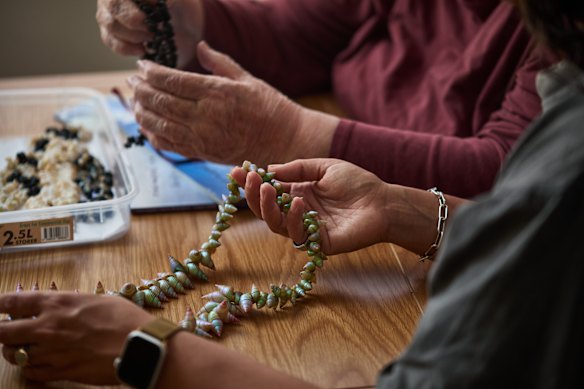
Sculthorpe-Green was nominated by celebrated Pakana artist and shell-worker Lola Greeno, who has been instrumental in maintaining the shell-necklace tradition and raising awareness of the practice nationally and internationally. Being chosen by Greeno “felt better than winning a lottery because I respect her so much”, she says.
She has created a wall installation featuring 200 slip-cast ceramic sculptures of marina shells, enlarged in scale and hand-painted with natural glazes. Marina shells, which live on kelp and seagrass beds, have been drastically diminishing in number due to ocean warming, urbanisation and pollution. It’s for this reason that Sculthorpe-Green chose to use ceramic sculptures of the shells rather than the actual shells themselves, wanting to highlight that the practise is at risk.
She sourced the materials for the glazes from her ancestral country in the north-east of Tasmania, harvesting and processing the materials to make glazes from various combinations of native wood ash, granite from the beaches, clay dug from the ground, and red ochre. “So the glazes are literally made of this country,” she says.
Through their art, each of these three women are celebrating the strength of Indigenous culture and knowledge, while inviting audiences to learn, listen and consider a better way forward.
“Future Country isn’t about something ahead of us, it sits alongside us, shaped by what we choose to confront now,” says Mabo. “Country carries memories … and the future depends on how we respond to that inheritance. It’s about what happens when truth is held and not avoided, and for me that means refusing the amnesia of this country.”
FUTURE COUNTRY: Country Road + NGV First Nations Commissions will run from 20 March – 13 September at NGV Australia.
Disclaimer : This story is auto aggregated by a computer programme and has not been created or edited by DOWNTHENEWS. Publisher: www.smh.com.au