
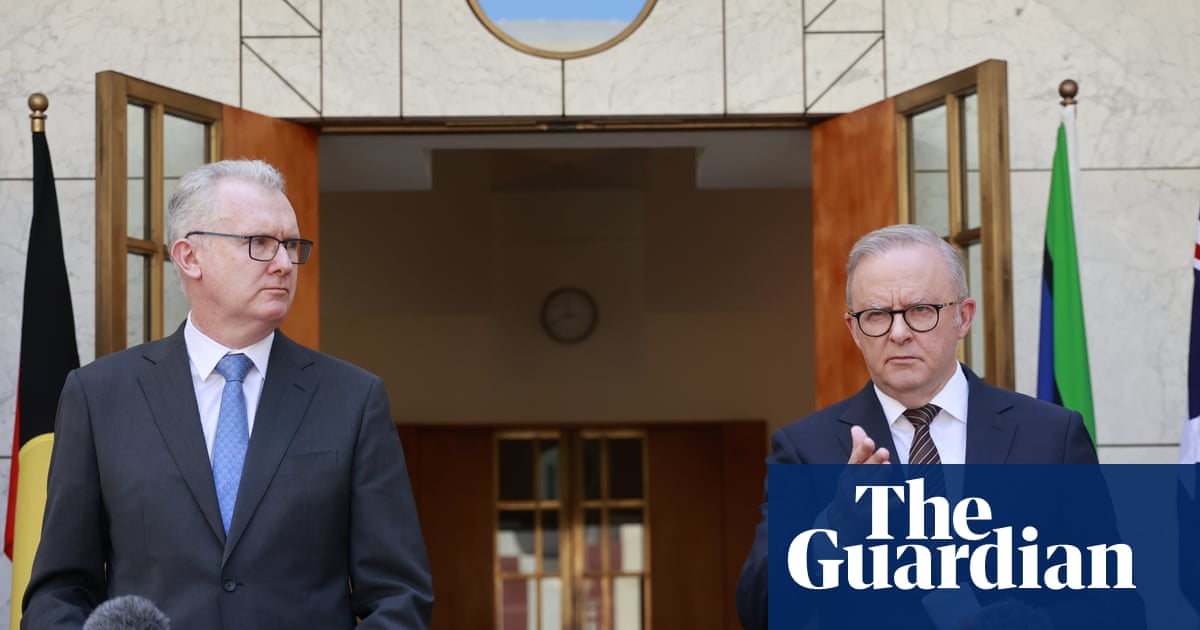
The home affairs minister, Tony Burke, says new hate speech laws will be drafted to the limits of the constitution to capture the “completely dehumanising” rhetoric deployed by so-called “hate preachers”.
But while Burke said he believed protesters chanting “globalise the intifada” was “horrific”, he couldn’t confirm whether the phrase would be outlawed under legislation to be fast-tracked in the wake of the Bondi beach massacre.
The comments came as the independent MP Allegra Spender, whose electorate includes Bondi beach, urged the government to widen the hate speech crackdown to capture vilification of other minorities, including LGBTQ+ people.
The federal government this week announced a five-step plan to urgently strengthen hate speech laws to combat antisemitism after Sajid Akram and son Naveed allegedly gunned down 15 people and injured dozens of others at a Hanukah celebration on Sunday night.
Sign up: AU Breaking News email
On Friday, Anthony Albanese said there was new evidence to suggest the terrorist attack – the worst in Australia’s history – was inspired by Islamic State.
Several measures announced on Thursday would target so-called “hate preachers”, including an aggravated hate speech offence for preachers and leaders who promote violence, and a new regime to list organisations whose leaders engage in hate speech that promotes violence or racial hatred.
Burke said some preachers used language that was “completely dehumanising” but were able to escape punishment because the rhetoric stopped short of advocating for physical violence.
The minister said the government wanted to lower the threshold for hate speech, although he wouldn’t be drawn on whether chanting “globalise the intifada” would be captured.
The New South Wales treasurer, Daniel Mookhey, said the slogan – which means uprising or resistance, and is used by Palestinians to describe uprisings against Israel – was an example of hate speech. It has been seen and heard at some Australian protests, but signs and chants of “free Palestine” are more common.
“What I can’t do is play the game of this sentence will be in, this sentence will be out, these words will be in, these words will be out,” Burke told ABC radio when asked if “globalise the intifada” would be classified as hate speech.
“We will be lowering the threshold to the extent that constitutionally we are able to, and it will be the strongest step forward in making hate speech illegal in Australia.”
The constitution doesn’t explicitly protect freedom of speech however the high court has upheld an implied right to political communication.
There are already state laws that have criminalised serious vilification of race or religion, and a federal civil penalty for vilification under the Race Discrimination Act.
The government hasn’t singled out organisations that could be listed under the new hate speech regime although the Islamic political organisation Hizb ut-Tahrir and neo-Nazi group National Socialist Network could be possible targets.
Luke Beck, a professor of constitutional law at Monash University, said legislation would not normally include particular phrases, but would include a definition for courts to rule against.
“They usually frame [legislation] around a concept, promoting hatred or severe ridicule or condemnation of people on the basis of their race, they use those definitions of concepts and then it’s up to the courts to work in the particular context: ‘is that what happened?’” he said.
The government also intends to outlaw “serious vilification” based on race and/or advocating racial supremacy.
Spender wants the “narrow” offence expanded beyond race and religion to capture vilification against other minorities, including LGBTQ+ people.
“No community should ever be targeted, or ever should we allow hate to ferment against any part of our community,” she told Guardian Australia.
“They should not just only focus on religion and race, I believe it should go broader and absolutely include the LGBTQ+ community, because we have seen some of the neo-Nazi rhetoric, for instance, against the trans community … they need protection from hate.”
Spender pushed, unsuccessfully, for a broad anti-vilification provision to be included in hate crimes laws that passed parliament in February, after it was dropped from the original draft following pushback from some faith groups.
Those laws, which the government is proposing to strengthen less than 12 months later, created a new offence for threatening to use force or violence against people based on their religion, sex, sexual orientation, gender identity, disability and nationality, national or ethnic origin or political opinion.
Disclaimer : This story is auto aggregated by a computer programme and has not been created or edited by DOWNTHENEWS. Publisher: theguardian.com




