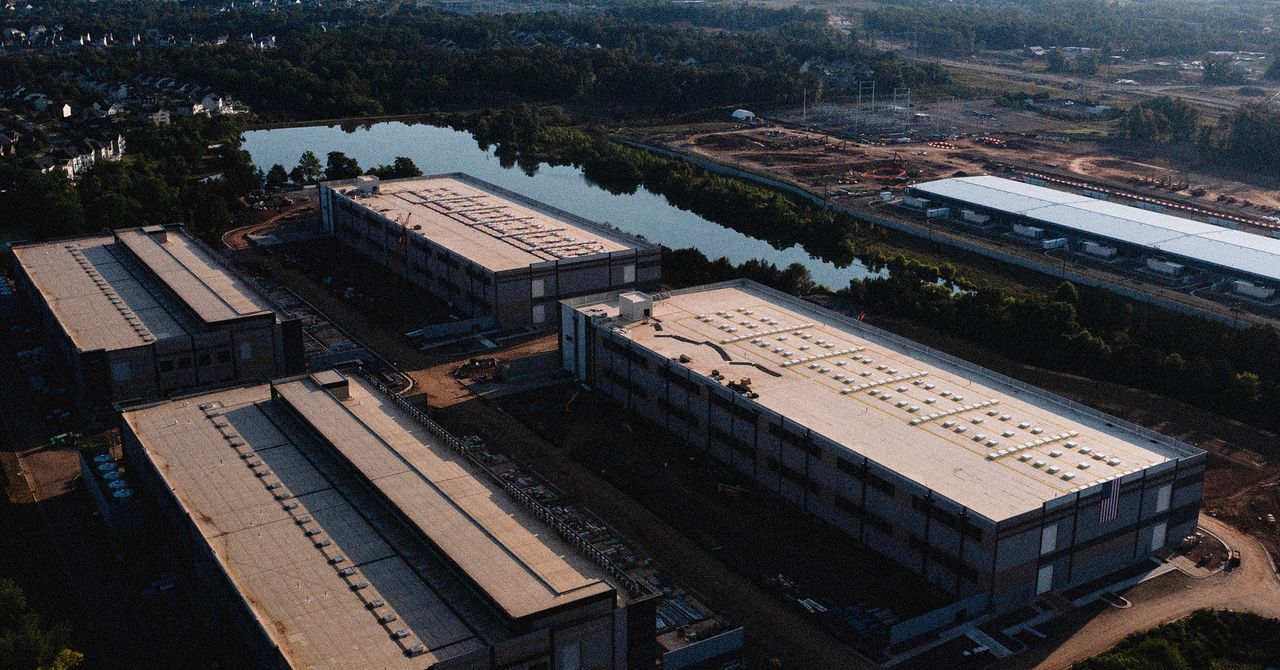
Two New York lawmakers on Friday announced that they are introducing a bill that would impose a three-year moratorium on data center development. The announcement makes New York at least the sixth state to introduce legislation putting a pause on data center development in the past few weeks—one of the latest signs of a growing and bipartisan backlash that is quickly finding traction in statehouses around the country.
Data center moratoriums are “being tested as a model throughout states in this country,” said state senator Liz Krueger, a Democrat, who presented the bill at a press conference Friday with its cosponsor, assemblymember Anna Kelles, also a Democrat. “Democrats and Republicans are moving forward with exactly these kinds of moratoriums. New York should be in the front of the line to get this done.”
The new bill comes as a wave of bipartisan anti-data center sentiment that has swept across the country in recent months. In December, Senator Bernie Sanders, the Vermont independent, became the first national politician to call for a blanket moratorium on data center permitting, saying that a moratorium would “ensure that the benefits of technology work for all of us, not just the 1 percent.”
Just a day before the New York bill was introduced, Governor Ron DeSantis of Florida sharply criticized data centers at a roundtable on AI policy. DeSantis had previously proposed legislation that would offer a variety of consumer protections and limit the expansion of data centers in Florida.
“I don’t think there’s very many people who want to have higher energy bills just so some chatbot can corrupt some 13-year-old kid online,” deSantis said at the roundtable, to applause. “That’s not what anybody is signing up for.”
New York currently has more than 130 data centers, with several large-scale projects—including a 450-megawatt project sited on an old coal plant—proposed or under construction. One of the state’s utilities said there is currently 10 gigawatts of electric demand, mainly driven by data centers, in line to be connected to the grid; that demand tripled in just one year. These projects are colliding with mounting concerns over impacts from data centers on the electric grid, environmental worries, and whether or not consumers would be footing the bill. Last month, as part of a larger set of actions intended to protect ratepayers from high energy costs, New York’s governor, Kathy Hochul, launched a new initiative to improve interconnection and grid upgrades while requiring data centers to “pay their fair share.”
In early December, days before Sanders’s call for a national moratorium, more than 200 national and local environmental groups from around the country convened by environmental group Food and Water Watch signed on to a letter asking members of Congress to pass a national moratorium on data center development, calling data center expansion and the AI boom “one of of the biggest environmental and social threats of our generation.”
The New York bill was “our idea,” says Eric Weltman, the senior strategist and organizer for Food and Water Watch’s New York chapter. The bill imposes at least a three-year moratorium on issuing permits for new data centers. During this time, the Department of Environmental Conservation and the Public Service Commission must issue reports on the impacts of data centers on the public and the environment, and suggest new regulations or orders to minimize impacts.
“There are a lot of extraordinarily well-intentioned and well-meaning bills that have been introduced to attempt to address the many impacts that data centers have,” says Weltman. “Our concern was, and remains, that they’re not adequate.”
Lawmakers in at least five other states—Georgia, Maryland, Oklahoma, Vermont, and Virginia—have also introduced bills this year that would impose various forms of temporary pauses on data center development. While Georgia, Vermont, and Virginia’s efforts are being led by Democrats, Oklahoma and Maryland’s bills were largely sponsored by Republicans. These bills mirror several moratoriums that have already passed locally: At the end of December, at least 14 states had towns or counties that have paused data center permitting and construction, Tech Policy Press reported.
There are some signs that the data center industry is beginning to respond to the backlash. Last month, Microsoft, with a boost from the White House, rolled out a set of commitments to be a “good neighbor” in communities where it builds data centers. In response to questions on how the industry is responding to the slew of state-level legislation, Dan Diorio, the vice president of state policy at the Data Center Coalition, an industry group, tells WIRED in a statement that it “recognizes the importance of continued efforts to better educate and inform the public about the industry, through community engagement and stakeholder education, which includes factual information about the industry’s responsible usage of water and our commitment to paying for the energy we use.”
Some of the states with moratorium bills have relatively few data centers: Vermont has just two, according to Data Center Map. But Georgia and Virginia are two of the national hubs for data center development and have found themselves at the center of much of the resistance, in both public reaction to data centers and legislative pushback. More than 60 data center-related bills have already been proposed in the Virginia legislature this year, according to Data Center Dynamics, an industry news site.
Josh Thomas is a state delegate in Virginia who has been at the forefront of leading the legislative charge to put limits on the expansion of data centers. During his first legislative session, in 2024, the caucus of self-identified data center “reformers” in both the House and Senate was just three politicians. That number grew to eight in 2025, “and now, it’s 12 or 13,” he says, with many more politicians willing to vote on reform bills. His fellow lawmakers, he says, now “understand that we need to negotiate where these things go.”
Last year, a proposal introduced by Thomas which would have required data centers to perform more in-depth environmental, noise, and community impact site assessments passed the legislature, but was vetoed by then-governor Glenn Youngkin. Newly-elected Governor Abigail Spanberger, a Democrat who talked about making data centers “pay their own way” on the campaign trail, seems much more likely to reconsider this year’s version of the bill, which has already passed the House.
“I’m much more optimistic that [Spanberger] will sign,” Thomas says.
Thomas, who was not involved in shaping the moratorium in the Virginia house, thinks that a moratorium on data centers is much more likely to pass in states where the industry has less of a foothold than Virginia. Still, he says, “it’s not a bad idea.”
Disclaimer : This story is auto aggregated by a computer programme and has not been created or edited by DOWNTHENEWS. Publisher: wired.com