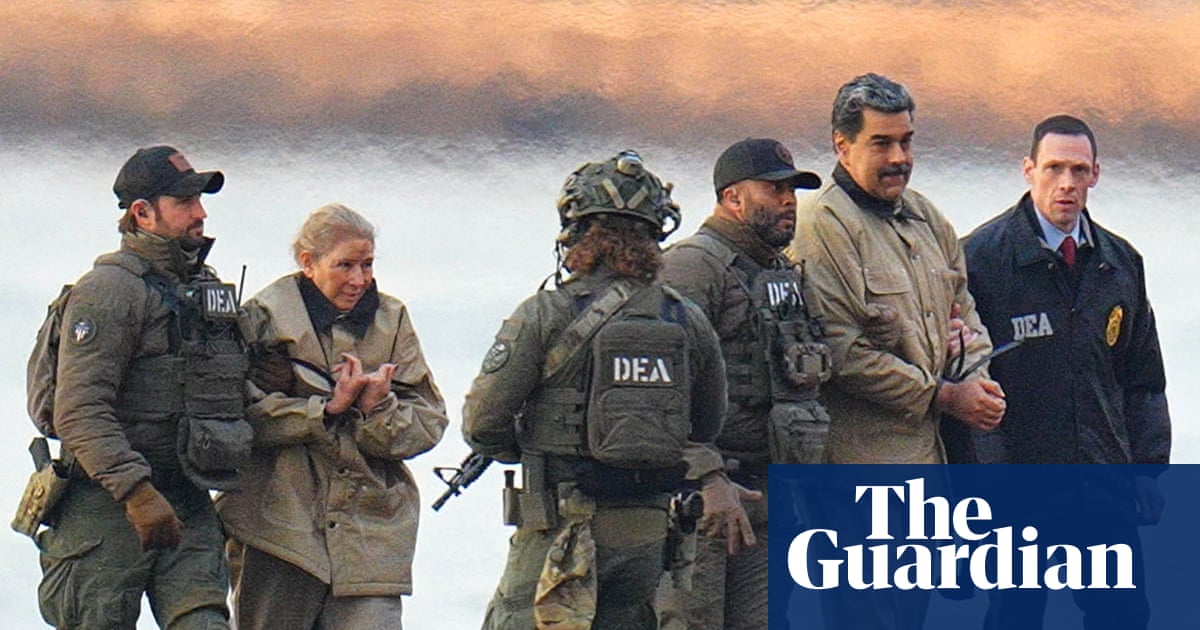
The deposed Venezuelan president Nicolás Maduro appeared in a Manhattan federal court on Thursday for his “narco-terrorism” case after his capture by US military forces earlier this year.
The hearing opened with the defense and prosecution arguing over whether Maduro should be allowed to use Venezuelan government funds to pay for his defense. The defense has insisted that the US is violating the deposed leader’s constitutional rights by blocking government money from being used for his legal costs.
US special forces captured Maduro and his wife, Cilia Flores, on 3 January in a controversial pre-dawn raid during an assault on Caracas that reportedly killed 100 people. Flores was also in court.
Charging papers allege that Maduro spearheaded a “corrupt, illegitimate government that, for decades, has leveraged government power to protect and promote illegal activity, including drug trafficking”.
Their capture followed months of US pressure against Maduro, such as assaults on purported “narco-boats”. These boat strikes resulted in more than 100 deaths. Some legal experts have challenged not only the legality of these attacks but whether they are equivalent to war crimes.
Maduro and Flores both pleaded not guilty during their 5 January arraignment.
Maduro’s politician son, Nicolás Maduro Guerra, had tried to put a brave face on his father’s plight.
“He’s really well, [he’s] strong – he’s really, really well. His spirits are really high,” he told state-run media on Monday, claiming the former president was in “athletic” shape from exercising every day.
Outside the court before the hearing, demonstrators for and against Maduro’s arrest faced each other on opposite sides of metal barricades. The temporary steel fences were separated by a buffer of several feet.
“Free President Maduro & Cilia Flores,” one banner read. “STRUGGLE FOR SOCIALISM,” was written in white text, over a red box. Other signs simply said: “FREE PRESIDENT MADURO.” One woman toted a display that featured a photo of Maduro and read: “The people’s president.”
One man with a loudspeaker said: “This is not a trial! This is a judicial farce!”
At one point, many of the several dozen Maduro opponents present – some wearing Venezuela’s flag around their shoulders, some sporting caps with the Andean nation’s ensign – sang the Venezuelan national anthem.
For a moment, the song Gloria al Bravo Pueblo drowned out pro-Maduro protesters’ call for his freedom.
In Caracas on Thursday morning, a couple of hundred people gathered at a public plaza including ruling party supporters, state employees and civilian militia members. One of the attenders, retiree Eduardo Cubillan, said he was there to pray for Maduro and Flores and condemn the violation of Venezuela’s sovereignty during the 3 January operation.
Experts say conditions inside the New York detention centre where Maduro is being held are dire. Meanwhile, back home in Venezuela, Maduro’s political legacy is rapidly being erased by his successor, the former vice-president Delcy Rodríguez, despite the presence of government propaganda billboards calling for the couple’s return.
In less than three months as acting president, Rodríguez has removed nearly half of Maduro’s cabinet ministers, purging key allies including the defence minister of 11 years, Vladimir Padrino López, the attorney general, Tarek William Saab, and the industry minister, Alex Saab.
Addressing a Saudi-funded business summit in Miami on Wednesday, Rodríguez made no mention of her incarcerated predecessor and claimed her oil-rich country was poised for a “tremendous [economic] takeoff” under her leadership.
“In the short time since I have been acting president of the Bolivarian Republic of Venezuela, we have welcomed more than 120 energy companies, above all from the US but also from the Middle East, from Asia, Africa and from Europe,” Rodríguez told foreign investors.
After ordering the abduction of Maduro, Donald Trump warned Rodríguez that unless she toed the US line, she could face an even more dramatic fate. Since then, the US embassy in Caracas has reopened for the first time since 2019 and senior officials including the energy minister and the head of the CIA have flown in to visit.
Maduro’s court appearance comes several weeks after he pushed for dismissal of his case by alleging that US officials were violating the fallen head of state’s “constitutional right to counsel of his choice”. They claimed that authorities were unlawfully prohibiting the Venezuelan government from paying for his defense.
The US treasury department’s office of foreign assets control (Ofac) on 9 January granted Maduro a waiver to accept money from Venezuela’s government – which is under sanction – for his legal fees. Just three hours later, however, Ofac “reversed course”, Maduro’s lawyers said.
“As a result, Mr Maduro, who lacks his own funds to retain counsel, is being deprived of his constitutional right to counsel of his choice,” Maduro’s lawyers said in court papers filed on 26 February.
“If Ofac’s interference with Mr Maduro’s ability to fund his defense persists, undersigned counsel cannot remain in the case, nor can Mr Maduro be represented by any other retained counsel,” his lawyers wrote. “Not only would the court need to appoint counsel and foist the cost of Mr Maduro’s defense on the United States taxpayers, despite the willingness and obligation of the government of Venezuela to pay Mr Maduro’s defense costs, but also any verdict against Mr Maduro would be constitutionally suspect.”
Ofac contends that it never meant to greenlight Venezuela’s funding of Maduro’s defense, saying in 13 March court papers: “The inclusion in these licenses of an authorization to use funds paid by the Government of Venezuela was an administrative error.”
Manhattan federal prosecutors are fighting Maduro’s push for dismissal.
They claimed in a 13 March filing that while Ofac would typically allow a defendant such as Maduro to use his own money for legal fees, it would be “highly unusual” for a sanctioned government to receive such a waiver.
During a cabinet meeting on Thursday, Trump accused Maduro of being a “major purveyor of drugs coming into our country”. Trump did not provide details, but suggested the current charges Maduro is facing might be “a fraction of the kind of things that he’s done”.
During the court proceeding, both the defense and prosecution largely reiterated their positions in court papers. “They cannot afford counsel themselves,” Barry Pollack, Maduro’s attorney, told judge Alvin K Hellerstein.
Pollack told Hellerstein that the government had not alleged that Venezuelan government funds were tainted by any purported illegal activity. He insisted that if they weren’t allowed access to these funds, whatever lawyer would be provided to Maduro and Flores would not have sufficient investigative capability.
Prosecutor Kyle Adam Wirshba insisted the government had every right to prevent the use of Venezuelan money for Maduro’s defense per sanctions. “The government interest is one of national security and foreign policy,” Wirshba said.
Hellerstein took issue with claims about national security, given that Maduro was in custody. He also noted that the US and Venezuela seemed to be cooperating in various ways.
“We are doing business with Venezuela,” Hellerstein said at one point. “The defendant is here. Miss Flores is here. They present no further national security threat. I don’t see that.”
Hellerstein asked both sides to present a possible solution to the Venezuelan money issue.
Pollack again said that if Venezuela’s government couldn’t pay, “the only remedy is dismissal”.
“I’m not going to dismiss the case,” Hellerstein quipped, prompting low laughter in the courtroom.
While Hellerstein did not make any ruling on this issue, the judge told Pollack that if he found special permission had been “arbitrarily withheld”, the attorney could renew his argument about dismissal.
The Associated Press contributed to this report
Disclaimer : This story is auto aggregated by a computer programme and has not been created or edited by DOWNTHENEWS. Publisher: theguardian.com