
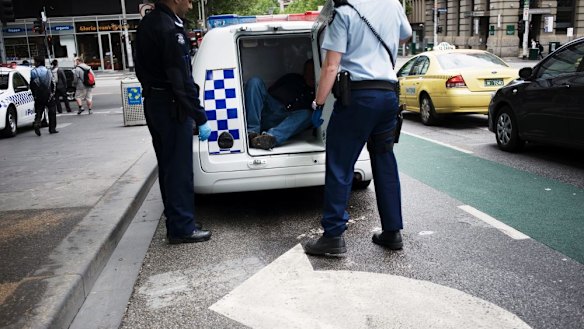

Basic rights of Victorians on remand are at risk of being breached as those shuffled between police cells fall through accountability gaps, a watchdog has warned, and the problem is expected to worsen.
The state ombudsman’s office has highlighted the plight of the 300 inmates a night being “decanted” around the state’s police stations, saying there is no independent oversight of the practice.
“The Victorian ombudsman does not have jurisdiction over Victoria Police,” Deputy Ombudsman Dan Nicholson said. “This means we are not able to assist those who call us from police cells. We cannot make enquiries, try to resolve those complaints quickly, or investigate serious or systemic issues that arise,” Nicholson said.
“There is literally no one that you can call to make a complaint and have it dealt with in a timely way.
“It shouldn’t be necessary to go to the Supreme Court for an injunction to get a complaint about conditions in custody addressed. There are real risks associated with prolonged detention in police cells.”
The ombudsman received more than 3000 complaints about Corrections Victoria during the last financial year – making it the second-largest area of complaint after local government – but the office has no control over the management of police cells.
Nicholson said the practice of “decanting” – under which people being held on remand are shuffled between cells and police stations instead of being taken to prison, in order for police to “reset the clock” and avoid breaching holding regulations – was deeply concerning.
On Monday, this masthead revealed as many as 300 Victorians were being moved between police cells each night to battle the state’s prison overcrowding crisis.
Most Victorian police cells have a 14-day limit for holding people, but recently an Indigenous man was housed in various station cells, including in Sale, for 26 days – almost double the legal limit. The man said he was isolated from family support while he was held by police, and feared he would die.
Experts are warning that the problem will worsen when further changes to the Bail Act come into effect from next month, including targeting repeat offenders for alleged crimes including burglary, affray, assault and car theft, and removing the principle of remand being a last resort for children.
Last year, the state amended the Bail Act to prioritise community safety and make it tougher to be granted bail for some offences, such as violent crimes.
Victoria Legal Aid’s criminal law executive director, Kate Bundrock, said the initial bail changes introduced last year had already led to significant increases in people on remand requiring help from a Legal Aid lawyer, with the situation expected to worsen when the further changes come into effect.
“Police cells are temporary and should not be used to hold people for long periods. There is limited access to fresh air in police cells, and it’s difficult for family to visit or even have a phone call,” she said.
“It increases the risk people will be ‘lost’ in the system. It disconnects people from their community, making it far more difficult for lawyers to locate and contact their clients, and removes people from their support structures, family and friends.”
Cells in the Melbourne Custody Centre, located under the Melbourne Magistrates’ Court, for example, have no access to fresh air or sunlight – a potential breach of human rights which is at the centre of a civil case involving convicted killer and drug baron George Marrogi.
Long-term police cell use could also make it more challenging for people on remand to access rehabilitation and treatment – including medication and mental health support – and other vital services, Bundrock said.
In the nine months since the bail amendments were passed last year, Victoria Legal Aid data shows, it has become harder for First Nations people and people experiencing or at risk of homelessness to be granted bail when compared with the previous year.
The rate of bail being granted to First Nations people dropped from 70 per cent to 50 per cent, and for those experiencing or facing homelessness it dropped from 63 per cent to 44 per cent.
The falls happened as more people experiencing homelessness (34 per cent) came to Legal Aid as remand clients – up 4 per cent. The data also showed that 54 per cent of adult remand clients and 33 per cent of children had a disability or mental health issues.
“We expect the situation will worsen when further changes to bail laws come into effect at the end of March. We know that First Nations people are disproportionately represented right across the justice system, including when it comes to bail,” Bundrock said.
“It is important that key services are appropriately funded to help address these system pressures.”
From our partners
Disclaimer : This story is auto aggregated by a computer programme and has not been created or edited by DOWNTHENEWS. Publisher: www.smh.com.au


