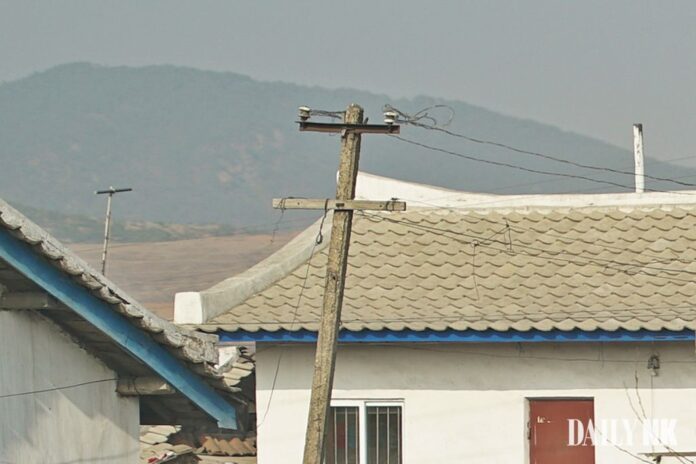
North Korean companies have struggled to maintain production since the start of the year due to a severe electricity shortage that officials say is threatening the regime’s new five-year economic plan, according to a source in South Pyongan province.
The source said electricity supply was among the central issues raised by company representatives at a conference convened by the regional industry management bureau of the people’s committee to discuss implementation of the plan announced at the Ninth Congress of the Workers’ Party of Korea.
Without a reliable power supply, companies face reduced production time, higher costs and increased rates of defective output. The result is widespread failure to meet production quotas, factory shutdowns and drag on regional economic growth.
The problem is compounded by North Korea’s current “20×10 regional development policy,” under which the regime is simultaneously building factories, hospitals and other amenities across the provinces, driving a surge in power demand.
Grid failures cut deep into factory output
In Songchon county, South Pyongan province, the shortage is severe enough that factories are averaging just three hours of operation per day. Songchon is not an outlier. Across much of the country, the power shortage is emerging as a major obstacle not only for industrial production but for daily life.
Even if North Korea delivers on its plan to build 20 factories per year, those facilities risk becoming a liability without the electricity to run them. The plan’s success may ultimately hinge on whether the regime can secure a grid capable of meeting expanded demand.
That prospect remains uncertain. A large number of companies are reportedly waiting for grid connections at both the regional and national levels.
“Unless a fundamental solution can be devised, the power shortage is likely to persist for a long time,” an official from Songchon county’s power distribution department was quoted as saying by the source.
North Korea’s electricity deficit is a longstanding structural problem. The country’s generating capacity has failed to keep pace with industrial and economic development since the 1970s, and the regime has long promoted “power saving” as a key policy slogan.
But pressures have intensified in recent years, driven not merely by insufficient supply but by a convergence of structural failures: aging generators, transmission and distribution losses, and chronic grid instability.
The power supply featured prominently on the economic agenda at the Ninth Party Congress, a sign that officials recognize the shortage as a binding constraint on development. Whether North Korea can find meaningful ways to generate more electricity and stabilize the grid remains the central question for industrial policy going forward.
Reporting from inside North Korea
Daily NK operates networks of sources inside North Korea who document events in real-time and transmit information through secure channels. Unlike reporting based on state media, satellite imagery, or defector accounts from years past, our journalism comes directly from people currently living under the regime. We verify reports through multiple independent sources and cross-reference details before publication.
Our sources remain anonymous because contact with foreign media is treated as a capital offense in North Korea — discovery means imprisonment or execution. This network-based approach allows Daily NK to report on developments other outlets cannot access: market trends, policy implementation, public sentiment, and daily realities that never appear in official narratives.
Maintaining these secure communication channels and protecting source identities requires specialized protocols and constant vigilance. Daily NK serves as a bridge between North Koreans and the outside world, documenting what’s happening inside one of the world’s most closed societies.
Disclaimer : This story is auto aggregated by a computer programme and has not been created or edited by DOWNTHENEWS. Publisher: dailynk.com