
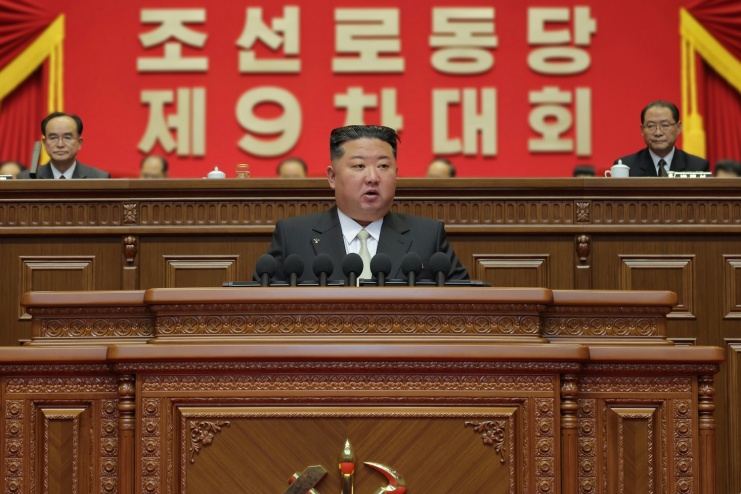
Daily NK has released a report analyzing North Korea’s Ninth Party Congress, examining what the congress reveals about the future direction of Kim Jong Un’s rule across the political, military, economic, and diplomatic spheres. The report finds that rather than introducing major new policies, the congress served primarily to consolidate existing governance structures — marking a formal transition to what the authors describe as “Kim Jong Un regime 2.0” — while reinforcing a Party-centered system of management, entrenching North Korea’s identity as a nuclear-armed state, and hardening its two-state stance toward South Korea.
The Ninth Party Congress marked a decisive transition away from governance rooted in the Kim Il Sung–Kim Jong Il legacy, effectively launching what the report calls “Kim Jong Un regime 2.0.” Rather than introducing major new policy directions, the Congress consolidated existing governance structures, with Kim Jong Un’s own ideology now serving as the sole guiding principle of state administration. The tone was notably more triumphalist than the Eighth Party Congress in 2021, which had candidly acknowledged economic failures — the Ninth Congress instead repeatedly characterized the previous five-year period as a “transformative phase” defined by achievements and stability.
On the political and organizational front, the Congress reinforced a Party-centered governing system at the expense of military influence. Key military figures like Ri Pyong Chol and Pak Jong Chon saw their Party standing diminished, signaling a deliberate shift away from military-centered power toward management through Party organizations. The Party Secretariat was expanded from eight to twelve members, with newer, younger officials brought in — a generational reshuffle interpreted not as a purge or power struggle, but as a gradual institutionalization of Kim Jong Un’s direct authority over policy implementation and elite management.
On external affairs, the Congress firmly entrenched North Korea’s identity as a nuclear-armed state, with denuclearization essentially removed from the negotiating table. Regarding South Korea, Kim Jong Un declared it the “most hostile entity” and formalized the two-state framework, abandoning any ethnic or reunification framing. Relations with Russia have deepened into substantive military and economic alignment, while China is managed more pragmatically as an economic rear base. Any future U.S.–DPRK engagement is now premised on Washington acknowledging North Korea’s nuclear status — meaning arms control or tension management frameworks are far more likely than denuclearization talks.
Read in the full report here.
Disclaimer : This story is auto aggregated by a computer programme and has not been created or edited by DOWNTHENEWS. Publisher: dailynk.com





