
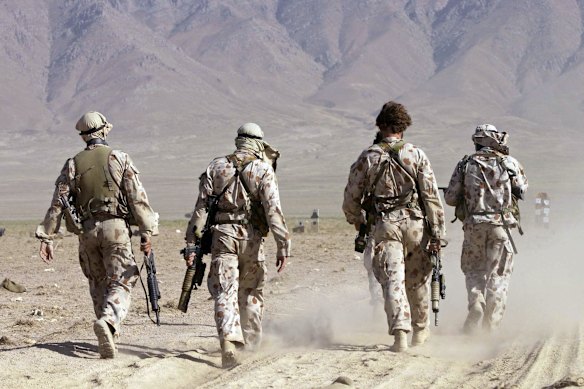

The nation’s peak veterans organisation is demanding authorities urgently resolve outstanding war crimes allegations against Australian soldiers who served in Afghanistan, arguing delays are sapping morale and unfairly smearing those who have served in uniform.
Former judge Paul Brereton’s explosive 2020 report into alleged war crimes allegations found credible evidence of 39 unlawful killings of civilians and prisoners by members of Australian special forces between 2005 and 2016.
His report recommended 19 current and former soldiers face criminal investigation, but just one charge has been laid.
Former special forces soldier Oliver Schulz was arrested and charged in 2023, becoming the first Australian soldier charged with a war crime under domestic law. He has pleaded not guilty and is not expected to face trial until 2027 because of national security concerns.
The Returned and Services League’s national president Peter Tinley demanded that all allegations, findings and charges relating to Australian service members’ conduct in Afghanistan be “resolved as a matter of urgent priority”.
Referring to the fact that just one charge had been laid in the five years since Brereton delivered his report, Tinley said: “That is not justice. That is limbo and it’s costing everyone: the accused and their families, the affected Afghan families who were promised accountability, and the 580,000 Australians who served this country honourably and now watch their service measured against unresolved allegations rather than the truth of what they gave.”
Tinley served for 17 years with the Special Air Service Regiment, the unit that is the focus of alleged wrongdoing, including as a deputy commander at the start of the war in Afghanistan.
Tinley, who has been flooded by complaints from frustrated veterans about the pace of action, said the response to Brereton’s report has been “too slow, too opaque, and too costly in human terms”.
“Complex prosecutions involving classified material take time, we understand that,” he said.
“But ‘complex’ cannot become a permanent condition or a defence of slow processes. The national security restrictions delaying both sides from accessing evidence must be resolved with urgency.”
Chris Moraitis, director-general of the Office of the Special Investigator (OSI), an agency set up to investigate alleged war crimes in Afghanistan, told Senate estimates hearings this month that his organisation has 13 active investigations underway.
He said another 39 investigations were no longer active.
Moraitis said the office’s joint investigation with the Australian Federal Police “continues to make significant progress”.
“We are working to complete the joint investigations as expeditiously as possible, cognisant of the potential impact on the welfare of those involved and the broader Defence community,” he said.
Tinley said that current military personnel were watching anxiously to see “whether Australia’s commitment to accountability is genuine or performative”.
“That uncertainty is not abstract,” he said in a statement.
“It affects operational cohesion, recruitment and retention, and our national capability. A Defence Force whose people have doubts about institutional integrity is a less effective Defence Force.”
For veterans, he said the ongoing uncertainty was a “reopening of wounds that had begun to close”, leading to a reluctance to speak about military service and a sense of shame among those who had done nothing wrong.
This masthead reported last year that the OSI had secured the co-operation of new witnesses in its investigation into allegations against disgraced soldier Ben Roberts-Smith and secured footage of him swilling beer from the prosthetic leg of an Afghan man he executed.
The standard of proof required for a civil court judge to make a finding is lower than that for a criminal court.
Labor MP Julian Hill warned following the Roberts-Smith defamation ruling there could be a wave of veteran suicides unless the nation moved past a focus on wrongdoing by Australian troops in Afghanistan.
“[F]rankly speaking, it is time to draw a line in the sand and rebalance our national conversation about this period,” Hill wrote in a report by the Joint Standing Committee on Foreign Affairs, Defence and Trade’s defence subcommittee.
“Most Australians who served in Afghanistan did so with distinction … As a society, Australia risks repeating another Vietnam and callously increasing veteran suicide if we lose perspective and balance.”
Cut through the noise of federal politics with news, views and expert analysis. Subscribers can sign up to our weekly Inside Politics newsletter.
 Matthew Knott is the foreign affairs and national security correspondent for The Sydney Morning Herald and The Age.Connect via X, Facebook or email.
From our partners
Disclaimer : This story is auto aggregated by a computer programme and has not been created or edited by DOWNTHENEWS. Publisher: www.smh.com.au


