
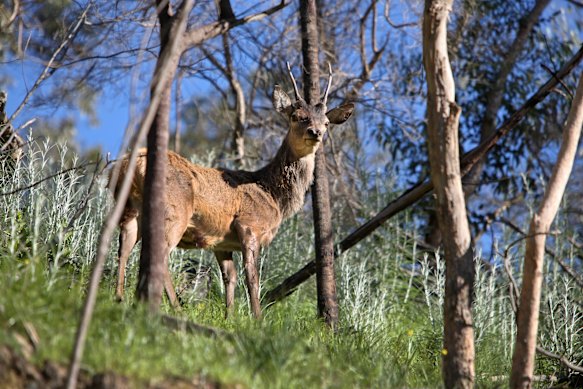

Victorian farmers and environment groups have condemned the Allan government as “offensive” for protecting feral deer as a game species even as numbers explode, and other states act to contain the pest.
With deer seen trotting down inner-city streets and even breaking into a suburban home in one case, the Invasive Species Council estimates there are now 1 million feral deer in Victoria, which has the highest population of feral deer of any state or territory.
In October, the government rejected expert advice to list feral deer as a pest in Victoria, and will instead continue to list deer as a protected game species.
It defended that decision in a government response to the expert panel’s report, stating: “The current arrangements are not a barrier to effective deer control.”
Ahead of the November state election, farmers and green groups have joined forces to lobby for urgent funding for a coordinated and widespread control program, describing the deer problem as “an invasive species emergency that requires immediate intervention”.
In 2021, a male sambar deer was euthanised after dodging cars in Thornbury, Northcote, Clifton Hill and Fitzroy over two days. It was believed the deer had made its way to the inner city via the Yarra River corridor.
They have been steadily encroaching from rural into peri-urban areas, and Australian Deer Association Barry Howlett told this masthead that feral deer had also been seen in suburban areas including Alphington, Ringwood and Ivanhoe.
Victorian Farmers Federation chief executive Charlie Thomas told this masthead the Allan government’s refusal to list feral deer as pests was “offensive”, and his members were concerned about damage to fences, farms, waterways and landscapes.
They were also deeply concerned about the biosecurity risk posed by feral deer, particularly if foot and mouth disease entered Australia and spread between deer and livestock, which Thomas said could place Australia’s $100 billion agricultural industry in danger.
“The fact that you’ve got a pest animal out there that is not native, it’s causing biosecurity risk, it’s causing damage to property, damage to crops and not to mention the safety impacts on rural roads – which are already unsafe enough as it is,” he said.
“The idea that we would be protecting something that so obviously needs to be eradicated is offensive. Hopefully, we will see some common sense on that.”
Also joining the campaign to increase funding to fight feral animals and weeds are Environment Victoria, the Invasive Species Council, Friends of the Earth, the Vertebrate Pest Management Association Australia, Victorian National Parks Association, the Australian Land Conservation Alliance, and the Victorian Deer Control Community Network.
Invasive Species Council chief executive Jack Gough said the groups had polling conducted that showed just 11 per cent of Victorians thought the government was managing invasive species well, which “should be a wake-up call”.
“That’s why farmers, conservationists and community advocates have come together, because we’re fed up with watching invasive species spread across the environment, farms and communities, while the resources needed to tackle this crisis are drained.”
“In New South Wales there was a similar political fight around the protected status of deer, and that shifted when New South Wales farmers and environment groups worked together in engaging directly with the government.”
Environment Victoria chief executive Jono La Nauze said the community was “ahead of the government on this issue”.
“This is an issue that impacts stakeholders across a real diversity of [electoral] seats, from regional seats to peri-urban – we’ve even seen deer trotting down streets in Fitzroy,” he said.
“Communities will throw out a red carpet to the politician who stands up and says, ‘I’m prepared to back you on tackling this problem’.”
Thomas said that, as they battle rising fuel and fertiliser costs, farmers were being forced to spend tens of thousands of dollars on repairing damage to fences and crops caused by deer.
VNPA executive director Matt Ruchel described the deer problem in Victoria as an “infestation”, and said only a systemic eradication program would control feral deer in a meaningful sense.
The Victorian government’s deer control strategy acknowledges that deer cannot be eradicated using current control methods, despite the damaging impacts caused by deer.
Feedback to the state’s deer strategy showed Victorians wanted “more emphasis on managing these impacts and less on deer as a hunting resource”.
The opposition’s public land management and outdoor recreation spokeswoman Melina Bath said Labor had for years failed to get on top of growing deer populations, “allowing the problem to spread while doing little more than shuffling paperwork”.
“The issue has never been classification; it’s been the government’s lack of focus and on‑ground action,” she said.
“The government should be making more use of the untapped resource of hunters and recreational shooters than it currently does, to keep numbers down.”
Australian Land Conservation Alliance chief executive Dr Jody Gunn said the election represented a crucial opportunity to rethink Victoria’s approach to deer control.
“We’ve got huge opportunities to have a restoration ecology across Australia and a restoration economy across Australia, but that’s been significantly impacted by the [effects caused by] deer.”
In 2023, incensed at a renewed push to ban duck hunting in Victoria, the Electrical Trades Union (Victorian branch) – which has a history of backing hunting lobby groups that want to keep deer protected for game shooters – brought together hunters, bush-user groups, rock climbers and prospectors to form the Outdoor Recreation Advocacy Group to lobby against the formation of new national parks, and on behalf of hunters and fishers.
In 2024, the Victorian government refused to adopt the recommendation by a Labor-led Victorian parliamentary inquiry it had established that urged a ban on duck hunting.
Environment Minister Steve Dimopoulos was contacted for comment.
Start the day with a summary of the day’s most important and interesting stories, analysis and insights. Sign up for our Morning Edition newsletter.
 Bianca Hall is The Age’s environment and climate reporter, and has worked in a range of roles including as a senior writer, city editor, and in the federal politics bureau in Canberra.Connect via X, Facebook or email.
From our partners
Disclaimer : This story is auto aggregated by a computer programme and has not been created or edited by DOWNTHENEWS. Publisher: www.smh.com.au





