
Long before the likes of Ben Earl and Andre Esterhuizen, Italy flanker Mauro Bergmasco was forced to moonlight at scrum-half against England in the Six Nations…
Mauro Bergamasco is in his car heading down memory lane, writes Alex Spink.
One of Italy’s greatest players is on his way home discussing rugby’s new penchant for hybrid players. He knows just where the conversation is going.
When the subject of forwards playing as backs and vice versa comes up, all roads inevitably lead back to Twickenham 2009 and that fateful afternoon when the Azzurri opted to start their star openside flanker at scrum-half.
These days there is no sense of jeopardy when André Esterhuizen comes off the bench and slots into the Springbok back row.
Read more: All you need to know about the 2026 Six Nations
An inside-centre by trade, he has made an international career out of his versatility. Nor when Ben Earl switches from back row to centre for England, Kwagga Smith covers wing for South Africa and Tiennan Costley makes the same switch from flanker in the colours of Japan.
Thirty years after rugby turned pro, hybrid players are all the rage. They enable teams to pack more muscle onto their bench and maximise the collective output of 23 men across 80 minutes.
It wasn’t like that 17 years ago when Bergamasco, an openside with 69 caps, got a tap on the shoulder from Nick Mallett, then head coach of Italy.
Mallett wasn’t trying to be clever, to shuffle his resources to allow for a 6-2, or even 7-1 forward-back configuration amongst the cavalry. He was desperate. And you know what they say about desperate times. The former Springbok No 8 had run out of scrum-halves for the game against England.
He looked at Bergamasco, saw a top-class defender with a decent kick on him, and thought, ‘why not?’
Days later, you didn’t need a coaching badge to answer the question. England won the game, Bergamasco, a fish out of water, was subbed off at half-time. Player and coach were lampooned. Until now, neither man has cared to revisit the episode.
Rugby World wanted to understand how it happened and the lessons that were learned. The two men agree to talk
Why did Italy flanker Mauro Bergamasco play scrum-half in the Six Nations?
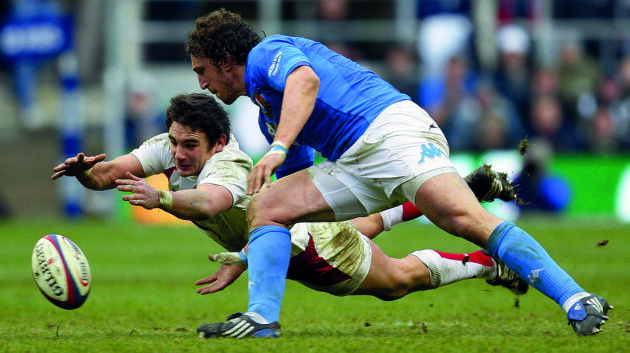
Italy’s scrum half Mauro Bergamasco (R) and England scrum half Harry Ellis (L) dive for a loose ball during the Six Nations international rugby match, at Twickenham, west of London, February 7, 2009. England won the match 36-11. AFP PHOTO / Adrian Dennis ( ADRIAN DENNIS/AFP via Getty Images)
The plot line…
The start of the 2009 Six Nations was days away and Italy were without a fit scrum-half of Test quality.
Simon Picone and Pietro Travagli were injured, so too Pablo Canavosio. Mallett, highly respected, decided switching Bergamasco was the best option given his Test nous and versatility.
He had, after all, already started a Test on the wing. Publicly, the former South Africa coach contended that Bergamasco would tackle more Englishmen at half-back than he would playing in the back row.
It was wishful thinking.
Related: Get this feature and much more in Issue 321 of Rugby World, our Six Nations Legends special…
Mallett: “It was needs-must. When I took the job I took it for granted that Italy would have enough nines. I never imagined a situation where a country would struggle to field a scrum-half capable of competing at international or even club level.
“But they just didn’t have any. Of the ten first division clubs in Italy, only three scrum-halves were qualified to play for the Azzurri. It was a position overseas players tended to fill.
“I should have thought about the lack of depth in the position long before but you don’t. You’re always thinking about which is the best player. I knew there were two or three, but when they all got injured I was really in trouble.
“I was between a rock and a hard place and no one understood it. They said, ‘This guy is off his head. What’s he doing playing a flanker at scrum-half? He’s making Mauro play at nine, making him look an incompetent, inadequate rugby player.’ But I didn’t have another option. It was a dreadful situation.
“I even tried to talk Alessandro Troncon (assistant coach and Italy’s most-capped scrum-half) into putting the jersey on again. He said, ‘No way, not fit enough.’ “I remember speaking to the president. ‘I don’t want to do this,’ I said. ‘But find me another scrum-half who’s qualified to play’.”
The build-up
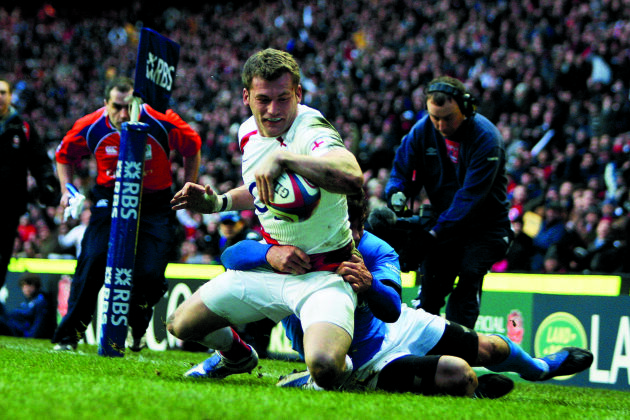
Mark Cueto of England dives to score a try during the RBS 6 Nations Championship match between England and Italy at Twickenham on February 7, 2009 in London, England. (Photo by Warren Little/Getty Images)
Bergamasco: “I can say this now but 17 years ago I didn’t realise how much time you need to spend learning new habits when you switch from flanker to No 9.
“On the Friday before the match I had pain in my legs because the position was so different. As a No 9 when you prepare to pass you put down your ass to the ground and stay straight with your back.
“When you are a flanker the body position is very different. You get in a position where your back is ready to impact the ruck. Mix those two up and you don’t have a good pass.
“That is one part of it. The other is that while your focus is on trying to think and play like a scrum-half, under pressure your instinct is to go back to thinking as a flanker. In the heat of the moment it’s not easy to make the right choice of which part of your brain to listen to first.”
Mallett: “I got Sergio Parisse and Troncon together and chatted to them about Mauro and the other option, Edoardo Gori. They said, ‘Listen, playing at Twickenham against England is a massive, massive pressure cooker. For a position like nine, it really is tough.’
“But they agreed we should start Mauro. He was kicking well from the base. Obviously, his defence was outstanding. And because he was dangerous over the ball as an openside, I thought it could work.”
Related: Wooden Spoons and Murderball – The wild days of Italy in the Six Nations
The match itself…
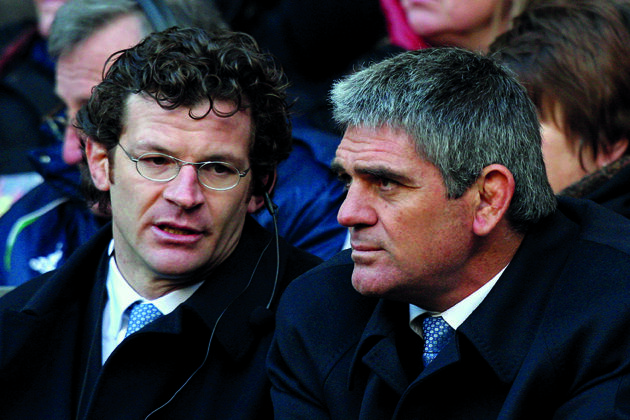
Nick Mallett (R) the head coach of Italy and Carlo Checchinato the Italy team manager look on during the RBS 6 Nations Championship match between England and Italy at Twickenham on February 7, 2009 in London, England. (Photo by David Rogers/Getty Images)
England, in their first Six Nations game under Martin Johnson, scored five tries and won 36-11. In 32 attempts Italy have never beaten England.
On 15 of those occasions, England scored 40 points or more. So 2009 was an upgrade but it’s not remembered as such.
England bagged three tries in the first half-hour, two after Bergamasco was sucked into rucks rather than patrolling the fringe, the third after his pass sailed over the head of Gonzalo Garcia and Riki Flutey capitalised.
Mallett: “Under the pressure of an England team playing at home and determined to put a lot of pressure on him, Mauro froze. He just hadn’t had enough experience in that position and that was on me.
“I took him off at half-time and in the changing rooms said, ‘I want to apologise to you, Mauro, and to the whole team. This hasn’t worked. I was hoping it would. I take all the blame for this. I’m helluva sorry.’
“It was a very, very embarrassing afternoon for us all. Mauro was in tears. He felt he’d let the team down. I had a long chat with him. I said, ‘Mauro, listen, I did it because I had confidence in you, because you’re an experienced player, because you’re a guy I can count on in any Test match.’
“I thought there was an outside chance we could get away with it. But we didn’t. The Italian rugby media were very critical of what I’d done. I can understand that.”
Bergamasco: “You sense a lot from how the team receives the news, the level of trust they have in that decision. In this instance, 50% of the team didn’t agree with the choice to move me to No 9.
“This is more difficult because on the field you give everything you have to your team-mates. If just one player doesn’t believe in that it becomes difficult. One of them said to me, ‘What are you f**king doing? Why did you say yes?’
“I said I accepted because it was a question the coaches asked of me in an emergency. There was just a young No 9, Giulio Toniolatti, who they preferred to put on the bench and use in the event of a problem, which they did in the second half.”
The lesson and the legacy…
Bergamasco: “You cannot switch from the forwards to playing No 9 without proper preparation. I could not say that in 2009. I can now.
“Some positional switches are less complex. From nine to ten, for example. But for this there was not enough time for me to prepare.”
For more stories like the one you are reading, buy the latest issue of Rugby World “Six Nations Legends” here.

Rugby World Six Nations Legends issue
Mallett: “If I could have that time again with Italy, I’d spend the first couple of months assessing the strength in depth of every position. That way I’d have seen we had a serious problem at scrum-half.
“I’d then say, ‘Okay, what do we do if in the Six Nations we have only one fit nine and no one who is able to come off the bench?’
“I’d then have assigned Mauro to at least two sessions a week with Troncon to work on his box kicking, positional play and passing from the base. That was my mistake. We should have given the guy two months of contact practices where he was put under pressure and adapted his game to it.
“Instead, I put Mauro in at Twickenham in front of 82,000. I asked much too much of him.
“Look at how Rassie (Erasmus) works with his players nowadays. Guys like André and Kwagga he gives absolute confidence in their ability to play in the position that he wants to move them to.
“Esterhuizen knows all the lineout calls. His impact on a driving maul is as good as Malcolm Marx because he’s 120 kilos. All the time Rassie is looking for hybrid players and he puts time into developing them.
“There’s a saying, imitation is the greatest form of flattery. You’ll see that every single national coach now is copying what Rassie does.
“Unfortunately, the way we went about it with Mauro had probably a 10% chance of working. Had I prepared them properly it would have been nearer 50%. You live and learn.”
Download the digital edition of Rugby World straight to your tablet or subscribe to the print edition to get the magazine delivered to your door.
Disclaimer : This story is auto aggregated by a computer programme and has not been created or edited by DOWNTHENEWS. Publisher: rugbyworld.com