Jon Gambrell, Melanie Lidman, Josh Boak and Eric Tucker
Updated ,first published
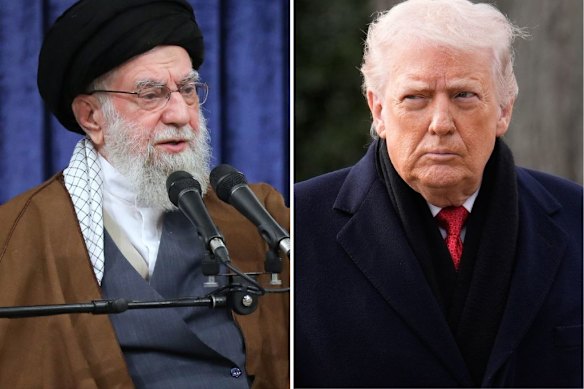
US President Donald Trump says the death of Iranian Supreme Leader Ali Khamenei is the “greatest chance” for Iranians to take back the country following a stunning new chapter in American military intervention that opens the potential for retaliatory violence in the Middle East and elsewhere.
Iranian state media confirmed the death, without elaborating on a cause of death, following the most ambitious strikes on the country by the United States and Israel in decades on Saturday Australian time.
In a social media post on Sunday Australian time, Trump called Khamenei “one of the most evil people in history” and said that “heavy and pinpoint bombing” would continue “uninterrupted” in the coming week and possibly beyond.
“This is not only Justice for the people of Iran, but for all Great Americans, and those people from many Countries throughout the World, that have been killed or mutilated by Khamenei,” he said in the post.
“He was unable to avoid our Intelligence and Highly Sophisticated Tracking Systems and, working closely with Israel, there was not a thing he, or the other leaders that have been killed along with him, could do.”
Earlier, Israeli Prime Minister Benjamin Netanyahu said in a nationally televised address that there were many signs indicating Khamenei “is no longer” and calling on Iranians to finish the job.
He said that Khamenei’s compound had been destroyed, and Revolutionary Guard commanders and senior nuclear officials had also been killed.
Iran has called the strikes unprovoked and illegal and responded with missiles fired at Israel and at least seven other countries, including Gulf states that host US bases.
Mourners raised a black flag over the Imam Reza shrine in Mashhad, Iran’s second-largest city and a major pilgrimage site for Shiite Muslims. Iran’s paramilitary Revolutionary Guard threatened on Sunday to launch its “most-intense offensive operation” ever after the killing of the supreme leader.
“The most-intense offensive operation in the history of the armed forces of the Islamic Republic of Iran will begin in moments, targeting (Israel) and American terrorist bases,” it said.
The death of the Iranian leader opens a stunning new chapter in US intervention in Iran and carries the potential for retaliatory violence in the Middle East and elsewhere. The strikes launched on Iran also represented a startling flex of military might for an American president who swept into office on an “America First” platform and vowed to keep out of “forever wars”.
The killing of Khamenei in the second Trump administration assault on Iran in eight months appeared certain to create a leadership vacuum given the absence of a known successor. The 86-year-old supreme leader had the final say on all major policies during his decades in power.
Khamenei led Iran’s clerical establishment and its paramilitary Revolutionary Guard, the two main centres of power in the governing theocracy. As reports trickled out about the death, eyewitnesses in Tehran told The Associated Press that some residents were rejoicing, blowing whistles and letting out ululations.
Australia doing its best to help stranded citizens
Australian Prime Minister Anthony Albanese said on Sunday that the federal government’s ability to help Australians stranded in the region was limited because of the lack of diplomatic staff in the region.
“We’re doing this on an hour-by-hour, minute-by-minute basis,” he said on Sunday.
The government’s national security committee met on Sunday morning to discuss the fast-developing situation.
Australia severed diplomatic ties with Iran in 2025 after spy agency ASIO accused Tehran of orchestrating two attacks on Jewish sites in Sydney and Melbourne.
The prime minister backed the US-Israeli strikes but called for civilians to be protected while dodging questions about the legality of the attacks, saying that was a matter for the countries involved.
“We support the United States acting to prevent Iran from obtaining a nuclear weapon and to prevent Iran from continuing to threaten international peace and security,” he said.
“Australia stands with the brave people of Iran in their struggle against what is an oppressive regime.” He added that no-one would mourn Khamenei.
Foreign Minister Penny Wong played down the likelihood of Australian troops becoming involved in the conflict, even if there was the potential for a change of Iranian leadership. She confirmed Australian leaders were not told in advance about the strikes.
The joint US-Israel operation, which officials say was planned for months, took place Saturday Australian time during the Muslim holy fasting month of Ramadan and at the start of the Iranian workweek. It followed stilted negotiations and warnings from Trump, who last year trumpeted his administration’s success in incapacitating the country’s nuclear program but nonetheless cast the latest round as necessary to head off its potential resurgence.
About 12 hours after the attacks began, the US military reported no US casualties and minimal damage at US. bases despite “hundreds of Iranian missile and drone attacks.” It said targets in Iran included Revolutionary Guard command facilities, air defence capabilities, missile and drone launch sites, and military airfields.
Israeli military officials confirmed that the initial Israeli-led strikes had killed Iranian Defence Minister Amir Nasirzadeh and Revolutionary Guards commander Mohammed Pakpour, along with five other senior Iranian military officers.
At least three explosions were heard on Saturday evening near the Intelligence Ministry building in northern Tehran, witnesses said, adding that air defence systems had begun operating there. Israel’s military said it had begun new strikes against missile launchers and aerial defence systems in central Iran.
In southern Iran, at least 115 people were reported killed when a girls’ school was struck, and dozens more were wounded, the local governor told Iranian state TV. US Central Command spokesperson Captain Tim Hawkins said he was “aware of reports” that a girls’ school was struck and that officials were looking into them.
State news agency IRNA said at least 15 people were killed in the southwest, quoting the governor of Lamerd, Ali Alizadeh, as saying a sports hall, two residential areas and a hall near a school were hit.
Iranian counterattack causes travel chaos
With much of the airspace over the Middle East closed, most major airports in the region, including the Dubai International Airport, have been forced to close.
Four people were injured after an incident at Dubai Airport, which is the world’s busiest international travel hub, handling more than 1000 flights a day. Iran fired missiles at Abu Dhabi, Dubai and Doha, all key east-west aviation gateways. Airlines suspended flights across the Middle East on Saturday — including to and from Dubai and Abu Dhabi.
Dubai and neighbouring Doha sit at the crossroads of east-west air travel, with much of the long-haul traffic between Europe and Asia passing through both airports. A prolonged shutdown, which looks likely, will put the global aviation network under pressure with airlines forced to cancel or reroute flights.
On Saturday, nearly 1000 of about 4200 flights scheduled to arrive in Middle Eastern countries were cancelled, data from aviation analytics firm Cirium shows. Adding in scheduled departures, the total number of cancellations exceeded 1800 flights in a day.
“Some flights already en route today were diverted,” said Juliette Alpha. “Most of those were from Middle Eastern carriers. A few non-Middle Eastern airlines had already departed at the time of the military action today.” Emirates cancelled 108 of 269 scheduled flights. Etihad cancelled 80 of 191 scheduled flights. Qatar cancelled 174 of 304 flights.
‘An unforgettable lesson’
Iran has responded to the strikes with its own counterassault, with Ali Larijani, the secretary of Iran’s National Security Council, saying that Israel and America will “regret their actions”.
“The brave soldiers and the great nation of Iran will deliver an unforgettable lesson to the hellish international oppressors,” Larijani posted on social media platform X.
Iran has targeted US bases in Qatar (Al-Udeid), Kuwait (Ali al-Salem), the UAE (al-Dhafra), and Bahrain (Fifth Fleet base), alongside attacks in Iraq and Jordan.
Israeli news outlet Haaretz said that one person had died and more than 20 wounded after an Iranian missile directly hit a building in central Tel Aviv. The building partially collapsed and a fire broke out at the scene, emergency services told Haaretz.
Meanwhile, blasts were heard in the Dubai area and over Qatari capital Doha for a second day on Sunday, as Iran continues to target the neighbouring Gulf states in response to US and Israeli strikes.
Iran’s government has declared 40 days of public mourning and a seven-day nationwide public holiday to commemorate Khamenei’s death. Iranian state television described Ayatollah Ali Khamenei as being at his compound in downtown Tehran when the initial attack began.
Satellite photos from Airbus showed the site heavily bombed. The daughter and son-in-law of Khamenei were killed in the US-Israeli attacks in Iran, according to semi-official news agency.
Also killed in Saturday’s attacks were a grandchild and a daughter-in-law, Fars News Agency, citing unidentified sources. The agency didn’t provide further details.
Domestic response to the attacks in the US
Trump’s military strikes have prompted the Democrats to demand an “immediate” vote in the US Congress, accusing the president of usurping the legislative branch’s power to declare war.
Given the scope of the strikes and the US president’s broad goal of toppling the Islamic Republic, the Democrats are arguing that under the US Constitution and the War Powers Resolution, only Congress could declare war.
However, there is also division in the party about how to respond to Trump’s strikes, with some prominent voices denouncing the strikes while others are ambivalent or supportive.
Hakeem Jeffries, leader of the Democrats in the House of Representatives, said Iran was a bad actor and must be restrained, but in the absence of exigent circumstances, Trump must seek congressional authorisation for pre-emptive use of military force that constitutes an act of war.
“The Trump administration must explain itself to the American people and Congress immediately and provide an ironclad justification for this act of war,” he said.
Meanwhile, the United States and Israel have clashed with Iran at an emergency meeting of the UN Security Council where the UN Secretary-General António Guterres and many other countries urged a halt to their attacks and a return to negotiations to prevent the conflict from spreading further into the region and beyond.
Guterres also condemned Iran’s attacks on Bahrain, Iraq, Jordan, Kuwait, Qatar, Saudi Arabia and the UAE.
Amir Saeid Iravani, Iranian ambassador to the UN, told the council that the airstrikes have killed and injured hundreds of Iranian civilians, which he called a war crime and a crime against humanity.
However, the US ambassador to the United Nations, Mike Waltz, insisted the US military action was lawful. “Iran cannot have a nuclear weapon,” he told the council. Israel’s UN ambassador Danny Danon also defended the airstrikes as necessary to stop an existential threat.
What happens next in Iran
Khamenei succeeded Ayatollah Ruhollah Khomeini, the leader of the 1979 Islamic Revolution. He had the final say on all major policies, led Iran’s clerical establishment and personally commanded the paramilitary Revolutionary Guard – the two main centres of power in the country’s theocracy.
He served as Iran’s president from 1981 to 1989 and is only the second Supreme Leader since the Islamic revolution of 1979.
A hardliner, Khamenei had strenuously resisted efforts from the Iranian government to improve relations with the US and was not in support of Iran downgrading it nuclear capabilities.
The regime led by Khamenei was under growing pressure with protests held earlier this year.
“Rioters must be put in their place,” Khamenei declared after security forces cracked down on hundreds of thousands protesters on January 8 and January 9. Activists said they documented more than 7000 killed and were working to verify more. The government has acknowledged more than 3000 dead, which is still higher than the toll from past crackdowns.
Israeli and US bombardment during last summer’s 12-day war had heavily damaged Iran’s nuclear program, missile systems and military capabilities. Iran’s network of regional proxies, including Hamas in Gaza, Hezbollah in Lebanon and the Houthis in Yemen, has been weakened by Israeli and US attacks since the war in Gaza began, along with Tehran’s influence across the Middle East.
The first major threat to Khamenei’s grip was the reform movement in 1989 that swept into a parliamentary majority and the presidency soon after he became supreme leader. It advocated for giving greater power to elected officials, which Khamenei’s hard-line supporters feared would lead to dismantling the Islamic Republic system.
Khamenei rallied the clerical establishment, and unelected bodies run by mullahs shut down major reforms and barred reform candidates from elections. Since then, waves of popular protests have been crushed, including nationwide demonstrations erupted in 2009 over allegations of vote-rigging and protests in 2017 and 2019.
More protests came in 2022 over the death of Mahsa Amini, who was detained by police for not wearing her mandatory headscarf properly. And the latest demonstrations touched off after the country’s currency, the rial, plunged to a record low of 1.42 million to the US dollar were mercilessly suppressed.
With no succession plan in place, a panel of Shiite clerics will be tasked with choosing one of their own to succeed Khamenei.
Danny Citrinowicz, an Iran expert at Israel’s Institute for National Security Studies, told The Associated Press this week that a key lesson Tehran drew from last year’s war was the need to ensure regime continuity in case of Khamenei’s death. He added that power could shift to a small committee of top officials until hostilities subside.
“It is possible that Khamenei has indicated a preferred successor behind closed doors,” Citrinowicz said. “However automatic implementation of a preselected successor will increase internal friction during war.”
However, Iran’s Revolutionary Guard has grown to become the country’s most powerful body and there is a risk that guard commanders or Iran’s regular military could opt to seize power more overtly.
AP
Read more on the US-Israel-Iran conflict:
From our partners
Disclaimer : This story is auto aggregated by a computer programme and has not been created or edited by DOWNTHENEWS. Publisher: www.smh.com.au