American and European universities have long been the gold standard in higher education, attracting top students from around the world to institutions like Harvard, Stanford, and Oxford—thanks in large part to their research prowess.
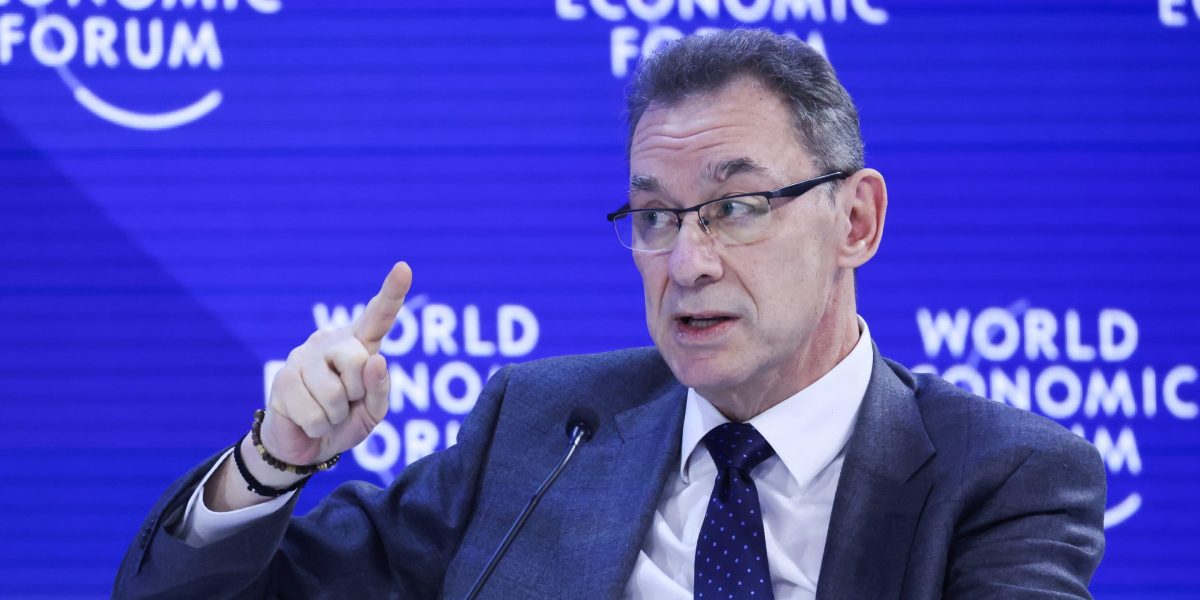
But that dominance is starting to erode—and Pfizer CEO Albert Bourla is sounding the alarm.
“Everything in China in research, it is three times the speed, half the cost,” Bourla said earlier this week at a Council on Foreign Relations event, pointing to a dramatic shift in the Nature Index, which tracks research output by institutions. In 2020, universities in the U.S. and Europe dominated the top 10. But now, just half a decade later, nine of those spots are held by Chinese institutions.
China’s rise, he argued, has been deliberate. Over the past few decades, they’ve modernized their regulator, strengthened their intellectual property system, increased funding for research institutions, and created incentives to channel capital into innovation. The result is a research ecosystem that, in some cases, is moving far faster—and more cheaply—than its Western counterparts.
“They built their science,” Bourla said, speaking alongside John Waldron, chief operating officer at Goldman Sachs, and Gina Raimondo, former U.S. secretary of commerce. “So this is where we need to become better.”
Less bureaucracy has also made it easier for hospitals to run studies, for example, and the widespread use of AI in study design and execution has accelerated progress, Bourla added.
While the Nature Index noted that the list only tracks a select group of natural and health science journals, and the U.S. still leads in the proportion of research of the highest quality, Bourla said it is still a wake-up call.
“Right now, I think they are not at the same level as the U.S., but they are very close,” he said. “But the rate with which they go up predicts that they will be better than us within the end of this decade.”
Fortune reached out to Pfizer for further comment.
China’s education push is fueling a new generation of scientific talent
Pfizer has seen global research leadership shift before. In the 1980s and 1990s, the company’s primary research hub was in the United Kingdom. But that changed in the early 2000s as U.S. investment—particularly through the National Institutes of Health—surged.
“That created a situation that they were giving a lot of grants to universities,” Bourla recalled. “Those universities would discover something new and interesting [and] spin it off into a separate company.”
Now, he said, the U.S. dominance in biotechnology is challenged by a major competitor for the first time in recent history. And what makes China’s rise different is the scale and coordination of its approach to innovation—particularly in education.
In many parts of the country, children are being introduced to AI at an early age. In Beijing, for example, primary and secondary schools are offering dedicated AI instruction each year, covering topics ranging from chatbot use to the ethics of technology. Chinese students also tend to spend more time in the classroom than their U.S. peers.
There are already signs that those investments are paying off. Nearly one-third of the world’s top AI talent was born in China, according to a 2020 study from the Paulson Institute. At the same time, a growing share of Chinese scientists trained in the U.S. are considering returning home, with more than 1,400 making the move in 2021 alone—a sharp increase from the year prior, according to research from Princeton University, Harvard University, and Massachusetts Institute of Technology.
“There’s a lot of enthusiasm for AI and machine learning within government, industry and academic circles,” Jun Liu, a former Harvard professor who joined Tsinghua University last year to lead the school’s new statistics and data science department, told Bloomberg. “The draw of AI talent is due to capital, and the Chinese government’s support for scientific research, including in AI and related areas.”
For Bourla, the takeaway is clear: the U.S. risks focusing too much on slowing China down—and not enough on speeding itself up. That mindset is already shaping Pfizer’s own strategy. Bourla said the company isn’t just looking at China as a market for selling drugs, but increasingly as a source of innovation. At the same time, the 64-year-old warned that U.S. policymakers and industry leaders need to rebalance their priorities.
“80% of our effort, 80% of our brain power, should go to—what do I need to change to become better than them?” he told Fortune earlier this year on the Titans and Disruptors of Industry podcast.
“How can I take the unique advantages of our political system, of our university, of our biotech, and do the right policy changes? Do the right investments so it can become better than them? And that’s what will define the success or failure of the U.S. biomedical community.”
Disclaimer : This story is auto aggregated by a computer programme and has not been created or edited by DOWNTHENEWS. Publisher: fortune.com