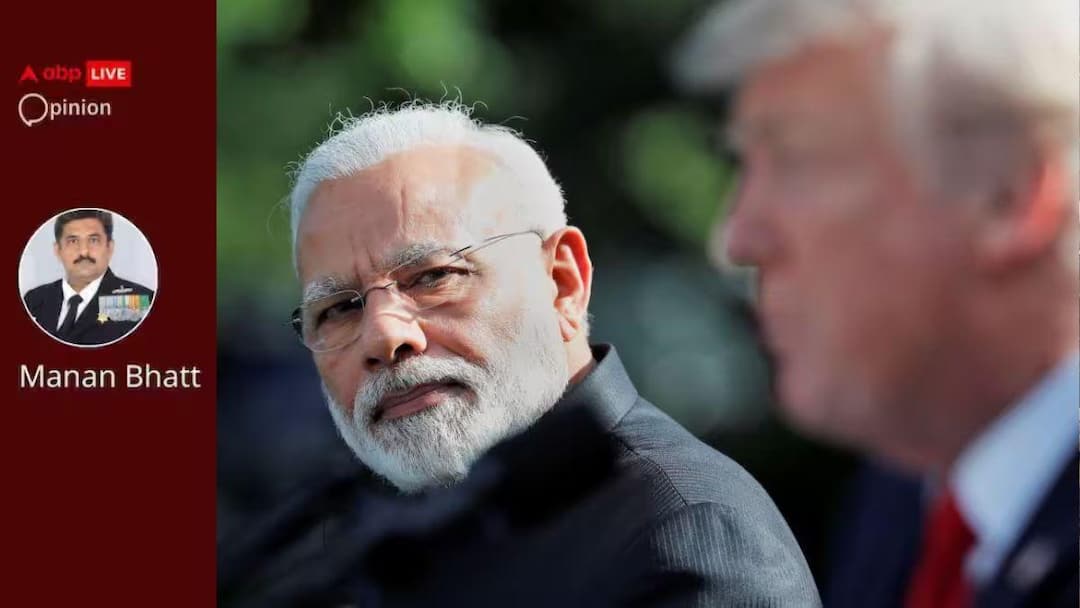
Recent revelations from senior American officials should serve as a wake-up call for New Delhi. According to a report in The Sunday Guardian, U.S. diplomats have explicitly conveyed that Washington “will not automatically align with India in the event of a crisis involving Pakistan”. The message is unambiguous: the United States views its relationship with India through the cold lens of “strategic realism,” where the “rules-based international order” is dismissed as a “gauzy abstraction” that cannot supersede American national interests.
This is not merely diplomatic hedging, it is a declaration that the U.S. maintains “working relationships with both India and Pakistan” and would prioritise “regional stability” over taking sides, even when India faces terror attacks. For those in Delhi who imagined the expanding defence partnership and technology-sharing agreements signalled an alliance, the wake-up call has arrived. Washington has drawn a clear line: cooperation against China in the Indo-Pacific does not translate into backing India in subcontinental conflicts.
1971: When The US Tilted Against India
To understand what this means for India’s future security, we must look to the past. During the 1971 Indo-Pakistani War, a conflict precipitated by Pakistan’s genocidal crackdown in East Bengal that sent ten million refugees flooding into India, the Nixon administration didn’t merely remain neutral; it actively mobilised against Indian interests.
Declassified documents reveal the extent of American hostility. President Richard Nixon and National Security Advisor Henry Kissinger, driven by their reliance on Pakistan as a conduit to China, orchestrated a massive show of force against India. On December 10, 1971, Nixon ordered the USS Enterprise, the world’s largest nuclear-powered aircraft carrier, to lead Task Force 74 into the Bay of Bengal. The fleet included guided missile destroyers, amphibious assault carriers carrying 200 Marines, and a nuclear attack submarine, a force explicitly assembled to “overshadow” Soviet vessels already supporting India.
The threat was not implicit. Nixon warned Indian Ambassador L.K. Jha that continued military operations against West Pakistan would lead “inevitably toward a confrontation between the USSR and the US”. The U.S. had “treaty obligations” to Pakistan, Nixon insisted, and Washington intended to honour them. Behind the scenes, Kissinger encouraged China to mobilise troops on India’s borders and provided Beijing with detailed intelligence on Indian deployments. The U.S. also orchestrated a covert arms pipeline, pressuring Iran, Jordan, Turkey, and Saudi Arabia to transfer fighter aircraft and military equipment to Pakistan despite a congressional arms embargo.
Freshly declassified papers reveal an even more chilling detail: the USS Enterprise had orders to target Indian Army facilities, and three battalions of Marines were kept on standby to deter India. This was not deterrence, it was preparation for potential conflict with a nation defending itself against Pakistani aggression.
Pokhran And The Sanctions Shock
America’s pattern of punishing Indian strategic autonomy extends beyond the battlefield. When India demonstrated its nuclear capability at Pokhran in May 1998, Washington’s response was immediate and severe. President Bill Clinton invoked the Glenn Amendment to impose comprehensive sanctions including: termination of all non-humanitarian aid; bans on defence exports and military training; opposition to World Bank and IMF loans; prohibition of U.S. bank credits to the Indian government; and blacklisting of 208 Indian entities including corporations and research institutions.
The sanctions were designed to cripple India’s defence, space, and technology sectors. As one State Department official noted, the goal was to “send a strong message to would-be nuclear testers” and “have maximum influence on Indian… behavior”. The U.S. even gained G-8 support to postpone consideration of non-basic human needs loans for India by international financial institutions.
Yet India endured. As Prime Minister Atal Bihari Vajpayee declared: “Sanctions cannot and will not hurt us. India will not be cowed down by any such threats and punitive steps”. The stock market responded positively to the tests, and India weathered the economic storm through indigenous development and diplomatic diversification. The sanctions were eventually lifted, not because America changed its mind about India’s nuclear programme, but because 9/11 transformed strategic calculations and Washington needed partners in its “War on Terror”.
The US-Pakistan Nexus
While America punished India for asserting its sovereign rights, it simultaneously embraced Pakistan, a nation that has consistently compromised its sovereignty to serve U.S. interests. The most striking example is the CIA-ISI collaboration during the Soviet-Afghan War. Beginning in 1979, the U.S., Saudi Arabia, and Pakistan’s Inter-Services Intelligence (ISI) formed a three-way alliance to fund and arm the Afghan mujahideen.
The American role provided logistics, technology, and money; the Saudis matched U.S. contributions dollar-for-dollar; but it was the Pakistani ISI that “picked the political winners and losers in the jihad,” deliberately favouring radical Islamist factions because it suited Pakistan’s goal of controlling Afghanistan. The U.S. acquiesced to this radicalisation because, as one CIA officer explained, “no more hearts and minds for us”, let the Pakistanis decide who carried the jihad forward.
The consequences were catastrophic. The madrassas of Pakistan, funded by Saudi Arabia and supported by the Pakistani military government, became breeding grounds for the Taliban. These “students” of radical Islam emerged from refugee camps and Pakistani seminaries to seize power in Afghanistan in 1996, creating a theocracy that would eventually shelter al-Qaeda. When the Soviets withdrew in 1989, the U.S. declared victory and abandoned Afghanistan, leaving Pakistan to manage the Frankenstein’s monster it had helped create.
This pattern repeated after 9/11. Despite Pakistan’s role in nurturing the Taliban, Washington immediately lifted sanctions on Islamabad and poured billions in military aid into the country, aid that often found its way back to the very extremist networks America claimed to be fighting. The U.S.-Pakistan relationship, as one analyst noted, has always been characterised by “independent Pakistani Islamization agendas” that Washington either ignores or actively supports when convenient.
Implications For India’s Security Today
The implications for India’s current security environment are stark. When India launched Operation Sindoor following the Pahalgam terror attack, it demonstrated the resolve to strike terrorist sanctuaries across the Line of Control. But the American message has been clear: don’t expect Washington’s support in future operations.
The “issue-based collaboration” framework means that while the U.S. wants India as a counterweight to China, it views Pakistan as a “regional stabiliser” necessary for managing Afghanistan and Central Asia. The State Department’s affection for Pakistan persists despite the Intelligence Community’s assessment that Pakistan’s missile development “put our homeland within range”. This cognitive dissonance, viewing Pakistan simultaneously as a threat and a partner, creates a permanent ambiguity in America’s South Asia policy.
History suggests that in any future crisis resembling 1971, Washington will again tilt toward Pakistan. The “hyphenation” of India and Pakistan in U.S. policy thinking means that American officials feel “no discomfort in addressing both countries within the same regional context”. For India, this is strategic poison, it reduces a rising power to the equivalent of a failed state that harbours terrorists.
1971 Revisited: India’s Strategic Resolve
Faced with the Seventh Fleet’s nuclear shadow in 1971, Indira Gandhi did not flinch. When Nixon’s task force entered the Bay of Bengal, she leveraged the Indo-Soviet Treaty of Peace, Friendship and Cooperation to its fullest extent. Her adviser D.P. Dhar asked: “What is the point of India having signed the Indo-Soviet treaty… if India cannot call this bluff?”.
The Soviets responded by deploying cruisers, destroyers, and a nuclear-armed submarine to trail the American fleet from December 18, 1971, to January 7, 1972. Moscow sent a top-secret message to Nixon warning against “involvement or interference”. Faced with this combined Indo-Soviet resolve, Task Force 74 remained hundreds of miles from the combat zone, arriving only after Pakistan’s surrender on December 16.
Strategic Autonomy: The Only Way Forward
This is the model for India’s future. Strategic autonomy is not a luxury, it is survival. The Vajpayee government’s Pokhran tests, undertaken despite certain knowledge of sanctions, demonstrated that India could withstand American pressure. The 2008 Indo-U.S. nuclear deal and subsequent defence agreements have created valuable partnerships, but they come with implicit strings that could strangle Indian options in a crisis.
The Sunday Guardian report confirms what realists have long suspected: the U.S.-India partnership has limits drawn by American interests, not Indian security. Washington’s willingness to “manage escalation risks” rather than take sides, its comfort with “hyphenating” India and Pakistan, and its refusal to diplomatically isolate Islamabad all point to a recurring pattern.
For India, the lesson is clear. The next Operation Sindoor, or any major response to Pakistani terror, must be planned without counting on American support. The defence partnerships, technology transfers, and joint production agreements are valuable, but they are not alliance commitments. As Kissinger might say, they represent “issue-based collaboration” that stops when the issue becomes inconvenient for Washington.
India must straighten its spine as Indira Gandhi did, understanding that sovereignty sometimes demands standing alone. The Pokhran sanctions were survived. The Seventh Fleet was stared down. The mujahideen-Taliban cycle, created by U.S.-Pakistani collusion, was contained. Each time India asserted its autonomy, it emerged stronger.
The alternative, bending to American pressure as Pakistan has consistently done, leads only to compromised sovereignty and perpetual subordination. Pakistan’s history of serving as a Cold War conduit, an Afghan jihad facilitator, and a post-9/11 “major non-NATO ally” has earned it American support, but at the cost of becoming a client state whose territory hosts drones, whose policies are dictated from Washington, and whose stability is measured by American metricThe alternative, bending to American pressure as Pakistan has consistently done, leads only to compromised sovereignty and perpetual subordination.s.
India’s path is harder but nobler: strategic autonomy, military self-reliance, and diplomatic diversification. The U.S. may be a partner, but it will never be a patron. In the next crisis, when the carrier groups move and the sanctions threats emerge, India must remember 1971 and Pokhran, and choose independence over alignment, whatever the cost.
(The Author is a Veteran of the Indian Navy and a Military Historian.)
(Disclaimer: The opinions, beliefs, and views expressed by the various authors and forum participants on this website are personal and do not reflect the opinions, beliefs, and views of ABP Network Pvt. Ltd.)
Related Video
Anti-War Wave: Iran Strikes Dimona as Global Protests Surge Against Escalating War
Disclaimer : This story is auto aggregated by a computer programme and has not been created or edited by DOWNTHENEWS. Publisher: abplive.com