
Mercedes drivers have won every grand prix and sprint race this season. A modest sample size, given this weekend’s Japanese Grand Prix is round three, but that hasn’t stopped George Russell continuing to be the championship favourite.
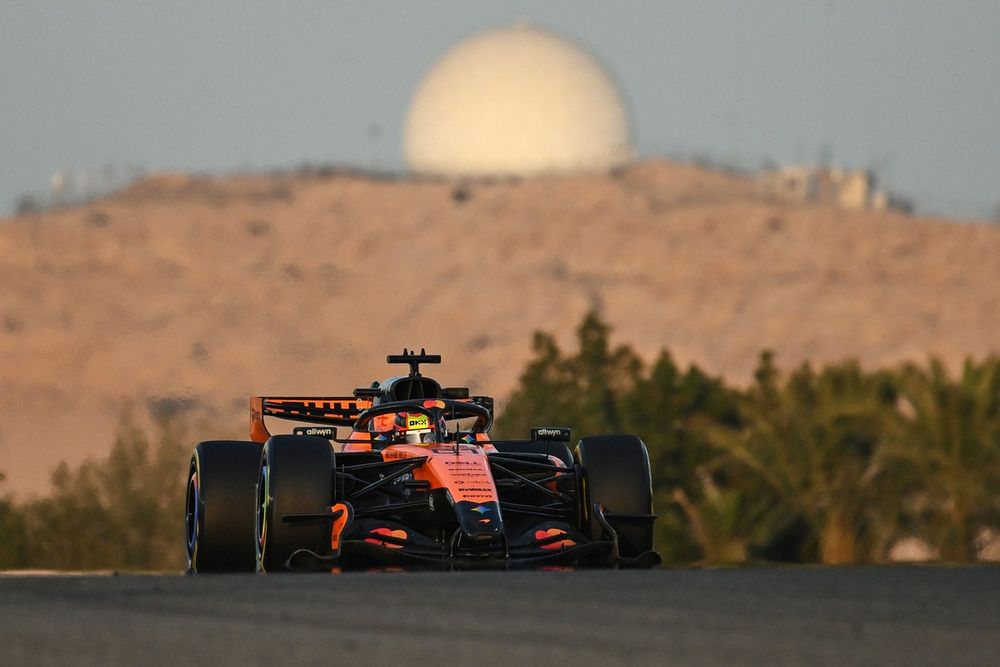
Oscar Piastri, a title contender last season, has yet to actually start a grand prix this year, and his McLaren team is having to come to terms with the fact that both Mercedes and Ferrari have faster cars at the moment. Mercedes’ advantage has been particularly galling for its customers – including McLaren – which didn’t receive the latest spec of power unit before the Australian Grand Prix, putting them further down the learning curve.
There has also been intrigue surrounding Mercedes’ active aerodynamics after it emerged that at least one team lodged a request for a regulatory clarification from the FIA – a standard piece of gamesmanship when competitors feel a rival is exploiting a loophole in the rules.
But McLaren’s public stance is that it needs to improve its own car after two brutal opening rounds.
“There’s nothing magical about it,” said Piastri when asked if McLaren was any closer to identifying the areas in which Mercedes is making significant gains.
“I think they just have probably more downforce. I think they’re using the power unit a bit better than us at the moment, and it’s as simple as that, really. There’s no magic.
“When you’re sitting in the race car, Kimi [Antonelli] disappeared in front of me pretty quickly [after the safety car restart in the Chinese sprint race]. The more helpful tool is definitely looking at the data, and we’re losing a bit everywhere.
“There’s not really one area where we’re weak or one area that we’re strong in. It’s just a bit across the board, so I think just finding more downforce is our main opportunity.
“I think the Ferrari is interesting as well because it almost looks like they’re even better in the corners, but maybe a bit worse on the straights – whether it’s the power unit or drag, I don’t know.
“It’s not just pure, qualifying pace. I think Mercedes has got a clear advantage over everybody. But the way that Ferrari are able to battle with them or contend with them at the start of races especially is quite interesting to see, so I think there’s inspiration in more than just one place.”
Piastri was a DNS in the Chinese Grand Prix owing to a software issue with his battery.
Photo by: Steven Tee / LAT Images via Getty Images
After the Chinese Grand Prix, footage emerged of the Mercedes front wing shutting in two stages when straightline mode was disengaged. The regulations permit a 400 millisecond ‘window’ for the transition from straightline mode, when the front and rear wing flaps are flattened, to cornering mode where the flaps return to their normal position.
Since the change of state between straightline mode and cornering mode has a significant effect on car balance, the aerodynamic centre of pressure and overall load on the tyres, it’s been suggested that closing the front wing in stages could mitigate this effect. But the FIA has investigated and pronounced itself satisfied that the entire movement took place within the permitted 400ms; it also accepted Mercedes’ explanation that the disparity in timing was caused by a hydraulic issue in the actuator rather than being a deliberate feature.
Nevertheless a belief persists in the paddock that Mercedes’ straightline mode is more powerful than rivals, enabling the drivers to super clip while it is activated, offsetting the speed loss incurred when harvesting energy. But Piastri insisted there is no one single ‘trick’ to Mercedes’ speed.
“We definitely saw the way the [Mercedes] straight mode closes in China, which was interesting,” he said.
“But I don’t know if it’s [Mercedes’ advantage] anything to do with straight mode itself. I think we kind of understand where we’re losing a bit in terms of the power unit usage, and, yeah, I’m sure maybe there’s something there as well, but there’s just little bits everywhere.
“And especially on the power unit side of things, small differences or seemingly small differences add up incredibly quickly. Even teams from lap to lap or driver to driver within the same team, you make mistakes at one point and it somehow helps you at a different point in the lap or weird stuff happens.
“So I think even looking at driver to driver within the same team or even lap to lap from the same driver, your straight-line speed can look wildly different.”
We want your opinion!
What would you like to see on Motorsport.com?
– The Motorsport.com Team
Disclaimer : This story is auto aggregated by a computer programme and has not been created or edited by DOWNTHENEWS. Publisher: motorsport.com







