Durban, South Africa – When Sipho Dlamini* stepped off a plane from Russia, returning home to the South African port city of Durban last week, he carried nothing but the clothes on his back.
“They made us burn everything we had,” the 32-year-old said. “Clothes, documents, even family photos. From the start, it was hell.”
Recommended Stories
list of 3 itemsend of list
Dlamini is one of more than a dozen South Africans repatriated from Russia, where they say they were lured under false pretences and thrust onto the front lines of the war in Ukraine – mirroring the experience of other African men from countries including Kenya and Zimbabwe.
In November last year, it came to light that several South Africans aged between 20 and 39 had been sent to Russia for what they believed would be security training. But soon after, they were conscripted into a paramilitary group and sent to fight in Ukraine.
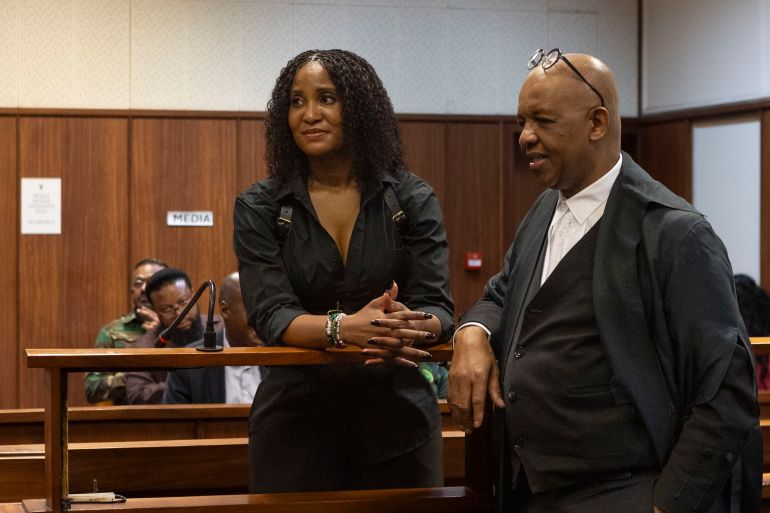
At the centre of the controversy is Duduzile Zuma-Sambudla – a daughter of South Africa’s former president, Jacob Zuma – who resigned as a lawmaker in December after she was implicated in the recruitment drive and the police opened an investigation against her.
The recruits, many from the Zumas’ home region of Nkandla in KwaZulu-Natal (KZN) province, returned after current President Cyril Ramaphosa reached out to his Russian counterpart Vladimir Putin for support in the matter, the presidency said last week.
The returnees and their families are now fearful of reprisals from the recruiters and possible prosecution under South African law, which prohibits citizens from fighting in foreign conflicts. They spoke to Al Jazeera on the condition that their identities be concealed.
Advertisement
“We were told we’d be trained as VIP bodyguards,” said Thabo Khumalo*, a 28-year-old who told Al Jazeera that Zuma-Sambudla and her stepmother were at the forefront of recruiting the men.
“Initially, she pretended to be going to Russia to receive us. But later we learned she had never left South Africa, even though she pretended to be on the front line in our WhatsApp chat group,” he said. “That’s how we ended up in the trenches.”
Thulani Mahlangu, a spokesperson for the returnees’ families, says Zuma-Sambudla, 43, and her associates were allegedly paid at least 14 million rand (about $845,000) by Russia’s Wagner Group to secure the services of the men.
“Our children were sold off,” said one parent. “They were promised jobs, but instead they were used.”
In a statement that Zuma-Sambudla submitted to police last year, she claimed she had been a “victim” herself, alleging she was deceived by promises of lucrative security contracts in Russia.
After the story first broke in South African media, Zuma‑Sambudla was forced to step down from her position in parliament, where she represented her father’s opposition uMkhonto weSizwe (MK) Party. It was another one of Zuma’s daughters, Nkosazana Bonganini Zuma-Mncube, who opened a case against her half-sister for her role in the alleged recruitment.
In KZN province, even those close to the Zumas were targeted.
One relative of former president Zuma – who did not want to be identified, fearing reprisals – told Al Jazeera two of her sons and two grandsons had been sent to Russia. “We lived in fear,” she said. “We just wanted them home, alive.”
The MK Party has since distanced itself from the scandal, while former President Zuma’s own attempts to secure the men’s release failed. It was Ramaphosa who eventually convinced Putin to allow their repatriation.
A continental campaign
At the start of their contracts in Russia, several of the men told Al Jazeera, they were paid a lump sum of 80,000 rand (about $4,800) – money they quickly sent home when they realised the conditions of their employment.
“I gave it to my mother immediately,” Khumalo said. “I thought I’d die there.”
In Russia, the recruits were issued military uniforms and weapons, and given barely a week of basic drills, they said.
“We were cannon fodder. Some of us didn’t even know how to fire properly before they pushed us forward,” Khumalo said.
Advertisement
On the front lines, the men were stationed in Ukraine’s eastern Donbas region, which has been a primary battlefield of the four-year war.
All the returnees Al Jazeera spoke to said that they witnessed violence and death – as well as the worst treatment meted out to African fighters.
“African recruits were made to do the most dangerous duties on the front line,” Khumalo said. “Some were forced to go and pick up the dead and injured while drones hovered above them … Others were shouted at and racially abused by the Russians. It was sad to see Africans treated this way.”
Khumalo said it was a “heartbreaking” experience, only made worse for those who never made it back home.
“They treated Africans worse,” Mandla Zulu*, 44, agreed. “We were racially abused, beaten, and sent into the most dangerous areas … We saw comrades from Nigeria, Zimbabwe, and Kenya die in numbers.”
South Africa’s inclusion in the Russia-Ukraine war is part of a wider African crisis.
More than 1,400 citizens from 36 African countries had been identified among the Russian ranks, Ukraine’s foreign minister said in November. Among those who have died on the front lines are casualties from Ghana, Cameroon, Kenya, Zimbabwe, South Africa, and other nations, according to reports.
In Ghana, Foreign Minister Samuel Okudzeto Ablakwa announced that his country has lost around 50 men and said he will travel to Moscow to negotiate the release of captured nationals. Cameroon has reported dozens of deaths, while Zimbabwe and South Africa have also confirmed fatalities among their citizens. Kenya’s Prime Cabinet Secretary Musalia Mudavadi is preparing a mission to Russia in March to secure the release of Kenyan fighters.
All Eyes on Wagner, a monitoring group, has documented the aggressive Russian recruitment drive carried out in Africa, noting how vulnerable men were promised jobs, training, or even pathways into Europe – only to be sent into the war zone with minimal preparation.
“Some of our African brothers said they [joined the war] because they were promised to be smuggled to Western Europe if they fought,” said Zulu, one of the South African returnees. “That dream was the bait.”
All Eyes on Wagner also said there could be more South Africans fighting in the Russia-Ukraine war.

Arrests and investigations
After Pretoria opened up diplomatic channels with Moscow, the South African men were repatriated in two separate batches – first four returned, then 11 a week later.
But not all came home unscathed: One returned in a wheelchair while another lost his leg in a drone strike and ended up in a Russian hospital, Mahlangu, the spokesperson for the families said.
Two South Africans are also known to have died in Russia, the government said last week.
Crispin Phiri, the spokesperson for the Department of International Relations and Cooperation, said the government is working with their families to decide whether to cremate their remains in Russia or repatriate them for burial at home.
Advertisement
“This is very difficult for us as government officials because we have to be sensitive to what they are going through,” he said.
On arrival in Durban last week, the 11 returnees said the police took them to a holding area at King Shaka International Airport. There, they were made to surrender their phones and gadgets so investigators could gather information before they were allowed to leave.
From Durban, they made the long trek back to Nkandla – more than 210km away – to reunite with their families.
“It was a big relief to finally go home,” Khumalo said. “At some stage, we thought we would never come back.”
South Africa’s Directorate for Priority Crime Investigation (DPCI), commonly known as the Hawks, confirmed that 15 men are under investigation. Colonel Katlego Mogale said the probe focuses on contraventions of the Regulation of Foreign Military Assistance Act, a law that prohibits mercenary activity and regulates the provision of military and security services by South Africans abroad.
The Hawks, which investigates organised crime and corruption, also said five other suspects, unrelated to this case, were arrested in Gauteng province late last year as part of the probe into the recruitment of South Africans for Russia’s war in Ukraine. That group faces charges of fraud, trafficking in persons, and contravening the Regulation of Foreign Military Assistance Act.

South Africa’s neutrality under scrutiny
When President Ramaphosa announced the South African recruits would return last week, he expressed “heartfelt gratitude” to Putin for his assistance.
Throughout the war, South Africa has sought to maintain a non-aligned stance, and has preserved strong ties with Moscow as a fellow BRICS member alongside Brazil, India and China.
But Pretoria’s stance on the Russia‑Ukraine war has sparked debate, with experts questioning its neutrality. “Our non‑aligned position does not mean that we condone Russia’s military intervention in Ukraine, which has violated international law,” said Elizabeth Sidiropoulos, of the think tank, the South African Institute of International Affairs.
South Africa has historical ties with Russia, which date back to the apartheid era when the Soviet Union helped arm and train resistance fighters opposing racist rule. This has led to a delicate political balancing act under democracy.
However, South Africa’s abstentions on United Nations resolutions condemning Russia’s actions in Ukraine have drawn criticism from Western nations in recent years.
Last Tuesday, the Russia‑Ukraine war entered its fourth year with no sign it will end anytime soon. The casualties – Ukrainians, Russians, and foreign mercenaries fighting on both sides – continue to rise, underscoring the human cost of a conflict that has drawn in vulnerable recruits from far beyond Europe’s borders.
Meanwhile, for the families of the fighters – especially those who feel they were duped into the war – the politics matters less than the pain they feel.
“We just want our children home, alive,” said one parent. “And we want those who deceived us to face justice.”
*Names have been changed to protect privacy and safety.
Disclaimer : This story is auto aggregated by a computer programme and has not been created or edited by DOWNTHENEWS. Publisher: aljazeera.com