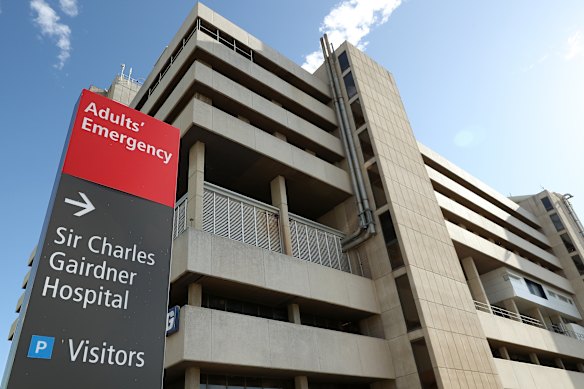

Internal documents have shone light on a raft of issues in the cardiothoracic surgery department of one of Perth’s major public hospitals.
The documents, released to this masthead under Freedom of Information laws, detail severe staffing shortages, contentious recruitment decisions and operational challenges – including two surgeons being stood down – at Sir Charles Gairdner Hospital, largely throughout 2024 and 2025.
They show that at the end of 2023, one cardiothoracic surgeon at Sir Charles Gairdner Hospital received a letter referring them to the integrity directorate within the North Metropolitan Health Service, responsible for handling issues related to misconduct and corruption.
A second letter, sent in December 2024, confirms another surgeon was “asked to remain absent from the workplace on full pay until further notice”.
It pointed out that an investigation was under way over an undisclosed incident, but that remaining absent was “a protective measure only and is not disciplinary action or prejudgment of outcome in any way.”
This masthead understands the first surgeon was officially stood down in 2025 over poor results and unprofessional behaviour, while the other remained on leave with pay at the end of last year.
The documents also revealed emails between members of staff, airing concerns over the work environment in the unit.
One email reads: “I need to ask you for your candid opinion about the atmosphere currently generated by your ward staff. I am hearing that the atmosphere is combative and disrespectful.”
The reply stated that while they had not been informed about it, they would meet with junior doctors to discuss further.
North Metropolitan Health Service chief executive Robert Toms said the department “has a positive and healthy workplace culture and is a preferred site for junior doctors wanting to be trained in the field of cardiothoracic service”.
He would not comment on individual cases when questioned over the two surgeons who were allegedly stood down.
“With cardiothoracic surgeons in short supply and on the Australian government occupational shortage list, we have undertaken national and international searches to identify candidates and maintain a high level of patient service,” Toms said.
“In the past there have been some staffing challenges, however, strategies were immediately implemented to ensure there was no impact to the service, such as undertaking short-term locum appointments and fixed term contracts.”
The department has had a full complement of cardiothoracic surgeons since August, Toms said.
Further documents revealed the extent of understaffing issues that put extra pressure on the unit, with major concerns highlighted in emails sent between hospital staff.
In one instance, Fiona Stanley Hospital redirected a complex case who would “certainly die” without urgent surgery, due to being too busy.
A junior surgeon working at Sir Charles Gairdner was told to reach out to a senior surgeon for assistance.
One was expected to be more available to help, but refused on this occasion because it was his birthday.
“I am highlighting why it is important for one senior person to be more FTE (full-time equivalent) as was planned during [redacted] time. It’s a pity that it didn’t work out that way due to poor attitude,” an email sent after the incident reads.
In July 2024, a surgeon was hired in a locum position at 0.8 FTE and another was hired under a 0.7 FTE.
Following this, one email read that it would be “the first time in 20 years that the work we do will be reflected in appropriate FTE with requisite admin/ teaching/ research time as it should be”.
But between July 15 and 19, emails revealed concerns over Fridays being particularly understaffed, with “blocked out leave in our calendar from now until December” showcasing a “highly undesirable situation”.
“It has taken six to nine months of planning (rearranging, cajoling and bartering) to have enough consultants … and it will still be touch and go every single week,” an email reads.
“We will be relying heavily on fellows and advanced trainees to run theatre lists solo.
“I cannot conjure anaesthetists out of the air in the interim and it is not safe to stretch my existing team any skinnier on those Fridays.”
Concerns were also raised that the unit was short of both registrars and resident medical officers – doctors who hold a general registration but are still working in hospitals under supervision – by 50 per cent.
“I sincerely think this will affect patient management and there will be safety issues. Currently our working RMO/ residents and registrars are overstretched and barely meeting the departmental needs. I am pleased to say that they are doing it to best of their effort,” an email reads.
“I suggest we shake the recruitment pool of RMO/registrar and urgently give them a rolling locum contract. For registrar – we can use the pool just being shortlisted.”
In other emails it was made clear that there was only one registrar and that an urgent cover was needed.
“There is a serious risk of compromising clinical services provided by CTS,” it states.
“In a current crisis, we need to ensure uninterrupted service provision and safe care to patients.”
The hospital turned to employing more staff based on personal contacts, seemingly without advertising the roles needed.
All permanent public sector vacancies or fixed-term contract opportunities over six months are required to be advertised on the state government’s jobs board, except under certain situations where a person is a current employee of the same company.
Toms said that all appointments and recruitment processes within the unit conformed to WA public sector guidelines and obligations.
“How do you feel about the idea of headhunting a mid-late career CTS from the UK?” one email reads.
“If this idea is agreeable, I think we could plot a process for identifying such a person – not by advertising, but by personal contacts starting with our current British (non-CTS) surgeons.
“It is a little risky inasmuch as we are committing someone from overseas to an unknown environment. But I see it as a potential circuit-breaker inside your department.”
Toms said at all times patient safety remained their “absolute priority” and reassured the public that there were now “robust processes in place to ensure we maintain appropriate staffing levels”.
Opposition Health Minister Libby Mettam described the revelations as “explosive” and said they showed public hospitals were at “breaking point and the health of West Australians is being compromised”.
“These documents show clinicians warning that staffing shortages in a critical surgical unit were creating serious risks to clinical services and patient care,” she said.
“When doctors inside the system are raising concerns that services could be compromised, it is a clear sign the hospital system is under enormous strain.
“The government must explain how a specialist unit responsible for life-saving heart and lung surgery was allowed to reach a point where staff themselves were warning about safety risks and governance failures.”
Start the day with a summary of the day’s most important and interesting stories, analysis and insights. Sign up for our Morning Edition newsletter.
 Holly Thompson is a journalist with WAtoday, specialising in education and the environment.Connect via X or email.
From our partners
Disclaimer : This story is auto aggregated by a computer programme and has not been created or edited by DOWNTHENEWS. Publisher: www.smh.com.au