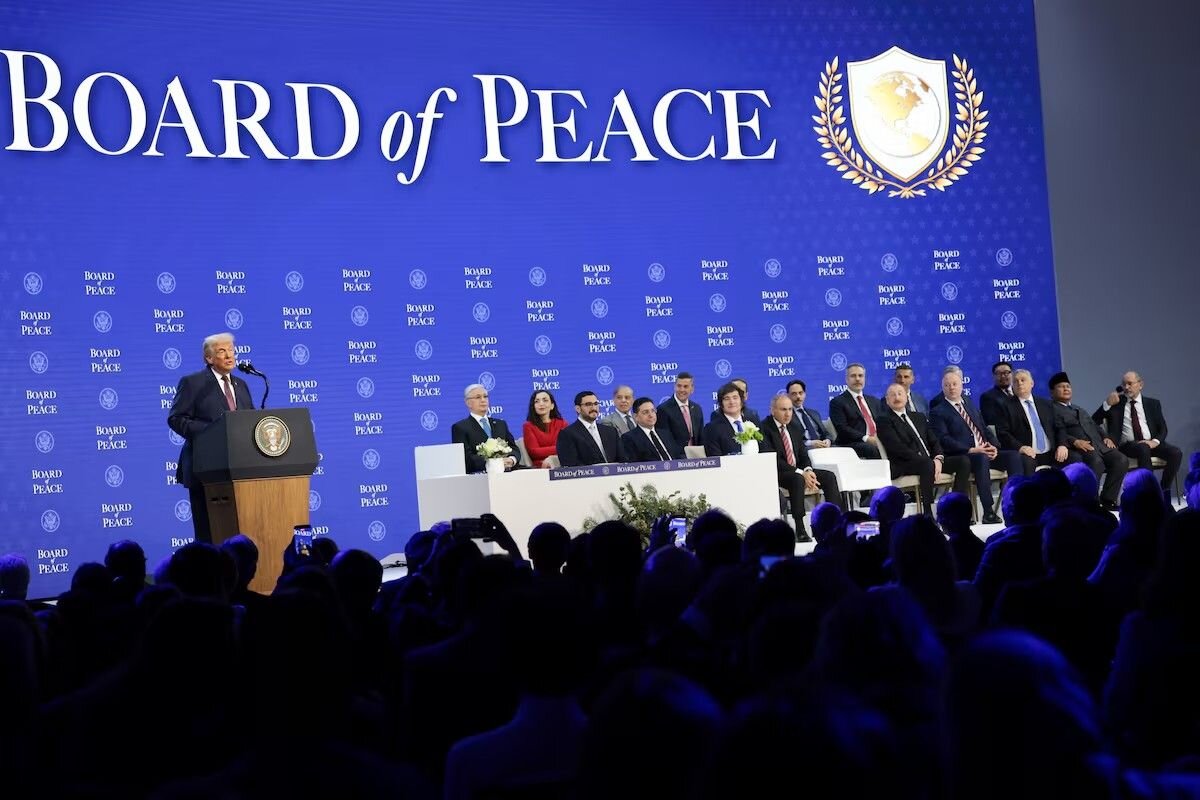
TEHRAN- In an interview with the Tehran Times, Palestinian Christian human rights activist Rifat Odeh Kassis offers a critical assessment of the Gaza “Board of Peace” amid growing international controversy over Gaza’s post-war governance and security arrangements.
Kassis, who has spent more than three decades working with Palestinian, regional, and international human rights and church-based organizations, situates the initiative within a broader pattern of externally imposed political frameworks that marginalize Palestinian voices while prioritizing foreign security interests. He argues that recent announcements on international troop deployments, reconstruction mechanisms, and ceasefire management reflect an approach driven by power and control rather than justice.
Drawing on his involvement in landmark Palestinian advocacy efforts, Kassis warns that peace initiatives detached from accountability, international law, and genuine Palestinian participation risk reproducing instability instead of ending decades of conflict.
The following is the text of the interview:
1. From a Palestinian human rights perspective, how do you assess the legitimacy of the Gaza “Board of Peace,” given the limited or absent role of elected Palestinian representatives and civil society actors?
In a free and ideal world, legitimacy would be rooted in self-determination, representation, and meaningful participation. Anybody claiming to shape Gaza’s future should neither exclude nor marginalize Palestinian official representatives, whether elected or appointed, nor sideline civil society actors, social movements, faith-based communities, women’s movements, and human rights organizations.
Unfortunately, this new structure appears to have been designed outside the framework and legitimacy of the United Nations and shaped only by the US, without meaningful Arab and Palestinian participation. As such, it risks being perceived not as a genuine peace initiative, but as an externally imposed administrative arrangement on a population already denied sovereignty and basic rights. A just peace cannot be engineered for Palestinians; it must be shaped by themselves.
2. You have long argued that peace without justice is unsustainable. How does the Board of Peace address or ignore core issues such as occupation, accountability for war crimes, and the right of return?
Any credible and just peace framework must confront the root causes of violence and human rights violations. Foremost among these are the system of apartheid imposed by Israeli policies, the ongoing settler-colonial project, the prolonged blockade of Gaza, and the continued denial of the right of return to Palestinian refugees. A sustainable framework must also end impunity by ensuring accountability for war crimes and grave violations of international law, including through mechanisms such as the International Criminal Court and the International Court of Justice.
If the Board of Peace prioritizes technocratic reconstruction while sidestepping these structural injustices, it risks reproducing the very instability it claims to resolve. Reconstruction without rights is not peace; it is merely temporary stabilization.
3. Based on your work documenting violations against Palestinian children, how do you assess a plan that speaks of reconstruction without addressing the policies that produced mass civilian suffering?
Based on our previous experiences, one central lesson we have learned is: infrastructure, hospitals, universities and homes can be rebuilt; but trauma, pain, grief, dispossession, and structural violence cannot simply be paved over. Plans that focus on rebuilding homes, schools, and hospitals without confronting the root causes will fail to prevent recurrence.
Reconstruction must be tied to guarantees of non-repetition, accountability, and protection of civilians. Otherwise, it risks becoming a cycle: destruction, rebuilding, destruction again.
4. Some countries have joined or expressed support for the Board of Peace, while others have refused. How do you assess the role of Arab, Muslim, and Global South countries in legitimizing or challenging this initiative?
The role of Arab, Muslim, and Global South countries is decisive. They can either legitimize externally driven frameworks that sideline Palestinian agency, or insist on a rights-based approach grounded in international law and Palestinian self-determination.
Historically, Global South solidarity has emphasized anti-colonial principles and self-determination. If states align with a process that avoids confronting apartheid, occupation and structural inequality, they risk weakening those principles. Conversely, they can play a constructive role by demanding Palestinian official and civil society representation, legal accountability, protection mechanisms, and clear timelines toward ending the occupation.
Their stance will determine whether this initiative becomes the normalization of the status quo or a step toward structural justice.
5. What role should Palestinian civil society, churches, human rights organizations, and grassroots movements play in shaping Gaza’s future, in contrast to elite-driven international plans?
Palestinian civil society, churches, human rights defenders, youth movements, and grassroots actors must not be symbolic participants. They must be central architects.
Organizations rooted in the reality of Gaza and the West Bank understand the community needs, the social cohesion challenges, the trauma recovery mechansims and legal accountability pathways. Churches and faith-based movements have historically framed justice as inseparable from peace.
Their role should include ethical accountability, advocacy for international law, protection of vulnerable communities and ensuring that humanitarian discourse does not replace political rights. Elite-driven plans often prioritize stability over justice. Grassroots participation prioritizes dignity and sustainability.
6. How do you evaluate the absence or marginalization of the United Nations in the Gaza “Board of Peace” framework, and do you see this initiative as a continuation of past externally imposed models—such as Oslo or international trusteeship proposals—rather than a genuinely rights-based approach?
The marginalization of the United Nations raises serious concerns. The UN framework, despite its limitations and weaknesses, anchors solutions in international law, human rights conventions, and multilateral legitimacy.
When new initiatives bypass or sideline the UN, they often move toward political arrangements driven by power dynamics rather than legal principles.
There are echoes of earlier externally failed models, such as the Oslo Accords, which deferred core issues (Jerusalem, refugees, settlements, borders) and institutionalized fragmentation rather than ending the occupation.
If the Board of Peace avoids addressing final-status issues, sovereignty, and accountability, it risks repeating a pattern of managing the root causes rather than resolving them, administering the occupation, the oppression and suffering of the Palestinian people rather than ending them.
A genuinely rights-based approach would begin not with administrative restructuring, but with ending the settler colonial occupation, ensuring accountability, recognizing Palestinian inalienable rights, and grounding the process firmly in international law.
Disclaimer : This story is auto aggregated by a computer programme and has not been created or edited by DOWNTHENEWS. Publisher: tehrantimes.com