

The vaporetto to the Venetian lace island of Burano is standing room only. But, as we slow on approach to the stop before it, Mazzorbo, I’m one of only three people waiting to disembark.
“That’s pretty standard,” Luca Carnevali tells me when I step off the quay to meet him. “People usually only get off here by accident, thinking they’re already at Burano.”
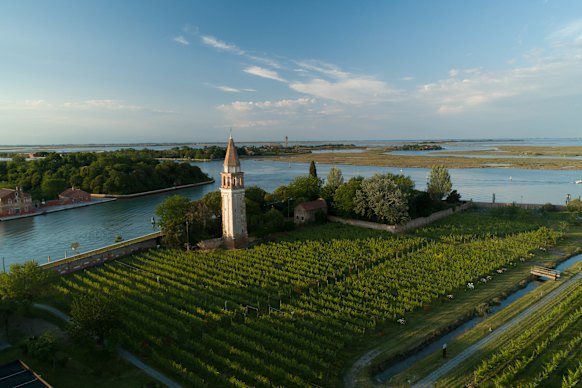
Those few that do set foot on this postage stamp of an island rarely venture into the walled garden footsteps away from the pier, either. Which is a shame, as they’re missing one of Venice’s unique sights: a turreted 14th-century bell tower surrounded by grape vines that, until a little over 20 years ago, were considered lost.
This is my fourth time in Venice and I’ve been determined to visit this vineyard, Venissa, since learning about its existence on my last visit 18 months ago. I’m here with my sister but flying solo for the afternoon. She’s never been to Venice before and we’ve only got one afternoon in town. In the morning we’re boarding the Venice Simplon-Orient-Express for Paris.
As much as she loves a wine tasting, she also knows that to come with me is to sacrifice precious daylight hours ticking off the first-timer’s Venice to-do list: Piazza San Marco, the Grand Canal, gondolas. As a compromise, she’ll catch a later vaporetto out to the island and join me for dinner at Osteria Contemporanea, the more casual of Venissa’s two acclaimed restaurants (its sibling, Venissa, has one Michelin star).
Sign up for the Traveller Deals newsletter
Get exclusive travel deals delivered straight to your inbox. Sign up now.
So we go our separate ways: her on foot, deep into the warren of canal-front alleyways towards the Doge’s Palace; me in search of the No.12 vaporetto for the hour-long ride to Mazzorbo, where Carnevali, Venissa’s wine ambassador, is waiting to greet me.
“Nowadays, finding a vineyard in Venice is unexpected, but there’s a long tradition of making wine all over the lagoon,” Carnevali says. Vines flourished on Mazzorbo for more than 700 years, until a devastating, 10-day-long acqua granda in 1966 spelt the end of viticulture on the island and in Venice as a whole.
In 2001 Venissa’s founder, winemaker Gianluca Bisol, unearthed a flicker of hope on the neighbouring island of Torcello when he stumbled across a small private garden planted with the indigenous Venetian grape thought to have been wiped out in the floods: dorona.
The two hectares of the thick-skinned, golden grape he has subsequently planted on Mazzorbo thrives in this salty earth just centimetres above the waterline. A duo of wines is the result: Venissa and Venusa. The production is minute, with only 4500 bottles made annually. A 500-millilitre bottle of Venissa, complete with a gold leaf label hand-beaten by the last goldsmith in Europe, sells for $285.
Carnevali pours me two tasting serves. Both share a distinct saline profile, although Venissa is richer. It is, as Carnevali describes it, “a red wine disguised as a white”, thanks to its full body and tannic structure. Dorona was the grape variety of choice during the banquets of the Doges. As I learn the following day, it’s nowadays fit for the Venice Simplon-Orient-Express.
With only two wines the tasting is brief, and soon I’m crossing over a wooden footbridge towards better-known neighbour Burano. The clocks have only just gone back, and when the sun sets it’s as if the lights have been switched off. The island is devoid of tourists.
For company I have a pair of nonnas on their nightly block walk, and stolen glimpses of life inside the ground-floor apartments I walk past. That’s how I spy an elderly woman contentedly watching an Italian soap on TV while her husband pours them an aperitivo. The snapshot of everyday life for Venetians is unexpected and magical.
I’m sipping an aperitivo of my own at one of the only bars along Burano’s main canal to be open when my sister texts me a photo of her in Piazza San Marco. “Out and about with half the world,” she jokes. Despite it being late October, Venice still heaves with tourists.
We reconvene a couple of hours later over the Osteria’s signature dish, blue crab from the lagoon, accompanied by vegetables grown alongside the vines (and tended to by pensioners from Burano).
My sister’s happy, satisfied that she’s finally visited Venice. “But I can’t help feeling it’s a theme park,” she says. “I’m not sure I need to come back.”
As the lights of Venice draw closer on our return vaporetto, however, she’s come around to my point of view: that the real charm of Venice lies in the little-known stories and streetscapes of its outer islands. Fortunately, with more than 100 of them scattered like a patchwork over the lagoon, there are plenty of reasons to return.
THE DETAILS
VISIT
A 45-minute tour and tasting of two wines at Venissa costs $80; the four-course tasting menu at Osteria Contemporanea costs $125. See venissa.it.
FLY
Emirates has multiple non-stop flights a day to Dubai from Sydney, Melbourne and Brisbane. From there, connect to a non-stop flight from Dubai to Venice’s Marco Polo Airport, also daily. See emirates.com.
STAY
A sleek five-room guesthouse away from the bustle of Venice on Mazzorbo, as well as 13 rooms inside the brightly coloured Casa Burano on the island of Burano, complement Venissa’s wine and dining offering. From $265 a night, breakfast included. See venissa.it.
MORE
visitvenezia.eu, italia.it
The writer was a guest of Venissa and the Venice Simplon-Orient-Express
Traveller Guides
From our partners
Disclaimer : This story is auto aggregated by a computer programme and has not been created or edited by DOWNTHENEWS. Publisher: www.smh.com.au




