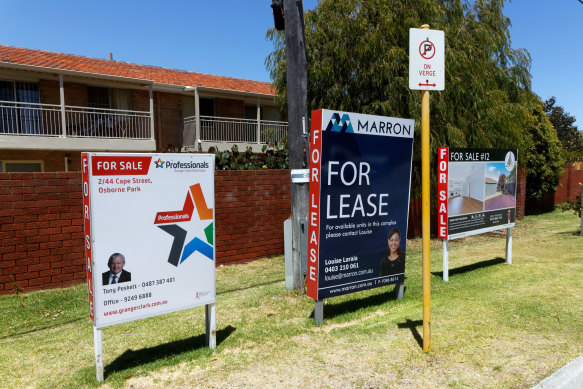
New data shoes the number of properties for sale across Perth increased by almost 30 per cent during the month of January, but new listings remain well below the 10-year average.
According to the latest figures from the Real Estate industry of WA, listings for sale across Perth rose to 2444 in January, following the record low of 1881 recorded at the end December last year.
REIWA data shows houses in Perth sold within a median period of nine days in January.Credit:
The recent data shows that while last month’s listings were 29.9 per cent higher than December, it was 50 per cent lower than 12 months ago.
REIWA president Suzanne Brown said active listings typically increased in January, but the latest increase came off a very low base and was still significantly lower than a year ago.
“New listings remain below the 10-year average, which is contributing to the low level of active listings,” she said.
“Our members are reporting they are currently doing a lot of appraisals, which indicates people are interested in selling. However, potential sellers are facing challenges when it comes to finding somewhere new to live – either to buy or rent – so this is slowing the increase of new listings.”
Domain chief of research and economics, Dr Nicola Powell, said the market has a tendency to be distracted during “holiday mode”.
“That’s actually quite a powerful seasonal impact in Australia, where you don’t necessarily have that in other countries,” Powell said.
“I don’t think that really tends to happen in the UK, for example, but I do think that the market does hit holiday mode.
“December is one of the quietest months for buyer and seller activity, particularly open homes and auctions really start to slow.
“And I think the market then shifts into people getting themselves ready for the autumn selling season.”
REIWA data shows houses in Perth sold within a median period of nine days in January, no change from December but 12 days faster than a year ago.
Units sold in a median period of eight days in January, one day faster than December and nine days faster than a year ago.
“We’re still forecasting price growth for Perth overall for the year of 2026 but what our expectations are is the pace of gains is going to slow rapidly,” Powell said.
“So I do think that the double-digit increases that we have seen is something that is going to be in the past, and I think that what we’re expecting is that prices will rise, but they won’t rise as fast, and we’re going to see the spotlight go back on markets like Sydney.”
The latest REIWA data shows the median dwelling rent rose to $720 per week in January, an increase of 2.9 per cent compared to December and 7.5 per cent higher than the same time in 2025.
Brown said it was fairly common to see strong shifts in rent prices in January, but while the increase was driven by price rises in more expensive suburbs and families securing rentals in the lead up to the new school year, it was a timely reminder about the state of the rental market.
“The WA rental market experienced several years of crisis conditions following a mass exodus of investors following the lifting of the COVID rental moratoriums in 2021. Our modelling shows nearly 20,000 properties – or 8.4 per cent of rental stock – were removed from the market,” she said.
“As a result, the vacancy rate dropped to record lows and rent prices soared, driven by the massive imbalance between supply and demand.
“The rental market has shown some improvement over the past 18 months, which has been mainly due to an increase in supply, however, we are not out of the woods.”
Brown added that population growth remains high and there are constrained conditions in both the new homes and the established homes markets.
“We cannot afford to be complacent about actions that might lead to another decline in supply and negatively affect the delicate state of the rental market,” Brown said.
“We know another review of the Residential Tenancies Act is coming up, and there are again growing calls for removing no grounds terminations.
“We also know investors are sensitive to legislative change and are capable of leaving the market if they feel conditions are unfavourable. We don’t want this to happen again; the WA rental market still hasn’t recovered from the previous exodus of investors.
“We all want improved outcomes for tenants, but we need to be careful of unintentionally impacting those we are trying to protect with any legislative change.”
Most Viewed in Property
Disclaimer : This story is auto aggregated by a computer programme and has not been created or edited by DOWNTHENEWS. Publisher: www.smh.com.au