Four Victorian AFL clubs raked in more than $37 million from their poker machine venues across the past financial year.
A detailed examination of all 10 Victorian AFL clubs’ annual reports by this masthead reveals that Carlton made $20.2 million from their gaming and hospitality outlets, Essendon returned $9.7 million, Richmond pulled in $5.6 million, and St Kilda’s social club revenue was listed as $1.7 million.
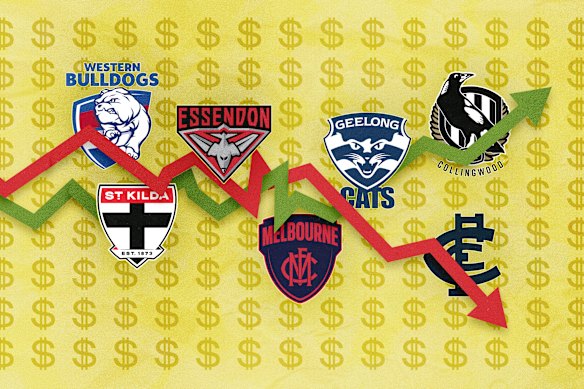
Inside the 2025 financial reports of the 10 Victorian AFL clubs.Credit: Artwork: Aresna Villanueva
But of the four, only Richmond and Essendon returned end-of-financial-year profits.
This masthead’s analysis also revealed that born-again Melbourne Football Club forked out almost $4 million to sever ties with key personnel, including axed coach Simon Goodwin and unwanted player Clayton Oliver, in a year they suffered a $4.45 million financial year loss.
In the same year, the Demons poured $400,000 into their ongoing search for a new home – a feasibility study focused on a base at Caulfield Racecourse that was being steered by former CEO Gary Pert as a paid consultant until June.
This masthead’s study confirmed an ongoing divide between the haves and the have-nots.
Collingwood continued to set the pace with 112,000 members, a home-and-away attendance of 1.4 million, a state-topping $96.5 million in revenue and a $54 million war chest.
“This year, 805,250 fans attended our home games, including an average of 75,178 at the MCG – an all-time league record, surpassing our own 2024 benchmark,” Collingwood president Barry Carp said.
Arch-rivals Carlton had more than 100,000 members on their books for the second year running, while Hawthorn boosted net assets of $140 million after moving into their new home at Dingley.
The AFL distributed $207.7 million to Victorian clubs last year. The most needy were North Melbourne ($28.15 million), St Kilda ($26.6 million), the Bulldogs ($23.1 million), and Melbourne ($22.5 million).
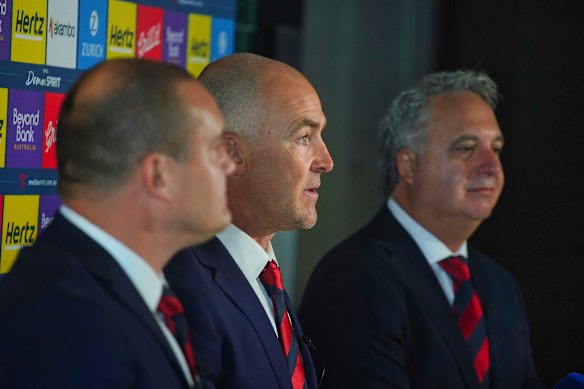
Former Melbourne president Brad Green (left), coach Steven King and CEO Paul Guerra in September.Credit: Luis Enrique Ascui
But all eyes will be drawn to the Demons’ performance over the next 12 months – on and off the field.
Guerra, new president Steve Smith and first-year coach Steven King will be looking to right an unsteady ship after the 2021 premiers missed the top eight for the second season running, shed almost 7000 members and dropped $600,000 in total revenue.
They also traded Norm Smith medallist Christian Petracca to Gold Coast and have agreed to pay half of Oliver’s wage for the next five years while he wears a Greater Western Sydney jumper.
Despite the club’s recent financial headwinds, the club maintained it made “positive progress” last year towards establishing a new home base – a prospect dependent on deals with the state government and Caulfield Racecourse Reserve Trust.
“The club is now closer to delivering the new facility which will unite all parts of the club into one state of the art new home base,” Melbourne’s annual report said.
Club-by-club analysis
Carlton
On face value, the Blues’ annual report looks disappointing. They suffered a $1 million loss, following a $3.84 million profit last year, and dropped almost 6000 members in a season in which they missed finals. But Carlton are in good health. They are debt free, have a huge membership base, made $28.43 million from membership and gate receipts last year, and raked in $20.2 million from their four hospitality and gaming venues – Manningham Club, Royal Oak Richmond, Club Laverton and The Vic Inn. The Blues, who are transitioning to life under new CEO Graham Wright, have also invested $2.6 million in a joint medical imaging venture at Ikon Park with Imaging Associates.
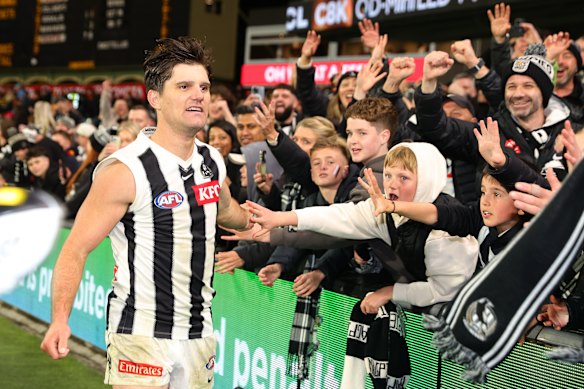
Collingwood forward Lachie Schultz celebrates with Magpies fans – the AFL’s biggest membership group. Credit: AFL Photos
Collingwood
The Magpies may have fallen just short of another grand final but, off field, they remain a financial juggernaut. They boast a whopping $54 million in the bank and have revenue of almost $100 million, ensuring they have the resources to invest heavily in all facets of the club. The Magpies also revealed they are working on a “strategy and road map” towards net zero emissions. As part of this commitment, they had a baseline greenhouse gas (GHG) emissions inventory assessment done in 2024 and 2025, the report confirming they had lowered their emissions year-on-year. No other club appears to do the same. Overall, it’s fair to say they are the envy of all Victorian rivals. Their membership and match day revenue was $43.4 million.
Essendon
The Bombers may have posted a modest profit of $170,000, but this is a club in good health. From a total revenue of $81.6 million, the Bombers made almost $15 million from venues, which include gaming operations at Windy Hill and Melton Country Club. Drawing on a registered supporter base of 85,568, they also raked in $24 million from memberships and match-day receipts. The Bombers may not have the financial might of Anzac Day rivals Collingwood, but that could change with overdue on-field success. They boast $51.3 million in net assets, have $8.2 million in cash and are debt-free with no bank borrowings, although they do have a $717,000 interest-free external loan on the books.
Geelong
The Cats delivered a solid $1.7 million profit amid record membership of 92,000 for a fifth straight season – more than Hawthorn and Essendon and the fourth-biggest supporter base of the 10 Victorian clubs. While hospitality revenue dropped more than $3 million, this was partly offset by a bump of $2.5 million to $27.8 million from membership and ticketing. The Cats collected $2.65 million from their health and fitness business, 10 South, while receiving $3.4 million in donations to support football department upgrades and the next phase of the Kardinia Park precinct. The club upped spending on football operations by almost $3 million to $35.5 million.
Hawthorn
After selling Waverley Park and moving into their new multimillion-dollar home at Dingley, the Kennedy Community Centre, the Hawks are clearly one of the competition’s wealthiest and biggest clubs. They have net assets of $145.3 million, 87,204 members and a total revenue of $67.8 million. They posted a ridiculous yearly surplus of $51 million, but that was largely down to $40 million in government grants – federal, state and local. In real terms – once grants, fundraising, one-off transactions and depreciation are taken into account – the football club returned a net profit of $1.9 million.
Melbourne
This was a year to forget for the Demons. There was major on-field upheaval, while they also recorded a $4.45 million loss, significantly impacted by the decision to axe Goodwin and move on Oliver. This came a year after the Demons had to factor in a $3.1 million payout to Angus Brayshaw for his medical retirement. While they had a drop in membership to 58,563, the Demons insist their balance sheet is strong. They have net assets of $24.4 million, a Future Fund of $23.7 million and combined cash and financial assets of $6.9 million. Their membership and gate receipts were $18.3 million.
North Melbourne
A club that continues to play in the shallow end of the pool. Returned a tiny $34,465 net profit, but continues to lean on the AFL for financial support. The league handed the Kangaroos $28.15 million in the past year, which includes $3.7 million for their record-breaking AFLW program. The Kangaroos have severed ties with Tasmania, but will earn about $2.5 million a year from Tourism WA to play two home games in the state in each of the next three years. North Melbourne make just $13.15 million from membership and gate receipts. In cold, hard terms, they are half the club of Collingwood – they have 56,283 members compared to Collingwood’s 112,491 and a yearly revenue of $58.6 million compared to $96.5 million.
Richmond
The Tigers continue to rebuild on and off the ground. Coach Adem Yze has been re-signed until the end of 2028 and has already spent time at soccer giants Dinamo Zagreb and Hajduk Split to build his skill set. Richmond also began their Punt Road Oval redevelopment in a year they turned a $4.7 million profit from $144.2 million in turnover, which included $2.09 million in fundraising for their home ground project. The club also received $2.75 million in government funding and was handed $16.7 million in annual AFL distributions. They pulled in $5.6 million from gaming and hospitality, raised $28.45 million from memberships and gate takings, and made $1.45 million from their health, fitness and community businesses, Aligned Leisure and Richmond Institute. But the Tigers did shed 5840 members, dropping to 92,531, in a season their young side finished 17th. The Tigers will display Chinese car company GWM’s logo on the back of their jumpers next year after signing a major sponsorship deal.
St Kilda
Despite splashing the cash on player payments – think $2 million a year for Nasaiah Wanganeen-Milera and $1.7 million a season for the incoming Tom De Koning – the Saints are still beholden to the AFL. They posted a $137,000 loss for the past financial year, compared to a $2 million loss last year. But this is on the back of being given $26.6 million by the league. The club has also drawn down $4.5 million of a $6.7 million borrowing facility with Westpac. But the membership base is headed in the right direction, jumping 8 per cent to 65,509. The club also made $1.7 million from its social club, which has poker machines, and made $14.2m from memberships and match days.
Western Bulldogs
The Bulldogs boasted record membership of 65,584 but missed finals and posted a $3 million loss, due largely to depreciation of the Whitten Oval redevelopment. The club counted an $18.2 million Whitten Oval grant in its 2024 financial year report, which resulted in an overall net profit of $14.9 million last year. But the Whitten Oval facility leaves them in healthy financial shape, boosting their net assets to $100.4 million. They made $16.8 million from memberships and gate receipts. Of note was a $2 million provision in their annual report for “legal judgment and costs”. In December last year, a $5.9 million payout awarded against the club for a historical child abuse case was reduced to $2.6 million on appeal.
Keep up to date with the best AFL coverage in the country. Sign up for the Real Footy newsletter
Most Viewed in Sport
Disclaimer : This story is auto aggregated by a computer programme and has not been created or edited by DOWNTHENEWS. Publisher: www.smh.com.au