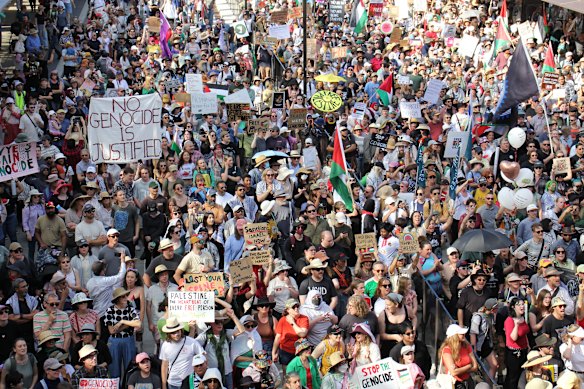

Queensland police said their officers could lean on video evidence or “choose their moment and choose their mark”, rather than make mass arrests, when enforcing a controversial government-proposed ban on widely used pro-Palestinian protest phrases.
Greens Maiwar MP Michael Berkman used part of Thursday’s rushed parliamentary scrutiny of the Crisafulli government’s proposed laws to ask how police would crack down on thousands of people in a crowd using the phrases “river to the sea” or “globalise the intifada”.
The new legislation would criminalise any phrases, spoken or written, decided by the attorney-general of the day to be regularly used to incite hostility toward a group and which are reasonably expected to offend a member of the public.
Warrantless police stop-and-search powers would then be extended to anyone suspected of committing the offence, which carries a maximum penalty of two years in jail. Explanatory notes specifically, and solely, reference “chants or placards at a protest”.
The omnibus bill will include changes to gun laws that stop short of a national gun buyback or mental health checks. It also broadens the list of banned hate symbols and boosts penalties for criminal offences related to places of worship.
Dozens of major religious organisations, civil society groups and legal experts across the political spectrum have raised concerns about scrutiny of the bill, and elements of the ban, in more than 300 submissions lodged within less than one week.
Institutional submissions span stakeholders including Islamic and multicultural bodies, the Brisbane Catholic Archdiocese, unions and the right-wing Institute of Public Affairs think tank. Many have called for the bill’s rejection or pause.
Berkman referred to incidents of mass arrests in Queensland’s past, but police appearing before the committee dismissed his questions as speculative, with one senior figure saying the agency no longer used such methods.
“As to your question about multiple people chanting an event, there are ways that we collect evidence that doesn’t necessarily mean police intervening at the time,” Deputy Commissioner Cheryl Scanlon said.
“It will depend on the circumstances … and I think it’s probably speculative to make a statement about what you’re suggesting today, because we certainly don’t respond the way that we might have a very long time ago.”
Assistant Commissioner Brian Connors said, “in simple terms, I’d suggest police officers at protests would choose their moment and choose their mark in terms of intervening to protect community safety and ensure that circumstances” did not put people at risk.
“The point I’m trying to make is you don’t want police officers to act rashly, to inflame a situation, that potentially has a catastrophic outcome on community safety,” Connors said.
The “river to the sea” phrase, which Queensland is the only Australian jurisdiction seeking to ban, is particularly contested by supporters of the Palestinian cause, who argue it is a call for freedom from oppression, illegal occupation and alleged genocide by Israel.
Queensland Jewish Board of Deputies president, appearing alongside Crisafulli while announcing the planned laws, argued it meant “to slaughter Jews from the river to the sea”.
In Thursday’s parliamentary hearing, one of only two this week before the committee makes recommendations about the bill ahead of parliament’s March 3 return, Berkman also raised questions about the lack of Palestinian and alternative Jewish voices.
After failing to have a representative from Justice for Palestine Magan-djin – the group behind Brisbane’s regular protests – appear before the committee, Berkman appeared at a media conference outside with spokesperson Remah Naji.
Naji said the exclusion of Palestinian voices directly targeted by the ban was discriminatory and questioned why antisemitic or racist slurs were not also being banned.
Bart Shteinman, an executive committee member of the progressive Jewish Council of Australia group, told this masthead the committee’s “failure to consult with diverse Jewish voices is extremely disappointing … and treating it as one erases our voices and stereotypes our community”.
In their submissions, JCA and Jewish Voices of Inner Sydney both opposed banning the phrases and warned criminalising speech which supports Palestinian human rights would only make Jewish Australians less safe by increasing community resentment towards them.
The Human Rights Law Centre, in its submission urging rejection of the bill, also argued the targeting of Palestinian rights movement speech and linkage to terrorist organisations is “likely to amount to a form of anti-Palestinian racism”.
“The bill is likely to also burden the implied constitutional freedom of political communication and do so in a discriminatory manner. Social cohesion will be undermined and not enhanced by such actions, as it will likely create further sources of division and grievance.”
Constitutional law expert Anne Twomey said the bill raised “a number of difficult legal issues in areas … which have not yet been fully developed” and had the long-term potential to “restrict communications on a range of contentious topics”.
In the IPA’s submission, research fellow Margaret Chambers said: “Far from a targeted and narrow legislative approach, the bill creates the architecture for a government minister to exercise unfettered powers to ban speech. For these reasons, the IPA recommends the bill be abandoned.”
Attorney-General Deb Frecklington, speaking to media in Brisbane earlier in the day, said the government “condemn[s] anyone who thinks it is OK to not stand with the Jewish community.”
Speaking to media in the state’s north, Premier David Crisafulli insisted his government did not intend to outlaw more phrases in the future.
Start the day with a summary of the day’s most important and interesting stories, analysis and insights. Sign up for our Morning Edition newsletter.
 Matt Dennien is a reporter at Brisbane Times covering state politics and the public service. He has previously worked for newspapers in Tasmania and Brisbane community radio station 4ZZZ. Contact him securely on Signal @mattdennien.15Connect via email.
From our partners
Disclaimer : This story is auto aggregated by a computer programme and has not been created or edited by DOWNTHENEWS. Publisher: www.smh.com.au